

250
A. Mazaheri Tehrani et al.
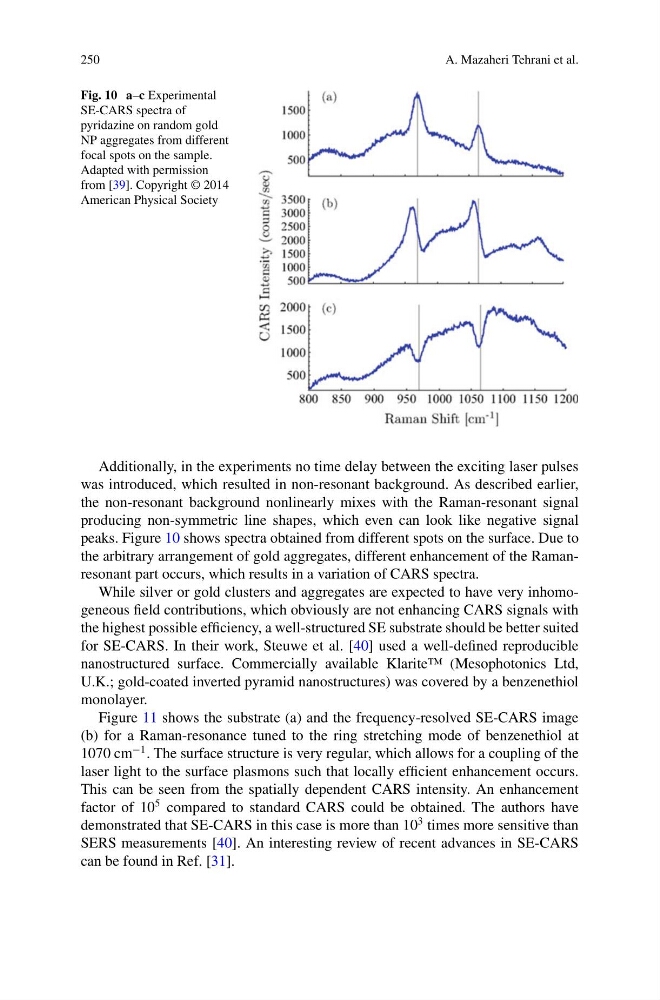
Fig. 10 a–c Experimental
SE-CARS spectra of
pyridazine on random gold
NP aggregates from different
focal spots on the sample.
Adapted with permission
from [39]. Copyright © 2014
American Physical Society
Additionally, in the experiments no time delay between the exciting laser pulses
was introduced, which resulted in non-resonant background. As described earlier,
the non-resonant background nonlinearly mixes with the Raman-resonant signal
producing non-symmetric line shapes, which even can look like negative signal
peaks. Figure 10 shows spectra obtained from different spots on the surface. Due to
the arbitrary arrangement of gold aggregates, different enhancement of the Ramanresonant part occurs, which results in a variation of CARS spectra.
While silver or gold clusters and aggregates are expected to have very inhomogeneous field contributions, which obviously are not enhancing CARS signals with
the highest possible efficiency, a well-structured SE substrate should be better suited
for SE-CARS. In their work, Steuwe et al. [40] used a well-defined reproducible
nanostructured surface. Commercially available Klarite™ (Mesophotonics Ltd,
U.K.; gold-coated inverted pyramid nanostructures) was covered by a benzenethiol
monolayer.
Figure 11 shows the substrate (a) and the frequency-resolved SE-CARS image
(b) for a Raman-resonance tuned to the ring stretching mode of benzenethiol at
1070 cm
−1 . The surface structure is very regular, which allows for a coupling of the
laser light to the surface plasmons such that locally efficient enhancement occurs.
This can be seen from the spatially dependent CARS intensity. An enhancement
factor of 10
5 compared to standard CARS could be obtained. The authors have
demonstrated that SE-CARS in this case is more than 10
3 times more sensitive than
SERS measurements [40]. An interesting review of recent advances in SE-CARS
can be found in Ref. [31].
A. Mazaheri Tehrani et al.
Fig. 10 a–c Experimental
SE-CARS spectra of
pyridazine on random gold
NP aggregates from different
focal spots on the sample.
Adapted with permission
from [39]. Copyright © 2014
American Physical Society
Additionally, in the experiments no time delay between the exciting laser pulses
was introduced, which resulted in non-resonant background. As described earlier,
the non-resonant background nonlinearly mixes with the Raman-resonant signal
producing non-symmetric line shapes, which even can look like negative signal
peaks. Figure 10 shows spectra obtained from different spots on the surface. Due to
the arbitrary arrangement of gold aggregates, different enhancement of the Ramanresonant part occurs, which results in a variation of CARS spectra.
While silver or gold clusters and aggregates are expected to have very inhomogeneous field contributions, which obviously are not enhancing CARS signals with
the highest possible efficiency, a well-structured SE substrate should be better suited
for SE-CARS. In their work, Steuwe et al. [40] used a well-defined reproducible
nanostructured surface. Commercially available Klarite™ (Mesophotonics Ltd,
U.K.; gold-coated inverted pyramid nanostructures) was covered by a benzenethiol
monolayer.
Figure 11 shows the substrate (a) and the frequency-resolved SE-CARS image
(b) for a Raman-resonance tuned to the ring stretching mode of benzenethiol at
1070 cm
−1 . The surface structure is very regular, which allows for a coupling of the
laser light to the surface plasmons such that locally efficient enhancement occurs.
This can be seen from the spatially dependent CARS intensity. An enhancement
factor of 10
5 compared to standard CARS could be obtained. The authors have
demonstrated that SE-CARS in this case is more than 10
3 times more sensitive than
SERS measurements [40]. An interesting review of recent advances in SE-CARS
can be found in Ref. [31].