

Coherent Anti-Stokes Raman Scattering: Basics, Theoretical …
251
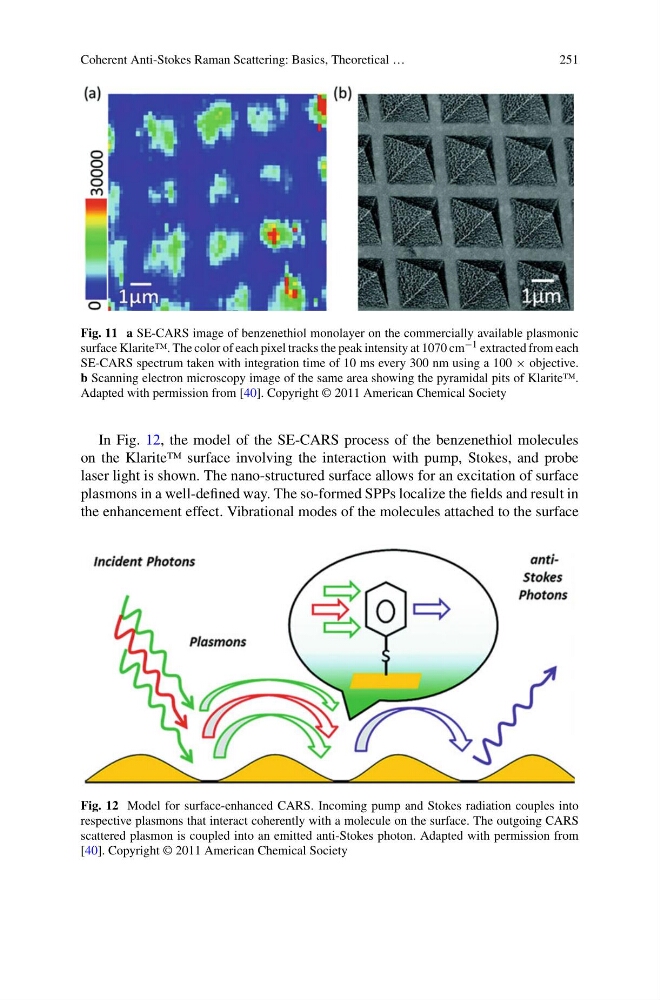
Fig. 11 a SE-CARS image of benzenethiol monolayer on the commercially available plasmonic
surface Klarite™. The color of each pixel tracks the peak intensity at 1070 cm −1 extracted from each
SE-CARS spectrum taken with integration time of 10 ms every 300 nm using a 100 × objective.
b Scanning electron microscopy image of the same area showing the pyramidal pits of Klarite™.
Adapted with permission from [40]. Copyright © 2011 American Chemical Society
In Fig. 12, the model of the SE-CARS process of the benzenethiol molecules
on the Klarite™ surface involving the interaction with pump, Stokes, and probe
laser light is shown. The nano-structured surface allows for an excitation of surface
plasmons in a well-defined way. The so-formed SPPs localize the fields and result in
the enhancement effect. Vibrational modes of the molecules attached to the surface
Fig. 12 Model for surface-enhanced CARS. Incoming pump and Stokes radiation couples into
respective plasmons that interact coherently with a molecule on the surface. The outgoing CARS
scattered plasmon is coupled into an emitted anti-Stokes photon. Adapted with permission from
[40]. Copyright © 2011 American Chemical Society
251
Fig. 11 a SE-CARS image of benzenethiol monolayer on the commercially available plasmonic
surface Klarite™. The color of each pixel tracks the peak intensity at 1070 cm −1 extracted from each
SE-CARS spectrum taken with integration time of 10 ms every 300 nm using a 100 × objective.
b Scanning electron microscopy image of the same area showing the pyramidal pits of Klarite™.
Adapted with permission from [40]. Copyright © 2011 American Chemical Society
In Fig. 12, the model of the SE-CARS process of the benzenethiol molecules
on the Klarite™ surface involving the interaction with pump, Stokes, and probe
laser light is shown. The nano-structured surface allows for an excitation of surface
plasmons in a well-defined way. The so-formed SPPs localize the fields and result in
the enhancement effect. Vibrational modes of the molecules attached to the surface
Fig. 12 Model for surface-enhanced CARS. Incoming pump and Stokes radiation couples into
respective plasmons that interact coherently with a molecule on the surface. The outgoing CARS
scattered plasmon is coupled into an emitted anti-Stokes photon. Adapted with permission from
[40]. Copyright © 2011 American Chemical Society