

Coherent Anti-Stokes Raman Scattering: Basics, Theoretical …
249
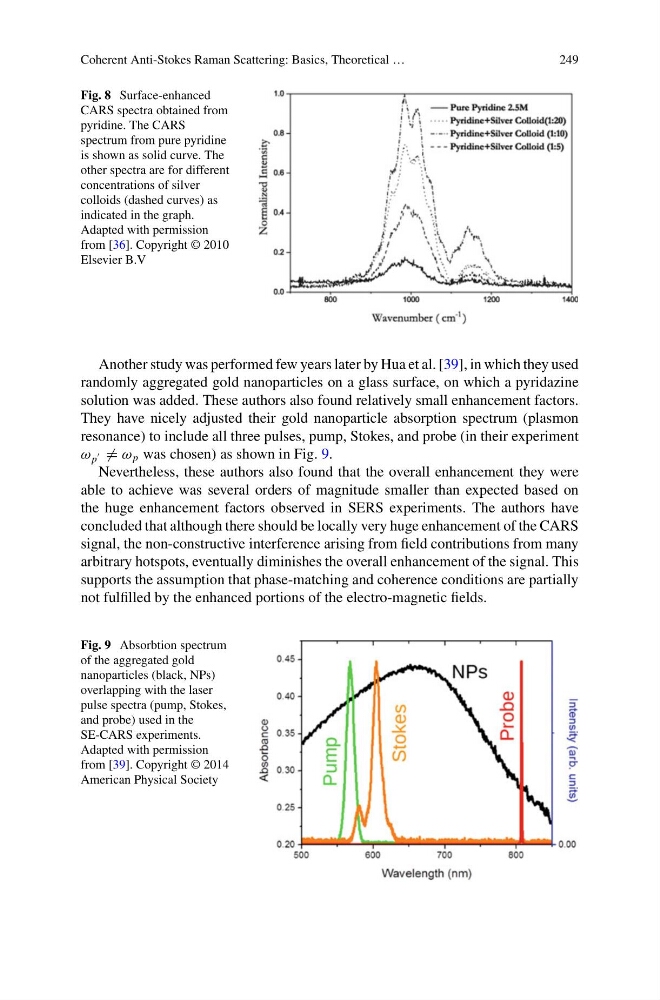
Fig. 8 Surface-enhanced
CARS spectra obtained from
pyridine. The CARS
spectrum from pure pyridine
is shown as solid curve. The
other spectra are for different
concentrations of silver
colloids (dashed curves) as
indicated in the graph.
Adapted with permission
from [36]. Copyright © 2010
Elsevier B.V
Another study was performed few years later by Hua et al. [39], in which they used
randomly aggregated gold nanoparticles on a glass surface, on which a pyridazine
solution was added. These authors also found relatively small enhancement factors.
They have nicely adjusted their gold nanoparticle absorption spectrum (plasmon
resonance) to include all three pulses, pump, Stokes, and probe (in their experiment
ω p
= ω p was chosen) as shown in Fig. 9.
Nevertheless, these authors also found that the overall enhancement they were
able to achieve was several orders of magnitude smaller than expected based on
the huge enhancement factors observed in SERS experiments. The authors have
concluded that although there should be locally very huge enhancement of the CARS
signal, the non-constructive interference arising from field contributions from many
arbitrary hotspots, eventually diminishes the overall enhancement of the signal. This
supports the assumption that phase-matching and coherence conditions are partially
not fulfilled by the enhanced portions of the electro-magnetic fields.
Fig. 9 Absorbtion spectrum
of the aggregated gold
nanoparticles (black, NPs)
overlapping with the laser
pulse spectra (pump, Stokes,
and probe) used in the
SE-CARS experiments.
Adapted with permission
from [39]. Copyright © 2014
American Physical Society
249
Fig. 8 Surface-enhanced
CARS spectra obtained from
pyridine. The CARS
spectrum from pure pyridine
is shown as solid curve. The
other spectra are for different
concentrations of silver
colloids (dashed curves) as
indicated in the graph.
Adapted with permission
from [36]. Copyright © 2010
Elsevier B.V
Another study was performed few years later by Hua et al. [39], in which they used
randomly aggregated gold nanoparticles on a glass surface, on which a pyridazine
solution was added. These authors also found relatively small enhancement factors.
They have nicely adjusted their gold nanoparticle absorption spectrum (plasmon
resonance) to include all three pulses, pump, Stokes, and probe (in their experiment
ω p
= ω p was chosen) as shown in Fig. 9.
Nevertheless, these authors also found that the overall enhancement they were
able to achieve was several orders of magnitude smaller than expected based on
the huge enhancement factors observed in SERS experiments. The authors have
concluded that although there should be locally very huge enhancement of the CARS
signal, the non-constructive interference arising from field contributions from many
arbitrary hotspots, eventually diminishes the overall enhancement of the signal. This
supports the assumption that phase-matching and coherence conditions are partially
not fulfilled by the enhanced portions of the electro-magnetic fields.
Fig. 9 Absorbtion spectrum
of the aggregated gold
nanoparticles (black, NPs)
overlapping with the laser
pulse spectra (pump, Stokes,
and probe) used in the
SE-CARS experiments.
Adapted with permission
from [39]. Copyright © 2014
American Physical Society