

248
A. Mazaheri Tehrani et al.
big that single molecule sensitivity [28–30] becomes feasible. While in principle this
can be used for enhancing weak CARS signals in frequency-domain spectroscopy,
also a combination with time-resolved ultrafast vibrational CARS spectroscopy [31–
34] is possible. In another word one could “watch a molecule breathing” [35] or study
molecular dynamics of nanostructures.
Namboodiri et al. [36], have performed SE-CARS, using silver sols, prepared
based on the well-known methods by Lee-Meisel [37] and Hiramatsu et al. [38].
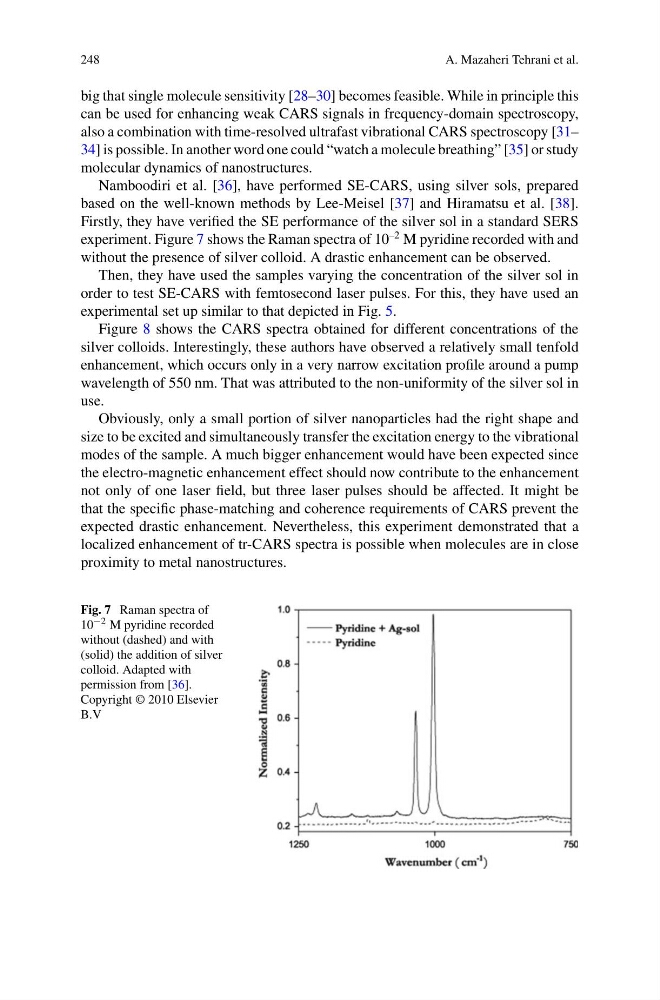
Firstly, they have verified the SE performance of the silver sol in a standard SERS
experiment. Figure 7 shows the Raman spectra of 10
–2 M pyridine recorded with and
without the presence of silver colloid. A drastic enhancement can be observed.
Then, they have used the samples varying the concentration of the silver sol in
order to test SE-CARS with femtosecond laser pulses. For this, they have used an
experimental set up similar to that depicted in Fig. 5.
Figure 8 shows the CARS spectra obtained for different concentrations of the
silver colloids. Interestingly, these authors have observed a relatively small tenfold
enhancement, which occurs only in a very narrow excitation profile around a pump
wavelength of 550 nm. That was attributed to the non-uniformity of the silver sol in
use.
Obviously, only a small portion of silver nanoparticles had the right shape and
size to be excited and simultaneously transfer the excitation energy to the vibrational
modes of the sample. A much bigger enhancement would have been expected since
the electro-magnetic enhancement effect should now contribute to the enhancement
not only of one laser field, but three laser pulses should be affected. It might be
that the specific phase-matching and coherence requirements of CARS prevent the
expected drastic enhancement. Nevertheless, this experiment demonstrated that a
localized enhancement of tr-CARS spectra is possible when molecules are in close
proximity to metal nanostructures.
Fig. 7 Raman spectra of
10 −2 M pyridine recorded
without (dashed) and with
(solid) the addition of silver
colloid. Adapted with
permission from [36].
Copyright © 2010 Elsevier
B.V
A. Mazaheri Tehrani et al.
big that single molecule sensitivity [28–30] becomes feasible. While in principle this
can be used for enhancing weak CARS signals in frequency-domain spectroscopy,
also a combination with time-resolved ultrafast vibrational CARS spectroscopy [31–
34] is possible. In another word one could “watch a molecule breathing” [35] or study
molecular dynamics of nanostructures.
Namboodiri et al. [36], have performed SE-CARS, using silver sols, prepared
based on the well-known methods by Lee-Meisel [37] and Hiramatsu et al. [38].
Firstly, they have verified the SE performance of the silver sol in a standard SERS
experiment. Figure 7 shows the Raman spectra of 10
–2 M pyridine recorded with and
without the presence of silver colloid. A drastic enhancement can be observed.
Then, they have used the samples varying the concentration of the silver sol in
order to test SE-CARS with femtosecond laser pulses. For this, they have used an
experimental set up similar to that depicted in Fig. 5.
Figure 8 shows the CARS spectra obtained for different concentrations of the
silver colloids. Interestingly, these authors have observed a relatively small tenfold
enhancement, which occurs only in a very narrow excitation profile around a pump
wavelength of 550 nm. That was attributed to the non-uniformity of the silver sol in
use.
Obviously, only a small portion of silver nanoparticles had the right shape and
size to be excited and simultaneously transfer the excitation energy to the vibrational
modes of the sample. A much bigger enhancement would have been expected since
the electro-magnetic enhancement effect should now contribute to the enhancement
not only of one laser field, but three laser pulses should be affected. It might be
that the specific phase-matching and coherence requirements of CARS prevent the
expected drastic enhancement. Nevertheless, this experiment demonstrated that a
localized enhancement of tr-CARS spectra is possible when molecules are in close
proximity to metal nanostructures.
Fig. 7 Raman spectra of
10 −2 M pyridine recorded
without (dashed) and with
(solid) the addition of silver
colloid. Adapted with
permission from [36].
Copyright © 2010 Elsevier
B.V