

Coherent Anti-Stokes Raman Scattering: Basics, Theoretical …
245
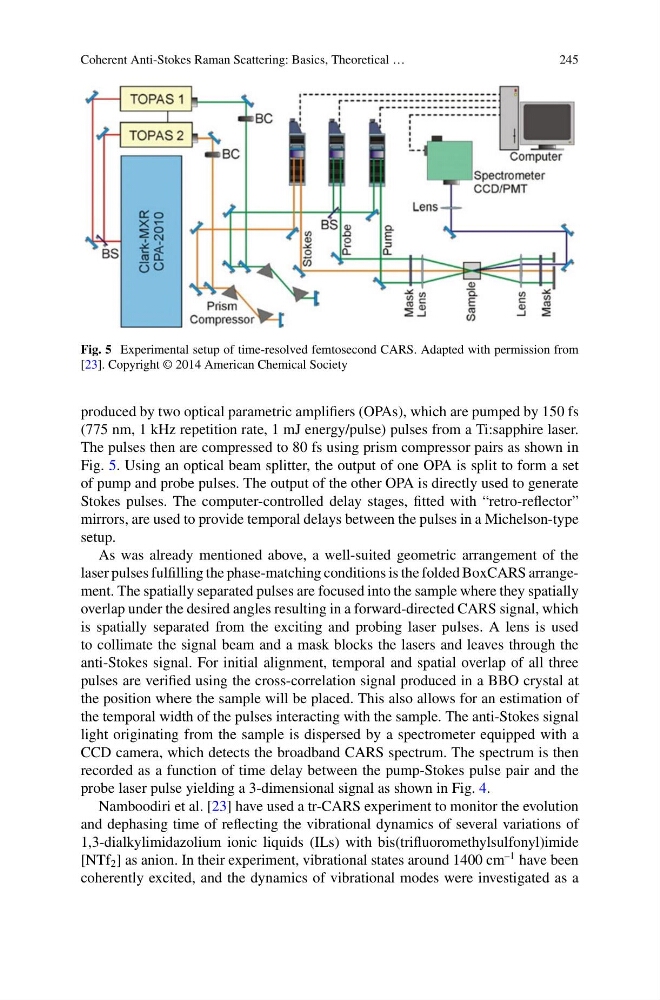
Fig. 5 Experimental setup of time-resolved femtosecond CARS. Adapted with permission from
[23]. Copyright © 2014 American Chemical Society
produced by two optical parametric amplifiers (OPAs), which are pumped by 150 fs
(775 nm, 1 kHz repetition rate, 1 mJ energy/pulse) pulses from a Ti:sapphire laser.
The pulses then are compressed to 80 fs using prism compressor pairs as shown in
Fig. 5. Using an optical beam splitter, the output of one OPA is split to form a set
of pump and probe pulses. The output of the other OPA is directly used to generate
Stokes pulses. The computer-controlled delay stages, fitted with “retro-reflector”
mirrors, are used to provide temporal delays between the pulses in a Michelson-type
setup.
As was already mentioned above, a well-suited geometric arrangement of the
laser pulses fulfilling the phase-matching conditions is the folded BoxCARS arrangement. The spatially separated pulses are focused into the sample where they spatially
overlap under the desired angles resulting in a forward-directed CARS signal, which
is spatially separated from the exciting and probing laser pulses. A lens is used
to collimate the signal beam and a mask blocks the lasers and leaves through the
anti-Stokes signal. For initial alignment, temporal and spatial overlap of all three
pulses are verified using the cross-correlation signal produced in a BBO crystal at
the position where the sample will be placed. This also allows for an estimation of
the temporal width of the pulses interacting with the sample. The anti-Stokes signal
light originating from the sample is dispersed by a spectrometer equipped with a
CCD camera, which detects the broadband CARS spectrum. The spectrum is then
recorded as a function of time delay between the pump-Stokes pulse pair and the
probe laser pulse yielding a 3-dimensional signal as shown in Fig. 4.
Namboodiri et al. [23] have used a tr-CARS experiment to monitor the evolution
and dephasing time of reflecting the vibrational dynamics of several variations of
1,3-dialkylimidazolium ionic liquids (ILs) with bis(trifluoromethylsulfonyl)imide
[NTf 2 ] as anion. In their experiment, vibrational states around 1400 cm
–1 have been
coherently excited, and the dynamics of vibrational modes were investigated as a
245
Fig. 5 Experimental setup of time-resolved femtosecond CARS. Adapted with permission from
[23]. Copyright © 2014 American Chemical Society
produced by two optical parametric amplifiers (OPAs), which are pumped by 150 fs
(775 nm, 1 kHz repetition rate, 1 mJ energy/pulse) pulses from a Ti:sapphire laser.
The pulses then are compressed to 80 fs using prism compressor pairs as shown in
Fig. 5. Using an optical beam splitter, the output of one OPA is split to form a set
of pump and probe pulses. The output of the other OPA is directly used to generate
Stokes pulses. The computer-controlled delay stages, fitted with “retro-reflector”
mirrors, are used to provide temporal delays between the pulses in a Michelson-type
setup.
As was already mentioned above, a well-suited geometric arrangement of the
laser pulses fulfilling the phase-matching conditions is the folded BoxCARS arrangement. The spatially separated pulses are focused into the sample where they spatially
overlap under the desired angles resulting in a forward-directed CARS signal, which
is spatially separated from the exciting and probing laser pulses. A lens is used
to collimate the signal beam and a mask blocks the lasers and leaves through the
anti-Stokes signal. For initial alignment, temporal and spatial overlap of all three
pulses are verified using the cross-correlation signal produced in a BBO crystal at
the position where the sample will be placed. This also allows for an estimation of
the temporal width of the pulses interacting with the sample. The anti-Stokes signal
light originating from the sample is dispersed by a spectrometer equipped with a
CCD camera, which detects the broadband CARS spectrum. The spectrum is then
recorded as a function of time delay between the pump-Stokes pulse pair and the
probe laser pulse yielding a 3-dimensional signal as shown in Fig. 4.
Namboodiri et al. [23] have used a tr-CARS experiment to monitor the evolution
and dephasing time of reflecting the vibrational dynamics of several variations of
1,3-dialkylimidazolium ionic liquids (ILs) with bis(trifluoromethylsulfonyl)imide
[NTf 2 ] as anion. In their experiment, vibrational states around 1400 cm
–1 have been
coherently excited, and the dynamics of vibrational modes were investigated as a