

244
A. Mazaheri Tehrani et al.
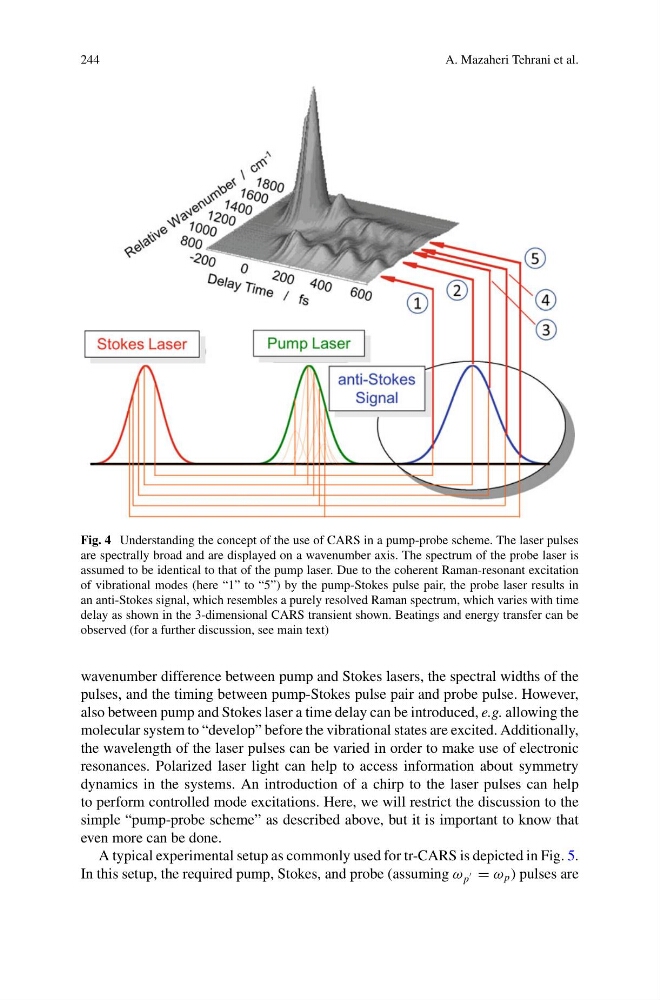
Fig. 4 Understanding the concept of the use of CARS in a pump-probe scheme. The laser pulses
are spectrally broad and are displayed on a wavenumber axis. The spectrum of the probe laser is
assumed to be identical to that of the pump laser. Due to the coherent Raman-resonant excitation
of vibrational modes (here “1” to “5”) by the pump-Stokes pulse pair, the probe laser results in
an anti-Stokes signal, which resembles a purely resolved Raman spectrum, which varies with time
delay as shown in the 3-dimensional CARS transient shown. Beatings and energy transfer can be
observed (for a further discussion, see main text)
wavenumber difference between pump and Stokes lasers, the spectral widths of the
pulses, and the timing between pump-Stokes pulse pair and probe pulse. However,
also between pump and Stokes laser a time delay can be introduced, e.g. allowing the
molecular system to “develop” before the vibrational states are excited. Additionally,
the wavelength of the laser pulses can be varied in order to make use of electronic
resonances. Polarized laser light can help to access information about symmetry
dynamics in the systems. An introduction of a chirp to the laser pulses can help
to perform controlled mode excitations. Here, we will restrict the discussion to the
simple “pump-probe scheme” as described above, but it is important to know that
even more can be done.
A typical experimental setup as commonly used for tr-CARS is depicted in Fig. 5.
In this setup, the required pump, Stokes, and probe (assuming ω p
= ω p ) pulses are
A. Mazaheri Tehrani et al.
Fig. 4 Understanding the concept of the use of CARS in a pump-probe scheme. The laser pulses
are spectrally broad and are displayed on a wavenumber axis. The spectrum of the probe laser is
assumed to be identical to that of the pump laser. Due to the coherent Raman-resonant excitation
of vibrational modes (here “1” to “5”) by the pump-Stokes pulse pair, the probe laser results in
an anti-Stokes signal, which resembles a purely resolved Raman spectrum, which varies with time
delay as shown in the 3-dimensional CARS transient shown. Beatings and energy transfer can be
observed (for a further discussion, see main text)
wavenumber difference between pump and Stokes lasers, the spectral widths of the
pulses, and the timing between pump-Stokes pulse pair and probe pulse. However,
also between pump and Stokes laser a time delay can be introduced, e.g. allowing the
molecular system to “develop” before the vibrational states are excited. Additionally,
the wavelength of the laser pulses can be varied in order to make use of electronic
resonances. Polarized laser light can help to access information about symmetry
dynamics in the systems. An introduction of a chirp to the laser pulses can help
to perform controlled mode excitations. Here, we will restrict the discussion to the
simple “pump-probe scheme” as described above, but it is important to know that
even more can be done.
A typical experimental setup as commonly used for tr-CARS is depicted in Fig. 5.
In this setup, the required pump, Stokes, and probe (assuming ω p
= ω p ) pulses are