

Coherent Anti-Stokes Raman Scattering: Basics, Theoretical …
241
k = k p + k p − k s − k as
(6)
From Eq. (5), it is clear that for an increase of the efficiency of the process several
parameters have to be considered, namely, laser intensities, third-order nonlinear
susceptibility (depending on material and Raman-resonance conditions) and also the
phase-matching condition.
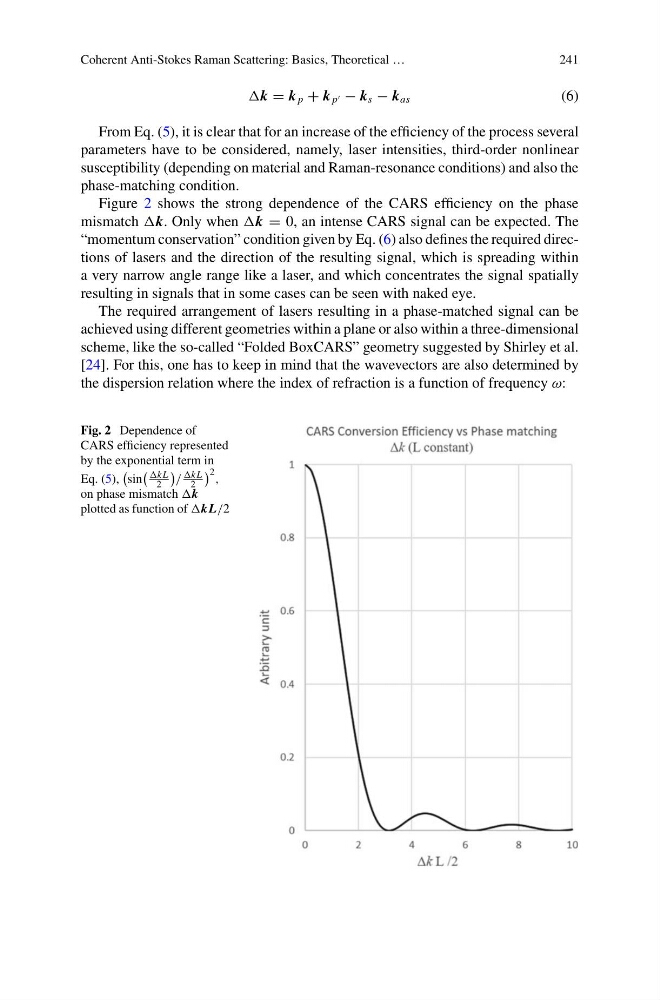
Figure 2 shows the strong dependence of the CARS efficiency on the phase
mismatch k. Only when k = 0, an intense CARS signal can be expected. The
“momentum conservation” condition given by Eq. (6) also defines the required directions of lasers and the direction of the resulting signal, which is spreading within
a very narrow angle range like a laser, and which concentrates the signal spatially
resulting in signals that in some cases can be seen with naked eye.
The required arrangement of lasers resulting in a phase-matched signal can be
achieved using different geometries within a plane or also within a three-dimensional
scheme, like the so-called “Folded BoxCARS” geometry suggested by Shirley et al.
[24]. For this, one has to keep in mind that the wavevectors are also determined by
the dispersion relation where the index of refraction is a function of frequency ω:
Fig. 2 Dependence of
CARS efficiency represented
by the exponential term in
Eq. (5),
sin
kL
2
/
kL
2
2 ,
on phase mismatch k
plotted as function of kL/2
241
k = k p + k p − k s − k as
(6)
From Eq. (5), it is clear that for an increase of the efficiency of the process several
parameters have to be considered, namely, laser intensities, third-order nonlinear
susceptibility (depending on material and Raman-resonance conditions) and also the
phase-matching condition.
Figure 2 shows the strong dependence of the CARS efficiency on the phase
mismatch k. Only when k = 0, an intense CARS signal can be expected. The
“momentum conservation” condition given by Eq. (6) also defines the required directions of lasers and the direction of the resulting signal, which is spreading within
a very narrow angle range like a laser, and which concentrates the signal spatially
resulting in signals that in some cases can be seen with naked eye.
The required arrangement of lasers resulting in a phase-matched signal can be
achieved using different geometries within a plane or also within a three-dimensional
scheme, like the so-called “Folded BoxCARS” geometry suggested by Shirley et al.
[24]. For this, one has to keep in mind that the wavevectors are also determined by
the dispersion relation where the index of refraction is a function of frequency ω:
Fig. 2 Dependence of
CARS efficiency represented
by the exponential term in
Eq. (5),
sin
kL
2
/
kL
2
2 ,
on phase mismatch k
plotted as function of kL/2