

242
A. Mazaheri Tehrani et al.
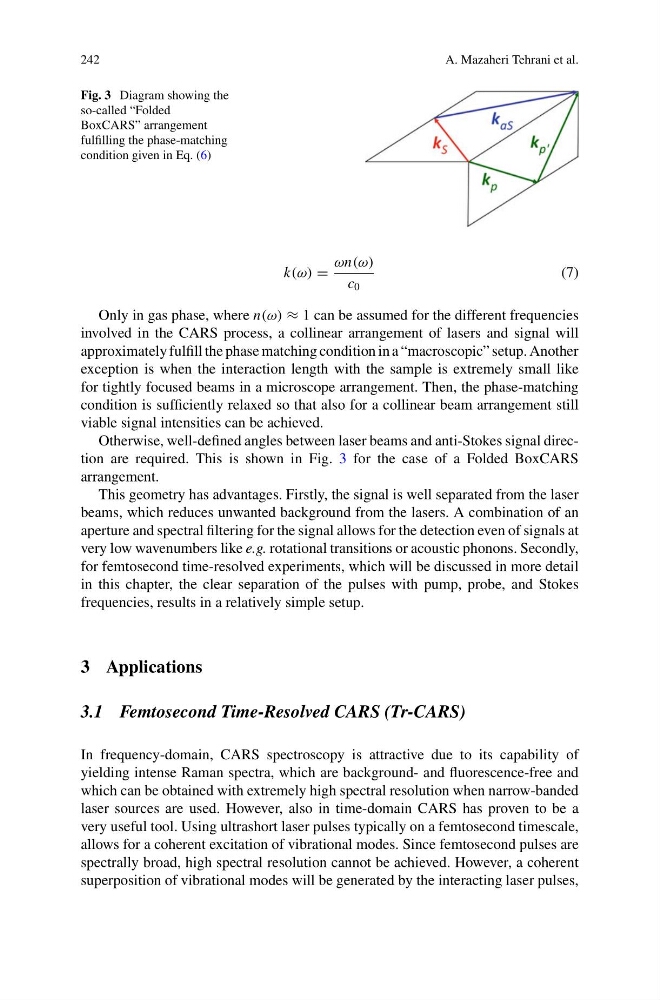
Fig. 3 Diagram showing the
so-called “Folded
BoxCARS” arrangement
fulfilling the phase-matching
condition given in Eq. (6)
k(ω) =
ωn(ω)
c 0
(7)
Only in gas phase, where n(ω) ≈ 1 can be assumed for the different frequencies
involved in the CARS process, a collinear arrangement of lasers and signal will
approximately fulfill the phase matching condition in a “macroscopic” setup. Another
exception is when the interaction length with the sample is extremely small like
for tightly focused beams in a microscope arrangement. Then, the phase-matching
condition is sufficiently relaxed so that also for a collinear beam arrangement still
viable signal intensities can be achieved.
Otherwise, well-defined angles between laser beams and anti-Stokes signal direction are required. This is shown in Fig. 3 for the case of a Folded BoxCARS
arrangement.
This geometry has advantages. Firstly, the signal is well separated from the laser
beams, which reduces unwanted background from the lasers. A combination of an
aperture and spectral filtering for the signal allows for the detection even of signals at
very low wavenumbers like e.g. rotational transitions or acoustic phonons. Secondly,
for femtosecond time-resolved experiments, which will be discussed in more detail
in this chapter, the clear separation of the pulses with pump, probe, and Stokes
frequencies, results in a relatively simple setup.
3 Applications
3.1 Femtosecond Time-Resolved CARS (Tr-CARS)
In frequency-domain, CARS spectroscopy is attractive due to its capability of
yielding intense Raman spectra, which are background- and fluorescence-free and
which can be obtained with extremely high spectral resolution when narrow-banded
laser sources are used. However, also in time-domain CARS has proven to be a
very useful tool. Using ultrashort laser pulses typically on a femtosecond timescale,
allows for a coherent excitation of vibrational modes. Since femtosecond pulses are
spectrally broad, high spectral resolution cannot be achieved. However, a coherent
superposition of vibrational modes will be generated by the interacting laser pulses,
A. Mazaheri Tehrani et al.
Fig. 3 Diagram showing the
so-called “Folded
BoxCARS” arrangement
fulfilling the phase-matching
condition given in Eq. (6)
k(ω) =
ωn(ω)
c 0
(7)
Only in gas phase, where n(ω) ≈ 1 can be assumed for the different frequencies
involved in the CARS process, a collinear arrangement of lasers and signal will
approximately fulfill the phase matching condition in a “macroscopic” setup. Another
exception is when the interaction length with the sample is extremely small like
for tightly focused beams in a microscope arrangement. Then, the phase-matching
condition is sufficiently relaxed so that also for a collinear beam arrangement still
viable signal intensities can be achieved.
Otherwise, well-defined angles between laser beams and anti-Stokes signal direction are required. This is shown in Fig. 3 for the case of a Folded BoxCARS
arrangement.
This geometry has advantages. Firstly, the signal is well separated from the laser
beams, which reduces unwanted background from the lasers. A combination of an
aperture and spectral filtering for the signal allows for the detection even of signals at
very low wavenumbers like e.g. rotational transitions or acoustic phonons. Secondly,
for femtosecond time-resolved experiments, which will be discussed in more detail
in this chapter, the clear separation of the pulses with pump, probe, and Stokes
frequencies, results in a relatively simple setup.
3 Applications
3.1 Femtosecond Time-Resolved CARS (Tr-CARS)
In frequency-domain, CARS spectroscopy is attractive due to its capability of
yielding intense Raman spectra, which are background- and fluorescence-free and
which can be obtained with extremely high spectral resolution when narrow-banded
laser sources are used. However, also in time-domain CARS has proven to be a
very useful tool. Using ultrashort laser pulses typically on a femtosecond timescale,
allows for a coherent excitation of vibrational modes. Since femtosecond pulses are
spectrally broad, high spectral resolution cannot be achieved. However, a coherent
superposition of vibrational modes will be generated by the interacting laser pulses,