

240
A. Mazaheri Tehrani et al.
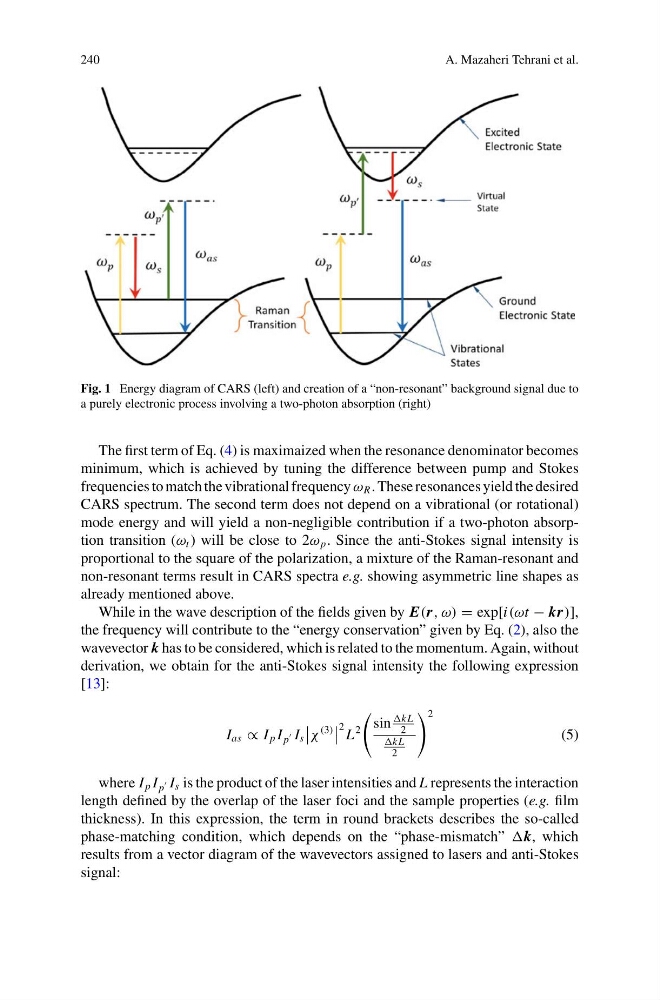
Fig. 1 Energy diagram of CARS (left) and creation of a “non-resonant” background signal due to
a purely electronic process involving a two-photon absorption (right)
The first term of Eq. (4) is maximaized when the resonance denominator becomes
minimum, which is achieved by tuning the difference between pump and Stokes
frequencies to match the vibrational frequency ω R . These resonances yield the desired
CARS spectrum. The second term does not depend on a vibrational (or rotational)
mode energy and will yield a non-negligible contribution if a two-photon absorption transition (ω t ) will be close to 2ω p . Since the anti-Stokes signal intensity is
proportional to the square of the polarization, a mixture of the Raman-resonant and
non-resonant terms result in CARS spectra e.g. showing asymmetric line shapes as
already mentioned above.
While in the wave description of the fields given by E(r, ω) = exp[i(ωt − kr)],
the frequency will contribute to the “energy conservation” given by Eq. (2), also the
wavevector k has to be considered, which is related to the momentum. Again, without
derivation, we obtain for the anti-Stokes signal intensity the following expression
[13]:
I as ∝ I p I p
I s
χ
(3)
2 L
2
sin
kL
2
kL
2
2
(5)
where I p I p
I s is the product of the laser intensities and L represents the interaction
length defined by the overlap of the laser foci and the sample properties (e.g. film
thickness). In this expression, the term in round brackets describes the so-called
phase-matching condition, which depends on the “phase-mismatch” k, which
results from a vector diagram of the wavevectors assigned to lasers and anti-Stokes
signal:
A. Mazaheri Tehrani et al.
Fig. 1 Energy diagram of CARS (left) and creation of a “non-resonant” background signal due to
a purely electronic process involving a two-photon absorption (right)
The first term of Eq. (4) is maximaized when the resonance denominator becomes
minimum, which is achieved by tuning the difference between pump and Stokes
frequencies to match the vibrational frequency ω R . These resonances yield the desired
CARS spectrum. The second term does not depend on a vibrational (or rotational)
mode energy and will yield a non-negligible contribution if a two-photon absorption transition (ω t ) will be close to 2ω p . Since the anti-Stokes signal intensity is
proportional to the square of the polarization, a mixture of the Raman-resonant and
non-resonant terms result in CARS spectra e.g. showing asymmetric line shapes as
already mentioned above.
While in the wave description of the fields given by E(r, ω) = exp[i(ωt − kr)],
the frequency will contribute to the “energy conservation” given by Eq. (2), also the
wavevector k has to be considered, which is related to the momentum. Again, without
derivation, we obtain for the anti-Stokes signal intensity the following expression
[13]:
I as ∝ I p I p
I s
χ
(3)
2 L
2
sin
kL
2
kL
2
2
(5)
where I p I p
I s is the product of the laser intensities and L represents the interaction
length defined by the overlap of the laser foci and the sample properties (e.g. film
thickness). In this expression, the term in round brackets describes the so-called
phase-matching condition, which depends on the “phase-mismatch” k, which
results from a vector diagram of the wavevectors assigned to lasers and anti-Stokes
signal: