

Coherent Anti-Stokes Raman Scattering: Basics, Theoretical …
239
ω as = ω p + ω p − ω s
(2)
The induced nonlinear polarization of third order then can be written as:
P
(3)
(ω as ) = χ
(3) E p (ω p )E p
(ω p
)E s (ω S )
(3)
Here, the frequencies ω p
and ω p can be different, however in most experiments
pump and probe pulses are used with the same frequency ω p
= ω p and originate
from the same laser source. However, in time-resolved CARS, pump and probe laser
pulses in general can be delayed against each other. In order to resonantly excite a
vibrational mode of the molecule under investigation oscillating with frequency ω R ,
the frequency difference between pump and Stokes laser is set such that ω p −ω S = ω R
is fulfilled.
In order to obtain a CARS spectrum, typically the Stokes laser frequency is tuned
(e.g. using a dye laser) over the range of Raman resonances while a detector records
the changes of the anti-Stokes signal intensity. Filters or a monochromator can help
to filter out the exciting laser frequencies, however, as will be discussed below, a
spatial separation in principle allows for a background-free detection of the CARS
signal even without spectral filtering. Another, more elegant method for obtaining a
nonlinear Raman spectrum within a shorter time is to use a broad-band laser emission
as Stokes laser. Then, a monochromator is required, which disperses the anti-Stokes
signal and a CCD detector records a spectrum over the range defined by the spectral width of the Stokes laser excitation. The spectral resolution is now defined by
the spectral widths of the pump and probe lasers and the spectral resolution of the
spectrometer used for dispersion and detection of the anti-Stokes signal.
Figure 1 shows on the left-hand side the energy diagram of a typical CARS
experiment, here assuming the interaction with a diatomic gas molecule. The righthand side of the figure depicts another process, which also can contribute due to a twophoton absorption step not involving any Raman resonance. This purely electronic
process can create a non-resonant (“resonant” referring to vibrational or rotational
energies) background, which in most cases is unwanted. It can result in line shifts
and in non-symmetric line shapes, which will not be discussed in more detail here.
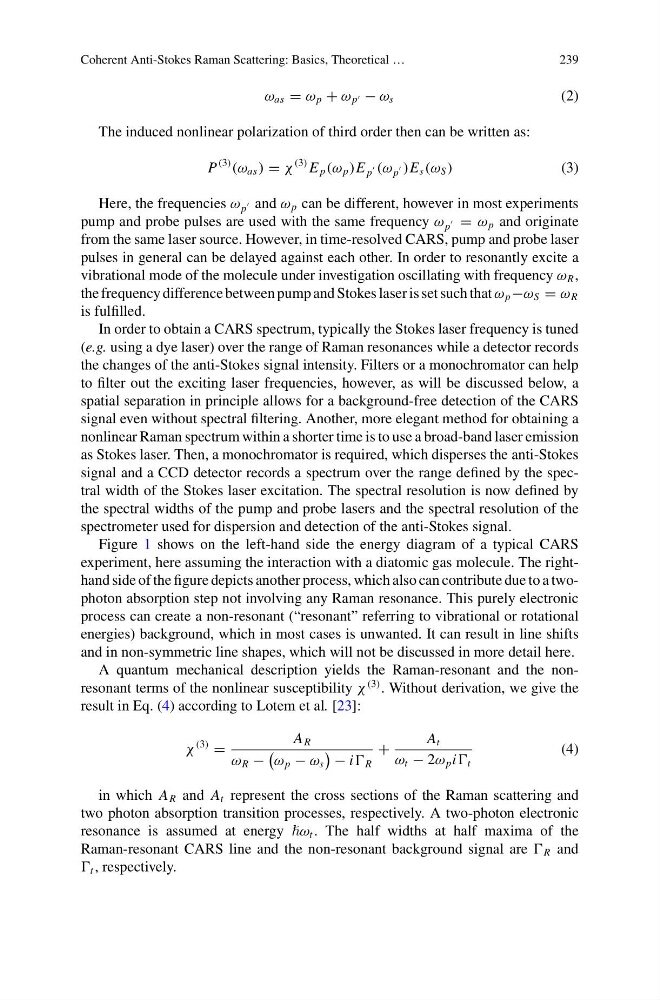
A quantum mechanical description yields the Raman-resonant and the nonresonant terms of the nonlinear susceptibility χ
(3) . Without derivation, we give the
result in Eq. (4) according to Lotem et al. [23]:
χ
(3)
=
A R
ω R −
ω p − ω s
− i R
+
A t
ω t − 2ω p i t
(4)
in which A R and A t represent the cross sections of the Raman scattering and
two photon absorption transition processes, respectively. A two-photon electronic
resonance is assumed at energy ω t . The half widths at half maxima of the
Raman-resonant CARS line and the non-resonant background signal are R and
t , respectively.
239
ω as = ω p + ω p − ω s
(2)
The induced nonlinear polarization of third order then can be written as:
P
(3)
(ω as ) = χ
(3) E p (ω p )E p
(ω p
)E s (ω S )
(3)
Here, the frequencies ω p
and ω p can be different, however in most experiments
pump and probe pulses are used with the same frequency ω p
= ω p and originate
from the same laser source. However, in time-resolved CARS, pump and probe laser
pulses in general can be delayed against each other. In order to resonantly excite a
vibrational mode of the molecule under investigation oscillating with frequency ω R ,
the frequency difference between pump and Stokes laser is set such that ω p −ω S = ω R
is fulfilled.
In order to obtain a CARS spectrum, typically the Stokes laser frequency is tuned
(e.g. using a dye laser) over the range of Raman resonances while a detector records
the changes of the anti-Stokes signal intensity. Filters or a monochromator can help
to filter out the exciting laser frequencies, however, as will be discussed below, a
spatial separation in principle allows for a background-free detection of the CARS
signal even without spectral filtering. Another, more elegant method for obtaining a
nonlinear Raman spectrum within a shorter time is to use a broad-band laser emission
as Stokes laser. Then, a monochromator is required, which disperses the anti-Stokes
signal and a CCD detector records a spectrum over the range defined by the spectral width of the Stokes laser excitation. The spectral resolution is now defined by
the spectral widths of the pump and probe lasers and the spectral resolution of the
spectrometer used for dispersion and detection of the anti-Stokes signal.
Figure 1 shows on the left-hand side the energy diagram of a typical CARS
experiment, here assuming the interaction with a diatomic gas molecule. The righthand side of the figure depicts another process, which also can contribute due to a twophoton absorption step not involving any Raman resonance. This purely electronic
process can create a non-resonant (“resonant” referring to vibrational or rotational
energies) background, which in most cases is unwanted. It can result in line shifts
and in non-symmetric line shapes, which will not be discussed in more detail here.
A quantum mechanical description yields the Raman-resonant and the nonresonant terms of the nonlinear susceptibility χ
(3) . Without derivation, we give the
result in Eq. (4) according to Lotem et al. [23]:
χ
(3)
=
A R
ω R −
ω p − ω s
− i R
+
A t
ω t − 2ω p i t
(4)
in which A R and A t represent the cross sections of the Raman scattering and
two photon absorption transition processes, respectively. A two-photon electronic
resonance is assumed at energy ω t . The half widths at half maxima of the
Raman-resonant CARS line and the non-resonant background signal are R and
t , respectively.