

238
A. Mazaheri Tehrani et al.
was developed in 1960 [6]. The principle of many nonlinear optical processes, were
later developed and presented by a Dutch-American physicist and Nobel laureate,
Nicolaas Bloembergen in his book entitled “Nonlinear Optics” [21].
In order to better understand the aspect of response of the matter to the external
electric field one should consider that the external field is simply polarizing the material and the amount of this externally induced polarization depends on the material
structure and the strength of the external driving field. It is actually the nature of this
dependence that defines the (non-)linearity of the response of the material.
The dependence of the macroscopically induced dipole moment, the polarization
P (per unit volume) on the driving field E is described by P = ε 0 χ E, where ε 0
is the electric permittivity of free space. The susceptibility χ is a tensor and is
representing the material properties and response, and, therefore, is also determined
by symmetry considerations. Keeping in mind that polarization and field are vectors
and the susceptibility is a tensor, we are in the following simplifying the expressions
using a scalar notation. Additionally, frequencies have to be assigned to the electric
fields and the generated polarization and also the susceptibility is a function of
frequency. To keep this introduction as simple as possible, we will only refer to this
where specifically required.
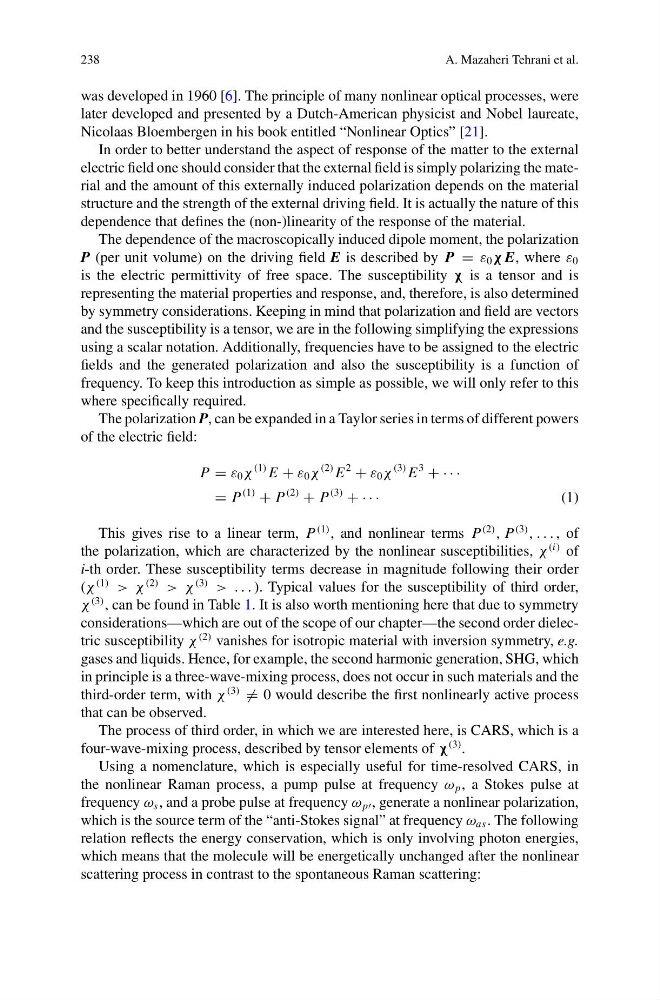
The polarization P, can be expanded in a Taylor series in terms of different powers
of the electric field:
P = ε 0 χ
(1) E + ε 0 χ
(2) E
2
+ ε 0 χ
(3) E
3
+ · · ·
= P
(1)
+ P
(2)
+ P
(3)
+ · · ·
(1)
This gives rise to a linear term, P
(1) , and nonlinear terms P
(2)
, P
(3)
, . . . , of
the polarization, which are characterized by the nonlinear susceptibilities, χ
(i) of
i-th order. These susceptibility terms decrease in magnitude following their order
(χ
(1)
> χ
(2)
> χ
(3)
> . . . ). Typical values for the susceptibility of third order,
χ
(3) , can be found in Table 1. It is also worth mentioning here that due to symmetry
considerations—which are out of the scope of our chapter—the second order dielectric susceptibility χ
(2) vanishes for isotropic material with inversion symmetry, e.g.
gases and liquids. Hence, for example, the second harmonic generation, SHG, which
in principle is a three-wave-mixing process, does not occur in such materials and the
third-order term, with χ
(3)
= 0 would describe the first nonlinearly active process
that can be observed.
The process of third order, in which we are interested here, is CARS, which is a
four-wave-mixing process, described by tensor elements of χ
(3) .
Using a nomenclature, which is especially useful for time-resolved CARS, in
the nonlinear Raman process, a pump pulse at frequency ω p , a Stokes pulse at
frequency ω s , and a probe pulse at frequency ω p , generate a nonlinear polarization,
which is the source term of the “anti-Stokes signal” at frequency ω as . The following
relation reflects the energy conservation, which is only involving photon energies,
which means that the molecule will be energetically unchanged after the nonlinear
scattering process in contrast to the spontaneous Raman scattering:
A. Mazaheri Tehrani et al.
was developed in 1960 [6]. The principle of many nonlinear optical processes, were
later developed and presented by a Dutch-American physicist and Nobel laureate,
Nicolaas Bloembergen in his book entitled “Nonlinear Optics” [21].
In order to better understand the aspect of response of the matter to the external
electric field one should consider that the external field is simply polarizing the material and the amount of this externally induced polarization depends on the material
structure and the strength of the external driving field. It is actually the nature of this
dependence that defines the (non-)linearity of the response of the material.
The dependence of the macroscopically induced dipole moment, the polarization
P (per unit volume) on the driving field E is described by P = ε 0 χ E, where ε 0
is the electric permittivity of free space. The susceptibility χ is a tensor and is
representing the material properties and response, and, therefore, is also determined
by symmetry considerations. Keeping in mind that polarization and field are vectors
and the susceptibility is a tensor, we are in the following simplifying the expressions
using a scalar notation. Additionally, frequencies have to be assigned to the electric
fields and the generated polarization and also the susceptibility is a function of
frequency. To keep this introduction as simple as possible, we will only refer to this
where specifically required.
The polarization P, can be expanded in a Taylor series in terms of different powers
of the electric field:
P = ε 0 χ
(1) E + ε 0 χ
(2) E
2
+ ε 0 χ
(3) E
3
+ · · ·
= P
(1)
+ P
(2)
+ P
(3)
+ · · ·
(1)
This gives rise to a linear term, P
(1) , and nonlinear terms P
(2)
, P
(3)
, . . . , of
the polarization, which are characterized by the nonlinear susceptibilities, χ
(i) of
i-th order. These susceptibility terms decrease in magnitude following their order
(χ
(1)
> χ
(2)
> χ
(3)
> . . . ). Typical values for the susceptibility of third order,
χ
(3) , can be found in Table 1. It is also worth mentioning here that due to symmetry
considerations—which are out of the scope of our chapter—the second order dielectric susceptibility χ
(2) vanishes for isotropic material with inversion symmetry, e.g.
gases and liquids. Hence, for example, the second harmonic generation, SHG, which
in principle is a three-wave-mixing process, does not occur in such materials and the
third-order term, with χ
(3)
= 0 would describe the first nonlinearly active process
that can be observed.
The process of third order, in which we are interested here, is CARS, which is a
four-wave-mixing process, described by tensor elements of χ
(3) .
Using a nomenclature, which is especially useful for time-resolved CARS, in
the nonlinear Raman process, a pump pulse at frequency ω p , a Stokes pulse at
frequency ω s , and a probe pulse at frequency ω p , generate a nonlinear polarization,
which is the source term of the “anti-Stokes signal” at frequency ω as . The following
relation reflects the energy conservation, which is only involving photon energies,
which means that the molecule will be energetically unchanged after the nonlinear
scattering process in contrast to the spontaneous Raman scattering: