

194
B. P. Majee and A. K. Mishra
key role in improving the signal. The SERS substrates have been mostly classified as
metallic and semiconducting substrates. In this section, we will discuss the possible
charge transfer mechanism in each of these substrates separately.
3.3.1 Metal Substrate and Analyte Molecule
The plasmon and molecular resonances occur in metals and analyte molecules,
respectively. Once both metals and molecules come in to contact of each other,
a charge transfer (CT)process occurs between them. Hence, in order to explain
the SERS enhancement in metal-molecular system, three types of resonances are
considered namely surface plasmon resonance, molecular resonance and the CT
resonance at the fermi energy. In last few years, numerous experiments and theoretical approaches have been invoked to find the influence of these resonances. John
R. Lombardi and Ronald L. Birke in 2008 explained the unified approach to SERS
in metal-molecular system [23]. They observed that these three terms are not totally
independent to each other. The wavelength dependence of these resonance showed
that CT occurs between the metal conduction band and the molecular highest occupied molecular orbital (HOMO) and lowest unoccupied molecular orbital (LUMO)
levels [34]. They observed thatthe maximum enhancement occurs in that system
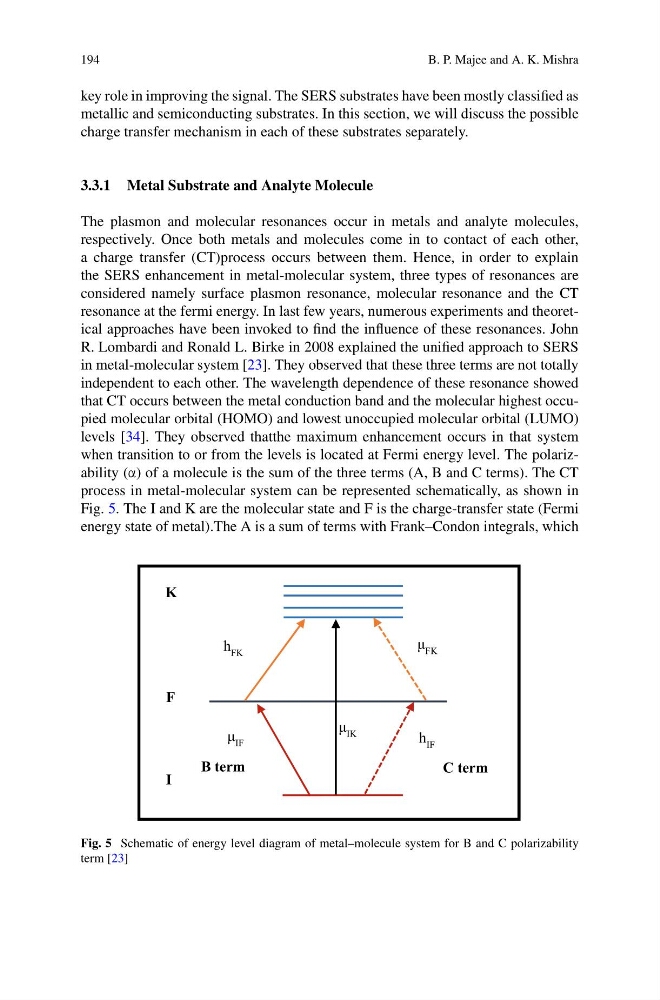
when transition to or from the levels is located at Fermi energy level. The polarizability (α) of a molecule is the sum of the three terms (A, B and C terms). The CT
process in metal-molecular system can be represented schematically, as shown in
Fig. 5. The I and K are the molecular state and F is the charge-transfer state (Fermi
energy state of metal).The A is a sum of terms with Frank–Condon integrals, which
I
K
F
h FK
μ IF
μ IK
h IF
μ FK
B term
C term
Fig. 5 Schematic of energy level diagram of metal–molecule system for B and C polarizability
term [23]
B. P. Majee and A. K. Mishra
key role in improving the signal. The SERS substrates have been mostly classified as
metallic and semiconducting substrates. In this section, we will discuss the possible
charge transfer mechanism in each of these substrates separately.
3.3.1 Metal Substrate and Analyte Molecule
The plasmon and molecular resonances occur in metals and analyte molecules,
respectively. Once both metals and molecules come in to contact of each other,
a charge transfer (CT)process occurs between them. Hence, in order to explain
the SERS enhancement in metal-molecular system, three types of resonances are
considered namely surface plasmon resonance, molecular resonance and the CT
resonance at the fermi energy. In last few years, numerous experiments and theoretical approaches have been invoked to find the influence of these resonances. John
R. Lombardi and Ronald L. Birke in 2008 explained the unified approach to SERS
in metal-molecular system [23]. They observed that these three terms are not totally
independent to each other. The wavelength dependence of these resonance showed
that CT occurs between the metal conduction band and the molecular highest occupied molecular orbital (HOMO) and lowest unoccupied molecular orbital (LUMO)
levels [34]. They observed thatthe maximum enhancement occurs in that system
when transition to or from the levels is located at Fermi energy level. The polarizability (α) of a molecule is the sum of the three terms (A, B and C terms). The CT
process in metal-molecular system can be represented schematically, as shown in
Fig. 5. The I and K are the molecular state and F is the charge-transfer state (Fermi
energy state of metal).The A is a sum of terms with Frank–Condon integrals, which
I
K
F
h FK
μ IF
μ IK
h IF
μ FK
B term
C term
Fig. 5 Schematic of energy level diagram of metal–molecule system for B and C polarizability
term [23]