

Fundamentals and Applications of Surface Enhanced Raman …
193
3.2.2 The SERS Substrate Enhancement Factor
Many of the SERS experiments show irrelevant and excess value of EF on substrates.
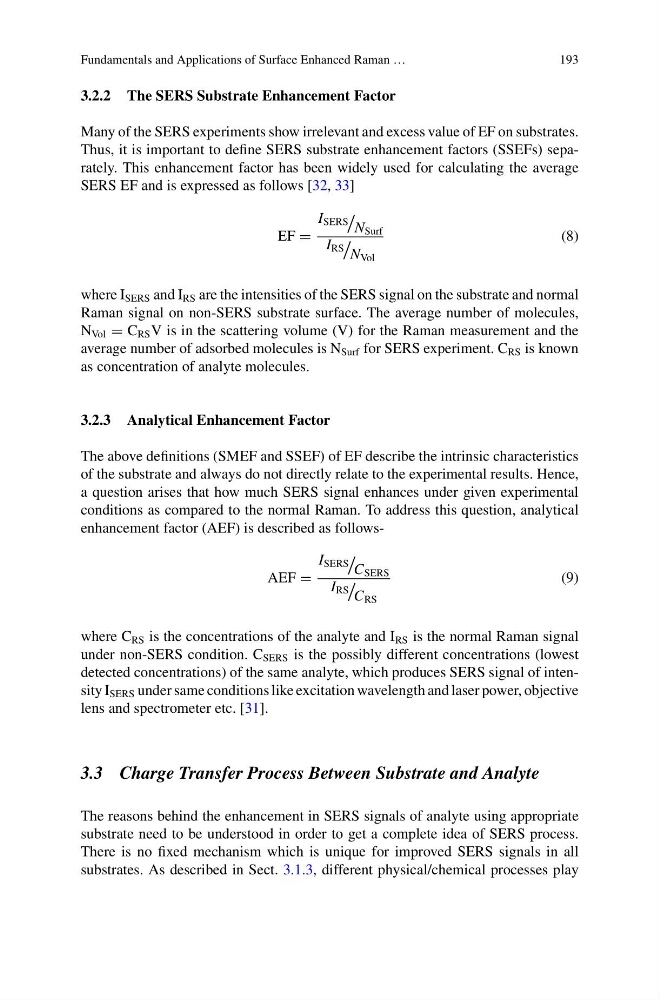
Thus, it is important to define SERS substrate enhancement factors (SSEFs) separately. This enhancement factor has been widely used for calculating the average
SERS EF and is expressed as follows [32, 33]
EF =
I SERS
N Surf
I RS
N Vol
(8)
where I SERS and I RS are the intensities of the SERS signal on the substrate and normal
Raman signal on non-SERS substrate surface. The average number of molecules,
N Vol = C RS V is in the scattering volume (V) for the Raman measurement and the
average number of adsorbed molecules is N Surf for SERS experiment. C RS is known
as concentration of analyte molecules.
3.2.3 Analytical Enhancement Factor
The above definitions (SMEF and SSEF) of EF describe the intrinsic characteristics
of the substrate and always do not directly relate to the experimental results. Hence,
a question arises that how much SERS signal enhances under given experimental
conditions as compared to the normal Raman. To address this question, analytical
enhancement factor (AEF) is described as followsAEF =
I SERS
C SERS
I RS
C RS
(9)
where C RS is the concentrations of the analyte and I RS is the normal Raman signal
under non-SERS condition. C SERS is the possibly different concentrations (lowest
detected concentrations) of the same analyte, which produces SERS signal of intensity I SERS under same conditions like excitation wavelength and laser power, objective
lens and spectrometer etc. [31].
3.3 Charge Transfer Process Between Substrate and Analyte
The reasons behind the enhancement in SERS signals of analyte using appropriate
substrate need to be understood in order to get a complete idea of SERS process.
There is no fixed mechanism which is unique for improved SERS signals in all
substrates. As described in Sect. 3.1.3, different physical/chemical processes play
193
3.2.2 The SERS Substrate Enhancement Factor
Many of the SERS experiments show irrelevant and excess value of EF on substrates.
Thus, it is important to define SERS substrate enhancement factors (SSEFs) separately. This enhancement factor has been widely used for calculating the average
SERS EF and is expressed as follows [32, 33]
EF =
I SERS
N Surf
I RS
N Vol
(8)
where I SERS and I RS are the intensities of the SERS signal on the substrate and normal
Raman signal on non-SERS substrate surface. The average number of molecules,
N Vol = C RS V is in the scattering volume (V) for the Raman measurement and the
average number of adsorbed molecules is N Surf for SERS experiment. C RS is known
as concentration of analyte molecules.
3.2.3 Analytical Enhancement Factor
The above definitions (SMEF and SSEF) of EF describe the intrinsic characteristics
of the substrate and always do not directly relate to the experimental results. Hence,
a question arises that how much SERS signal enhances under given experimental
conditions as compared to the normal Raman. To address this question, analytical
enhancement factor (AEF) is described as followsAEF =
I SERS
C SERS
I RS
C RS
(9)
where C RS is the concentrations of the analyte and I RS is the normal Raman signal
under non-SERS condition. C SERS is the possibly different concentrations (lowest
detected concentrations) of the same analyte, which produces SERS signal of intensity I SERS under same conditions like excitation wavelength and laser power, objective
lens and spectrometer etc. [31].
3.3 Charge Transfer Process Between Substrate and Analyte
The reasons behind the enhancement in SERS signals of analyte using appropriate
substrate need to be understood in order to get a complete idea of SERS process.
There is no fixed mechanism which is unique for improved SERS signals in all
substrates. As described in Sect. 3.1.3, different physical/chemical processes play