

Fundamentals and Applications of Surface Enhanced Raman …
195
E C
E V
HOMO
LUMO
μ CT
μ mol
μ ex
h IV
Molecule
Semiconductor
h CK
B term
μ CT
HOMO
LUMO
μ mol
μ ex
h IV
Molecule
Semiconductor
h CK
C term
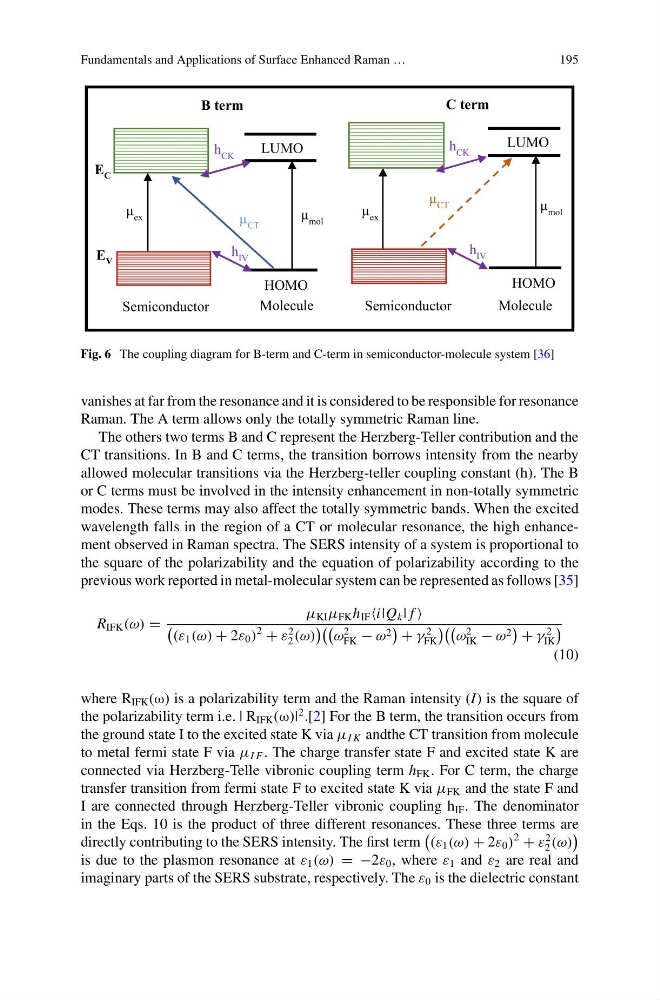
Fig. 6 The coupling diagram for B-term and C-term in semiconductor-molecule system [36]
vanishes at far from the resonance and it is considered to be responsible for resonance
Raman. The A term allows only the totally symmetric Raman line.
The others two terms B and C represent the Herzberg-Teller contribution and the
CT transitions. In B and C terms, the transition borrows intensity from the nearby
allowed molecular transitions via the Herzberg-teller coupling constant (h). The B
or C terms must be involved in the intensity enhancement in non-totally symmetric
modes. These terms may also affect the totally symmetric bands. When the excited
wavelength falls in the region of a CT or molecular resonance, the high enhancement observed in Raman spectra. The SERS intensity of a system is proportional to
the square of the polarizability and the equation of polarizability according to the
previous work reported in metal-molecular system can be represented as follows [35]
R IFK (ω) =
μ KI μ FK h IF i|Q k | f
(ε 1 (ω) + 2ε 0 )
2
+ ε
2
2 (ω)
ω
2
FK − ω 2
+ γ
2
FK
ω
2
IK − ω 2
+ γ
2
IK
(10)
where R IFK (ω) is a polarizability term and the Raman intensity (I) is the square of
the polarizability term i.e. | R IFK (ω)|
2 .[2] For the B term, the transition occurs from
the ground state I to the excited state K via μ I K andthe CT transition from molecule
to metal fermi state F via μ I F . The charge transfer state F and excited state K are
connected via Herzberg-Telle vibronic coupling term h FK . For C term, the charge
transfer transition from fermi state F to excited state K via μ FK and the state F and
I are connected through Herzberg-Teller vibronic coupling h IF . The denominator
in the Eqs. 10 is the product of three different resonances. These three terms are
directly contributing to the SERS intensity. The first term
(ε 1 (ω) + 2ε 0 )
2
+ ε
2
2 (ω)
is due to the plasmon resonance at ε 1 (ω) = −2ε 0 , where ε 1 and ε 2 are real and
imaginary parts of the SERS substrate, respectively. The ε 0 is the dielectric constant
195
E C
E V
HOMO
LUMO
μ CT
μ mol
μ ex
h IV
Molecule
Semiconductor
h CK
B term
μ CT
HOMO
LUMO
μ mol
μ ex
h IV
Molecule
Semiconductor
h CK
C term
Fig. 6 The coupling diagram for B-term and C-term in semiconductor-molecule system [36]
vanishes at far from the resonance and it is considered to be responsible for resonance
Raman. The A term allows only the totally symmetric Raman line.
The others two terms B and C represent the Herzberg-Teller contribution and the
CT transitions. In B and C terms, the transition borrows intensity from the nearby
allowed molecular transitions via the Herzberg-teller coupling constant (h). The B
or C terms must be involved in the intensity enhancement in non-totally symmetric
modes. These terms may also affect the totally symmetric bands. When the excited
wavelength falls in the region of a CT or molecular resonance, the high enhancement observed in Raman spectra. The SERS intensity of a system is proportional to
the square of the polarizability and the equation of polarizability according to the
previous work reported in metal-molecular system can be represented as follows [35]
R IFK (ω) =
μ KI μ FK h IF i|Q k | f
(ε 1 (ω) + 2ε 0 )
2
+ ε
2
2 (ω)
ω
2
FK − ω 2
+ γ
2
FK
ω
2
IK − ω 2
+ γ
2
IK
(10)
where R IFK (ω) is a polarizability term and the Raman intensity (I) is the square of
the polarizability term i.e. | R IFK (ω)|
2 .[2] For the B term, the transition occurs from
the ground state I to the excited state K via μ I K andthe CT transition from molecule
to metal fermi state F via μ I F . The charge transfer state F and excited state K are
connected via Herzberg-Telle vibronic coupling term h FK . For C term, the charge
transfer transition from fermi state F to excited state K via μ FK and the state F and
I are connected through Herzberg-Teller vibronic coupling h IF . The denominator
in the Eqs. 10 is the product of three different resonances. These three terms are
directly contributing to the SERS intensity. The first term
(ε 1 (ω) + 2ε 0 )
2
+ ε
2
2 (ω)
is due to the plasmon resonance at ε 1 (ω) = −2ε 0 , where ε 1 and ε 2 are real and
imaginary parts of the SERS substrate, respectively. The ε 0 is the dielectric constant