

Fundamentals and Applications of Surface Enhanced Raman …
189
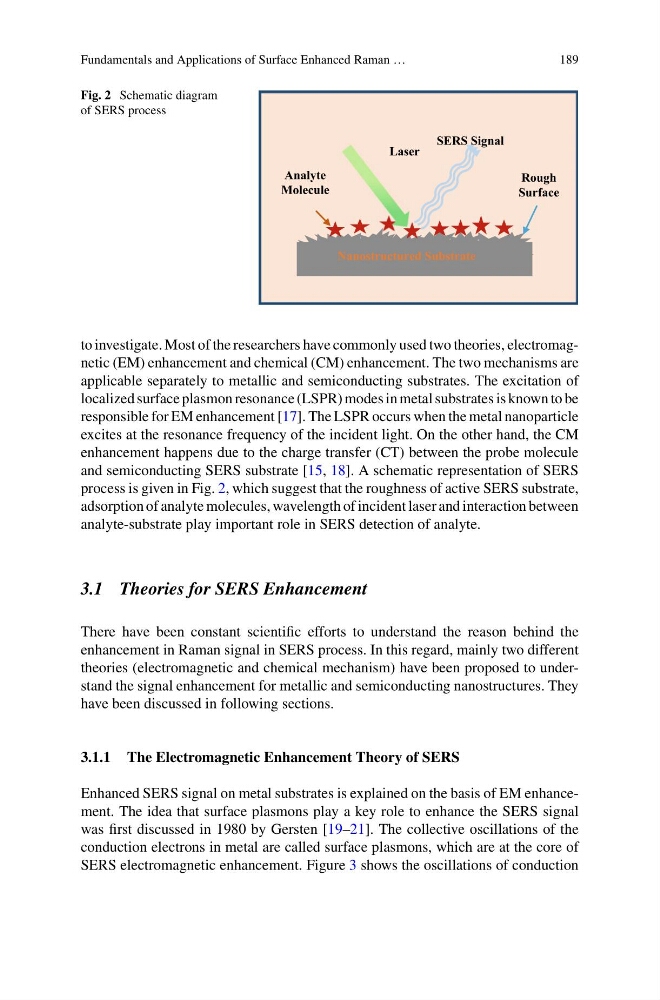
Fig. 2 Schematic diagram
of SERS process
Nanostructured Substrate
Analyte
Molecule
Rough
Surface
Laser
SERS Signal
to investigate. Most of the researchers have commonly used two theories, electromagnetic (EM) enhancement and chemical (CM) enhancement. The two mechanisms are
applicable separately to metallic and semiconducting substrates. The excitation of
localized surface plasmon resonance (LSPR) modes in metal substrates is known to be
responsible for EM enhancement [17]. The LSPR occurs when the metal nanoparticle
excites at the resonance frequency of the incident light. On the other hand, the CM
enhancement happens due to the charge transfer (CT) between the probe molecule
and semiconducting SERS substrate [15, 18]. A schematic representation of SERS
process is given in Fig. 2, which suggest that the roughness of active SERS substrate,
adsorption of analyte molecules, wavelength of incident laser and interaction between
analyte-substrate play important role in SERS detection of analyte.
3.1 Theories for SERS Enhancement
There have been constant scientific efforts to understand the reason behind the
enhancement in Raman signal in SERS process. In this regard, mainly two different
theories (electromagnetic and chemical mechanism) have been proposed to understand the signal enhancement for metallic and semiconducting nanostructures. They
have been discussed in following sections.
3.1.1 The Electromagnetic Enhancement Theory of SERS
Enhanced SERS signal on metal substrates is explained on the basis of EM enhancement. The idea that surface plasmons play a key role to enhance the SERS signal
was first discussed in 1980 by Gersten [19–21]. The collective oscillations of the
conduction electrons in metal are called surface plasmons, which are at the core of
SERS electromagnetic enhancement. Figure 3 shows the oscillations of conduction
189
Fig. 2 Schematic diagram
of SERS process
Nanostructured Substrate
Analyte
Molecule
Rough
Surface
Laser
SERS Signal
to investigate. Most of the researchers have commonly used two theories, electromagnetic (EM) enhancement and chemical (CM) enhancement. The two mechanisms are
applicable separately to metallic and semiconducting substrates. The excitation of
localized surface plasmon resonance (LSPR) modes in metal substrates is known to be
responsible for EM enhancement [17]. The LSPR occurs when the metal nanoparticle
excites at the resonance frequency of the incident light. On the other hand, the CM
enhancement happens due to the charge transfer (CT) between the probe molecule
and semiconducting SERS substrate [15, 18]. A schematic representation of SERS
process is given in Fig. 2, which suggest that the roughness of active SERS substrate,
adsorption of analyte molecules, wavelength of incident laser and interaction between
analyte-substrate play important role in SERS detection of analyte.
3.1 Theories for SERS Enhancement
There have been constant scientific efforts to understand the reason behind the
enhancement in Raman signal in SERS process. In this regard, mainly two different
theories (electromagnetic and chemical mechanism) have been proposed to understand the signal enhancement for metallic and semiconducting nanostructures. They
have been discussed in following sections.
3.1.1 The Electromagnetic Enhancement Theory of SERS
Enhanced SERS signal on metal substrates is explained on the basis of EM enhancement. The idea that surface plasmons play a key role to enhance the SERS signal
was first discussed in 1980 by Gersten [19–21]. The collective oscillations of the
conduction electrons in metal are called surface plasmons, which are at the core of
SERS electromagnetic enhancement. Figure 3 shows the oscillations of conduction