

188
B. P. Majee and A. K. Mishra
where E inc (ω inc ) and E(ω s ) are the local electric field enhancement at frequency ω inc
and electric field enhancement at the stoke frequency ω s . If the electric field value is
very close to each other than the SERS intensity
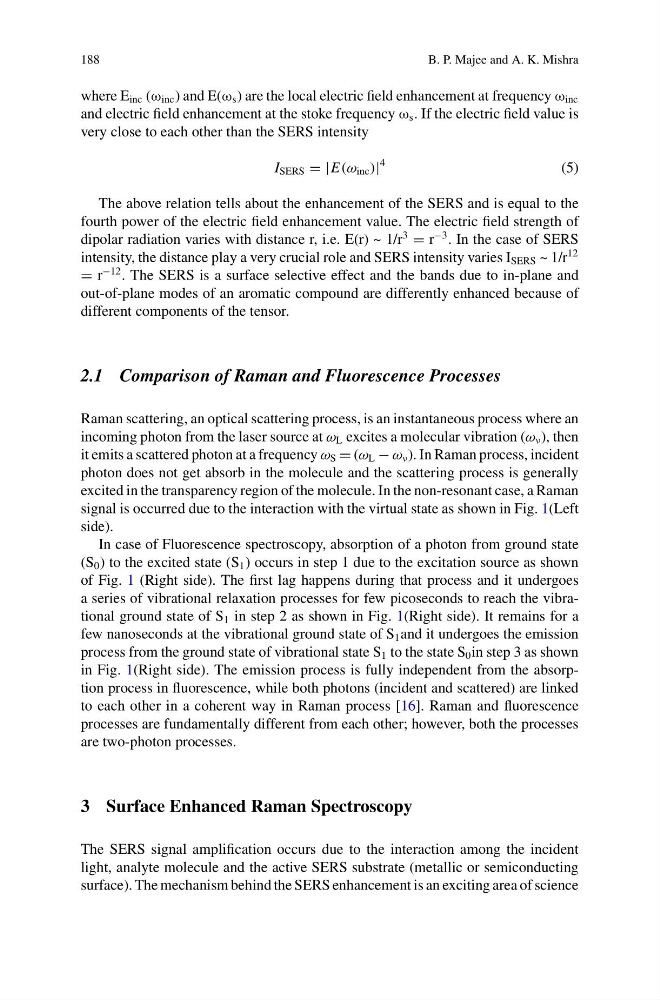
I SERS = |E(ω inc )|
4
(5)
The above relation tells about the enhancement of the SERS and is equal to the
fourth power of the electric field enhancement value. The electric field strength of
dipolar radiation varies with distance r, i.e. E(r) ~ 1/r
3
= r
−3 . In the case of SERS
intensity, the distance play a very crucial role and SERS intensity varies I SERS ~ 1/r
12
= r
−12 . The SERS is a surface selective effect and the bands due to in-plane and
out-of-plane modes of an aromatic compound are differently enhanced because of
different components of the tensor.
2.1 Comparison of Raman and Fluorescence Processes
Raman scattering, an optical scattering process, is an instantaneous process where an
incoming photon from the laser source at ω L excites a molecular vibration (ω ν ), then
it emits a scattered photon at a frequency ω S = (ω L − ω ν ). In Raman process, incident
photon does not get absorb in the molecule and the scattering process is generally
excited in the transparency region of the molecule. In the non-resonant case, a Raman
signal is occurred due to the interaction with the virtual state as shown in Fig. 1(Left
side).
In case of Fluorescence spectroscopy, absorption of a photon from ground state
(S 0 ) to the excited state (S 1 ) occurs in step 1 due to the excitation source as shown
of Fig. 1 (Right side). The first lag happens during that process and it undergoes
a series of vibrational relaxation processes for few picoseconds to reach the vibrational ground state of S 1 in step 2 as shown in Fig. 1(Right side). It remains for a
few nanoseconds at the vibrational ground state of S 1 and it undergoes the emission
process from the ground state of vibrational state S 1 to the state S 0 in step 3 as shown
in Fig. 1(Right side). The emission process is fully independent from the absorption process in fluorescence, while both photons (incident and scattered) are linked
to each other in a coherent way in Raman process [16]. Raman and fluorescence
processes are fundamentally different from each other; however, both the processes
are two-photon processes.
3 Surface Enhanced Raman Spectroscopy
The SERS signal amplification occurs due to the interaction among the incident
light, analyte molecule and the active SERS substrate (metallic or semiconducting
surface). The mechanism behind the SERS enhancement is an exciting area of science
B. P. Majee and A. K. Mishra
where E inc (ω inc ) and E(ω s ) are the local electric field enhancement at frequency ω inc
and electric field enhancement at the stoke frequency ω s . If the electric field value is
very close to each other than the SERS intensity
I SERS = |E(ω inc )|
4
(5)
The above relation tells about the enhancement of the SERS and is equal to the
fourth power of the electric field enhancement value. The electric field strength of
dipolar radiation varies with distance r, i.e. E(r) ~ 1/r
3
= r
−3 . In the case of SERS
intensity, the distance play a very crucial role and SERS intensity varies I SERS ~ 1/r
12
= r
−12 . The SERS is a surface selective effect and the bands due to in-plane and
out-of-plane modes of an aromatic compound are differently enhanced because of
different components of the tensor.
2.1 Comparison of Raman and Fluorescence Processes
Raman scattering, an optical scattering process, is an instantaneous process where an
incoming photon from the laser source at ω L excites a molecular vibration (ω ν ), then
it emits a scattered photon at a frequency ω S = (ω L − ω ν ). In Raman process, incident
photon does not get absorb in the molecule and the scattering process is generally
excited in the transparency region of the molecule. In the non-resonant case, a Raman
signal is occurred due to the interaction with the virtual state as shown in Fig. 1(Left
side).
In case of Fluorescence spectroscopy, absorption of a photon from ground state
(S 0 ) to the excited state (S 1 ) occurs in step 1 due to the excitation source as shown
of Fig. 1 (Right side). The first lag happens during that process and it undergoes
a series of vibrational relaxation processes for few picoseconds to reach the vibrational ground state of S 1 in step 2 as shown in Fig. 1(Right side). It remains for a
few nanoseconds at the vibrational ground state of S 1 and it undergoes the emission
process from the ground state of vibrational state S 1 to the state S 0 in step 3 as shown
in Fig. 1(Right side). The emission process is fully independent from the absorption process in fluorescence, while both photons (incident and scattered) are linked
to each other in a coherent way in Raman process [16]. Raman and fluorescence
processes are fundamentally different from each other; however, both the processes
are two-photon processes.
3 Surface Enhanced Raman Spectroscopy
The SERS signal amplification occurs due to the interaction among the incident
light, analyte molecule and the active SERS substrate (metallic or semiconducting
surface). The mechanism behind the SERS enhancement is an exciting area of science