

Fundamentals and Applications of Surface Enhanced Raman …
187
where σ r and d are cross-section and element of solid angle, respectively. The differential Raman cross-section depends on the particular vibrational mode of a molecule,
which is different for different methods. The Raman cross-section of a molecule for
a given medium depends on the refractive index and the excitation wavelength. The
Raman signal intrinsically weak due to the relatively low cross-section per molecule
(~10
−31 to 10
−29 cm
2 sr
−1 ) as compared to the fluorescence spectroscopy (~10
−16
cm
2 sr
−1 ) [15]. In Raman spectroscopy, one photon goes inelastic scattering out of
10
6 -10
9 incident photons resulting in the low signal strength and hence laser sources
are used to enhance the signal strength.
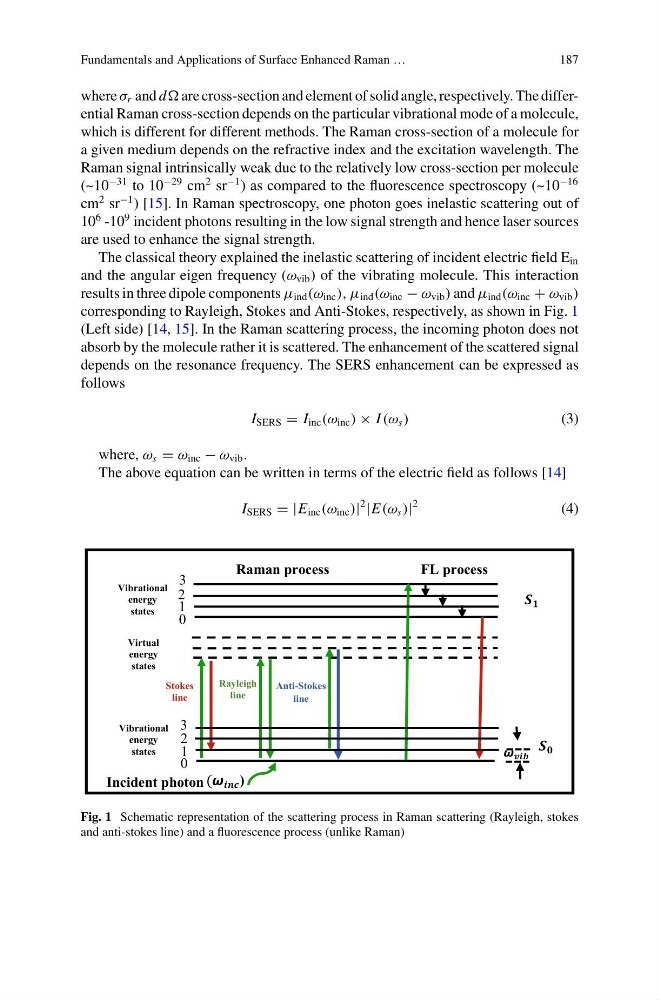
The classical theory explained the inelastic scattering of incident electric field E in
and the angular eigen frequency (ω vib ) of the vibrating molecule. This interaction
results in three dipole components μ ind (ω inc ), μ ind (ω inc − ω vib ) and μ ind (ω inc + ω vib )
corresponding to Rayleigh, Stokes and Anti-Stokes, respectively, as shown in Fig. 1
(Left side) [14, 15]. In the Raman scattering process, the incoming photon does not
absorb by the molecule rather it is scattered. The enhancement of the scattered signal
depends on the resonance frequency. The SERS enhancement can be expressed as
follows
I SERS = I inc (ω inc ) × I (ω s )
(3)
where, ω s = ω inc − ω vib .
The above equation can be written in terms of the electric field as follows [14]
I SERS = |E inc (ω inc )|
2
|E(ω s )|
2
(4)
Virtual
energy
states
0
1
2
3
1
2
3
0
Stokes
line
Rayleigh
line
Anti-Stokes
line
)
Incident photon
Vibrational
energy
states
Vibrational
energy
states
Raman process
FL process
Fig. 1 Schematic representation of the scattering process in Raman scattering (Rayleigh, stokes
and anti-stokes line) and a fluorescence process (unlike Raman)
187
where σ r and d are cross-section and element of solid angle, respectively. The differential Raman cross-section depends on the particular vibrational mode of a molecule,
which is different for different methods. The Raman cross-section of a molecule for
a given medium depends on the refractive index and the excitation wavelength. The
Raman signal intrinsically weak due to the relatively low cross-section per molecule
(~10
−31 to 10
−29 cm
2 sr
−1 ) as compared to the fluorescence spectroscopy (~10
−16
cm
2 sr
−1 ) [15]. In Raman spectroscopy, one photon goes inelastic scattering out of
10
6 -10
9 incident photons resulting in the low signal strength and hence laser sources
are used to enhance the signal strength.
The classical theory explained the inelastic scattering of incident electric field E in
and the angular eigen frequency (ω vib ) of the vibrating molecule. This interaction
results in three dipole components μ ind (ω inc ), μ ind (ω inc − ω vib ) and μ ind (ω inc + ω vib )
corresponding to Rayleigh, Stokes and Anti-Stokes, respectively, as shown in Fig. 1
(Left side) [14, 15]. In the Raman scattering process, the incoming photon does not
absorb by the molecule rather it is scattered. The enhancement of the scattered signal
depends on the resonance frequency. The SERS enhancement can be expressed as
follows
I SERS = I inc (ω inc ) × I (ω s )
(3)
where, ω s = ω inc − ω vib .
The above equation can be written in terms of the electric field as follows [14]
I SERS = |E inc (ω inc )|
2
|E(ω s )|
2
(4)
Virtual
energy
states
0
1
2
3
1
2
3
0
Stokes
line
Rayleigh
line
Anti-Stokes
line
)
Incident photon
Vibrational
energy
states
Vibrational
energy
states
Raman process
FL process
Fig. 1 Schematic representation of the scattering process in Raman scattering (Rayleigh, stokes
and anti-stokes line) and a fluorescence process (unlike Raman)