

Classical- and Heterodyne-Detected Vibrational Sum …
99
I
Q
H D−SFG ∝
r L O E Q e
iωωt
+ r Q(V I S) r Q(I R) E L O,Q
2
∝
r L O E Q
2 +
r Q(V I S) r Q(I R) E L O,Q
2 + E Q E
∗
L O,Q r L O r
∗
Q(V I S) r
∗
Q(I R) e
iωωt
+ E
∗
Q E L O,Q r
∗
L O r Q(V I S) r Q(I R) e
−iωωt
(21)
where, E Q ∝ F Q χ
(2)
Q E V I S E I R ; E L O,Sor Q ∝ F L O χ
(2)
L O E V I S E I R ; and E S =
F S χ
(2)
S E V I S E I R
e
iπ/2 e
iϕ
.
Where, r S , r Q and r L O are the reflectivity coefficients of the sample, quartz and LO
surfaces, respectively. ‘F’ terms indicate the product of Fresnel factors for individual
beams, i.e., SFG, VIS and IR in respective medium. In case of sample (bulk χ
(2) inactive), a phase difference of π/2 is generated with respect to the reference quartz or LO
(bulk χ
(2) active), which is taken care by e
iπ / 2 = i. An additional phase factor, e
iϕ
is introduced to account for the phase-difference between sample and reference SFG
signal that may appear due to difference in heights following evaporation of the liquid
sample. This is the most important source of phase error in HD-VSFG measurement;
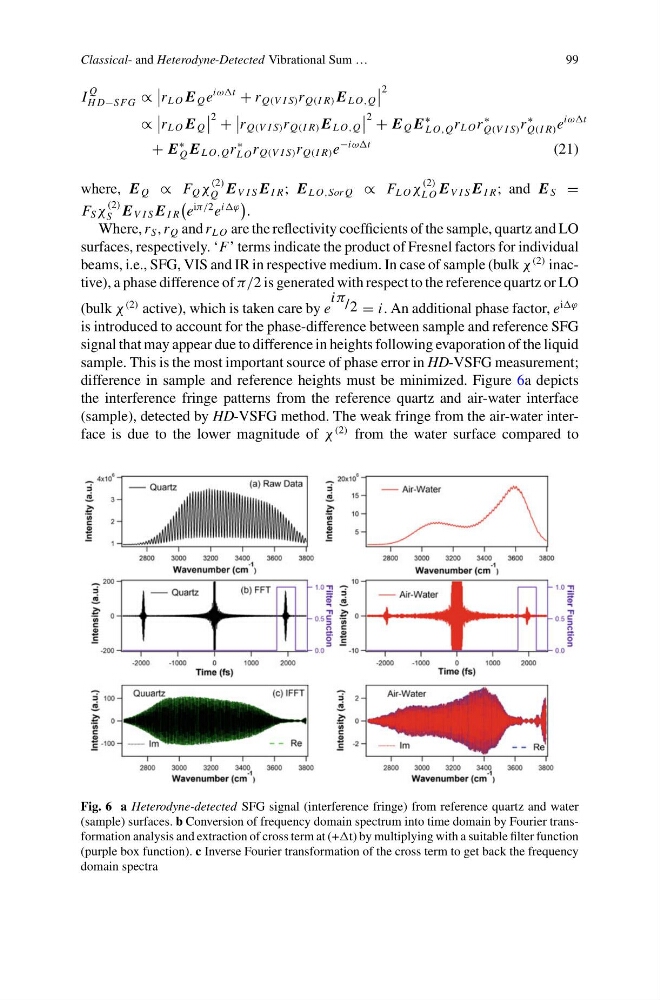
difference in sample and reference heights must be minimized. Figure 6a depicts
the interference fringe patterns from the reference quartz and air-water interface
(sample), detected by HD-VSFG method. The weak fringe from the air-water interface is due to the lower magnitude of χ
(2) from the water surface compared to
Fig. 6 a Heterodyne-detected SFG signal (interference fringe) from reference quartz and water
(sample) surfaces. b Conversion of frequency domain spectrum into time domain by Fourier transformation analysis and extraction of cross term at (+t) by multiplying with a suitable filter function
(purple box function). c Inverse Fourier transformation of the cross term to get back the frequency
domain spectra
99
I
Q
H D−SFG ∝
r L O E Q e
iωωt
+ r Q(V I S) r Q(I R) E L O,Q
2
∝
r L O E Q
2 +
r Q(V I S) r Q(I R) E L O,Q
2 + E Q E
∗
L O,Q r L O r
∗
Q(V I S) r
∗
Q(I R) e
iωωt
+ E
∗
Q E L O,Q r
∗
L O r Q(V I S) r Q(I R) e
−iωωt
(21)
where, E Q ∝ F Q χ
(2)
Q E V I S E I R ; E L O,Sor Q ∝ F L O χ
(2)
L O E V I S E I R ; and E S =
F S χ
(2)
S E V I S E I R
e
iπ/2 e
iϕ
.
Where, r S , r Q and r L O are the reflectivity coefficients of the sample, quartz and LO
surfaces, respectively. ‘F’ terms indicate the product of Fresnel factors for individual
beams, i.e., SFG, VIS and IR in respective medium. In case of sample (bulk χ
(2) inactive), a phase difference of π/2 is generated with respect to the reference quartz or LO
(bulk χ
(2) active), which is taken care by e
iπ / 2 = i. An additional phase factor, e
iϕ
is introduced to account for the phase-difference between sample and reference SFG
signal that may appear due to difference in heights following evaporation of the liquid
sample. This is the most important source of phase error in HD-VSFG measurement;
difference in sample and reference heights must be minimized. Figure 6a depicts
the interference fringe patterns from the reference quartz and air-water interface
(sample), detected by HD-VSFG method. The weak fringe from the air-water interface is due to the lower magnitude of χ
(2) from the water surface compared to
Fig. 6 a Heterodyne-detected SFG signal (interference fringe) from reference quartz and water
(sample) surfaces. b Conversion of frequency domain spectrum into time domain by Fourier transformation analysis and extraction of cross term at (+t) by multiplying with a suitable filter function
(purple box function). c Inverse Fourier transformation of the cross term to get back the frequency
domain spectra