

Classical- and Heterodyne-Detected Vibrational Sum …
97
4 Broadband Heterodyne-Detected VSFG Spectrometer
As shown in Eq. 15, the vibrational resonance of interfacial molecule is contained
in the imaginary component of χ
(2) . Therefore, it is desirable to experimentally
record the Imχ
(2) spectrum, preferably by using broad band IR and narrow band
visible pulses, typically from a femtosecond laser system. As described by Tahara and
coworkers, [4, 17] heterodyne detection of broad band SFG signal, can independently
provide the imaginary- and real-χ
(2) spectra of an interface. In this method, the SFG
from a sample is mixed with another non-resonant SFG signal from a substrate,
known as ‘local oscillator’ (LO). Sample SFG signal (SF S ) is delayed with respect to
the LO (SF LO ) in time domain (described later) and the interference pattern following
their dispersion in a spectrograph is detected with a charge coupled device (CCD).
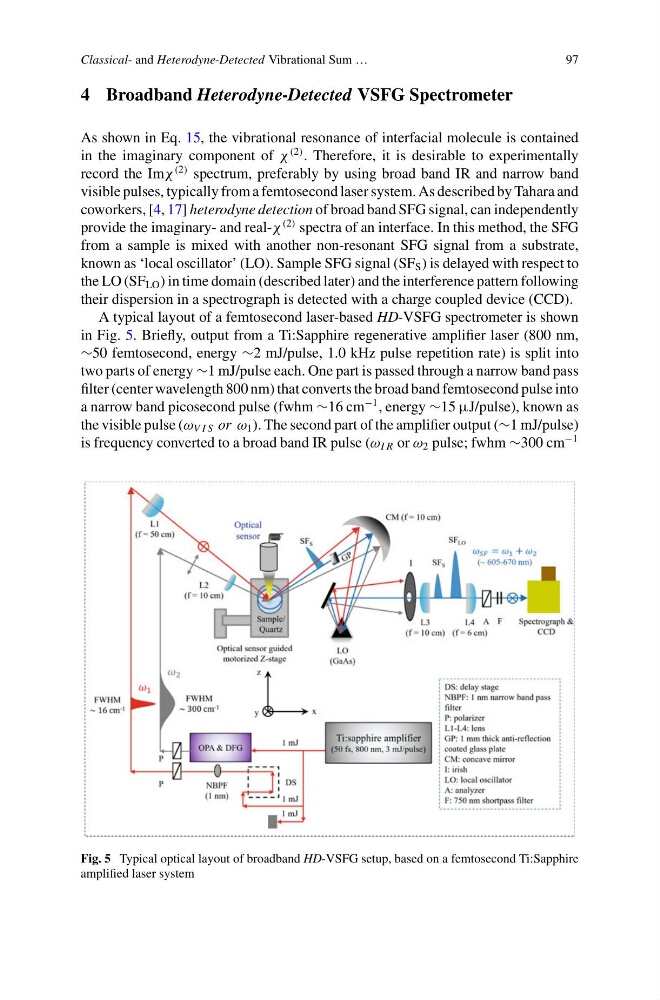
A typical layout of a femtosecond laser-based HD-VSFG spectrometer is shown
in Fig. 5. Briefly, output from a Ti:Sapphire regenerative amplifier laser (800 nm,
∼50 femtosecond, energy ∼2 mJ/pulse, 1.0 kHz pulse repetition rate) is split into
two parts of energy ∼1 mJ/pulse each. One part is passed through a narrow band pass
filter (center wavelength 800 nm) that converts the broad band femtosecond pulse into
a narrow band picosecond pulse (fwhm ∼16 cm
−1 , energy ∼15 μJ/pulse), known as
the visible pulse (ω V I S or ω 1 ). The second part of the amplifier output (∼1 mJ/pulse)
is frequency converted to a broad band IR pulse (ω I R or ω 2 pulse; fwhm ∼300 cm
−1
Fig. 5 Typical optical layout of broadband HD-VSFG setup, based on a femtosecond Ti:Sapphire
amplified laser system
97
4 Broadband Heterodyne-Detected VSFG Spectrometer
As shown in Eq. 15, the vibrational resonance of interfacial molecule is contained
in the imaginary component of χ
(2) . Therefore, it is desirable to experimentally
record the Imχ
(2) spectrum, preferably by using broad band IR and narrow band
visible pulses, typically from a femtosecond laser system. As described by Tahara and
coworkers, [4, 17] heterodyne detection of broad band SFG signal, can independently
provide the imaginary- and real-χ
(2) spectra of an interface. In this method, the SFG
from a sample is mixed with another non-resonant SFG signal from a substrate,
known as ‘local oscillator’ (LO). Sample SFG signal (SF S ) is delayed with respect to
the LO (SF LO ) in time domain (described later) and the interference pattern following
their dispersion in a spectrograph is detected with a charge coupled device (CCD).
A typical layout of a femtosecond laser-based HD-VSFG spectrometer is shown
in Fig. 5. Briefly, output from a Ti:Sapphire regenerative amplifier laser (800 nm,
∼50 femtosecond, energy ∼2 mJ/pulse, 1.0 kHz pulse repetition rate) is split into
two parts of energy ∼1 mJ/pulse each. One part is passed through a narrow band pass
filter (center wavelength 800 nm) that converts the broad band femtosecond pulse into
a narrow band picosecond pulse (fwhm ∼16 cm
−1 , energy ∼15 μJ/pulse), known as
the visible pulse (ω V I S or ω 1 ). The second part of the amplifier output (∼1 mJ/pulse)
is frequency converted to a broad band IR pulse (ω I R or ω 2 pulse; fwhm ∼300 cm
−1
Fig. 5 Typical optical layout of broadband HD-VSFG setup, based on a femtosecond Ti:Sapphire
amplified laser system