

3.6.2 Local System of Galaxy
Kaburaki worked on two areas of stellar astronomy: moving clusters and velocity
ellipsoids of nearby stars around the Sun in the Galaxy.
3.6.2.1 Moving Clusters
A moving cluster is a group of nearby stars with a common motion with respect to
the local standard of rest. Rasmuson (1921) classified eight moving clusters into two
types, one composed of low-velocity stars and the other of high-velocity stars, as
given in Table 3.8 (Rasmuson 1921). All moving clusters are distributed within 30
in galactic latitude, and the direction of motion is opposite to that of solar motion. A
notable difference in the composition of stars in the two types of clusters is the
spectral type, that is, stars of low-velocity clusters are almost early-type (B and A
stars), whereas high-velocity clusters are dominated by stars of the G and K types.
Kaburaki considered the statistical properties of moving clusters through the
study of radial velocities and proper motions by taking into account the effects of
solar motion and galactic rotation for low-velocity and high-velocity clusters,
successively (Kaburaki 1933).
(a) Low-velocity moving clusters. These clusters consist of early-type stars and are
distributed in low galactic latitudes. They are located at distances comparatively
far from the Sun. Kaburaki calculated the radial velocity (V r ) and proper motion
in longitude (μ l ) of the cluster members as a function of galactic longitude. His
calculated mean curve of proper motion is illustrated in Fig. 3.12, where one can
see good agreement for three clusters, Perseus, Sco-Cen, and Pleiades, against a
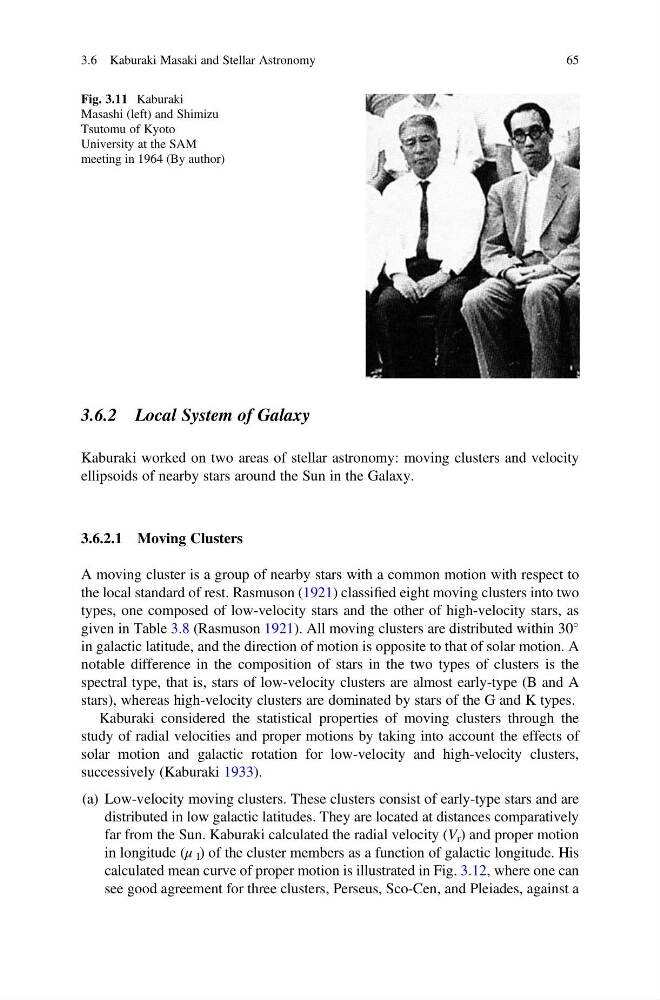
Fig. 3.11 Kaburaki
Masashi (left) and Shimizu
Tsutomu of Kyoto
University at the SAM
meeting in 1964 (By author)
3.6 Kaburaki Masaki and Stellar Astronomy
65
Kaburaki worked on two areas of stellar astronomy: moving clusters and velocity
ellipsoids of nearby stars around the Sun in the Galaxy.
3.6.2.1 Moving Clusters
A moving cluster is a group of nearby stars with a common motion with respect to
the local standard of rest. Rasmuson (1921) classified eight moving clusters into two
types, one composed of low-velocity stars and the other of high-velocity stars, as
given in Table 3.8 (Rasmuson 1921). All moving clusters are distributed within 30
in galactic latitude, and the direction of motion is opposite to that of solar motion. A
notable difference in the composition of stars in the two types of clusters is the
spectral type, that is, stars of low-velocity clusters are almost early-type (B and A
stars), whereas high-velocity clusters are dominated by stars of the G and K types.
Kaburaki considered the statistical properties of moving clusters through the
study of radial velocities and proper motions by taking into account the effects of
solar motion and galactic rotation for low-velocity and high-velocity clusters,
successively (Kaburaki 1933).
(a) Low-velocity moving clusters. These clusters consist of early-type stars and are
distributed in low galactic latitudes. They are located at distances comparatively
far from the Sun. Kaburaki calculated the radial velocity (V r ) and proper motion
in longitude (μ l ) of the cluster members as a function of galactic longitude. His
calculated mean curve of proper motion is illustrated in Fig. 3.12, where one can
see good agreement for three clusters, Perseus, Sco-Cen, and Pleiades, against a
Fig. 3.11 Kaburaki
Masashi (left) and Shimizu
Tsutomu of Kyoto
University at the SAM
meeting in 1964 (By author)
3.6 Kaburaki Masaki and Stellar Astronomy
65