

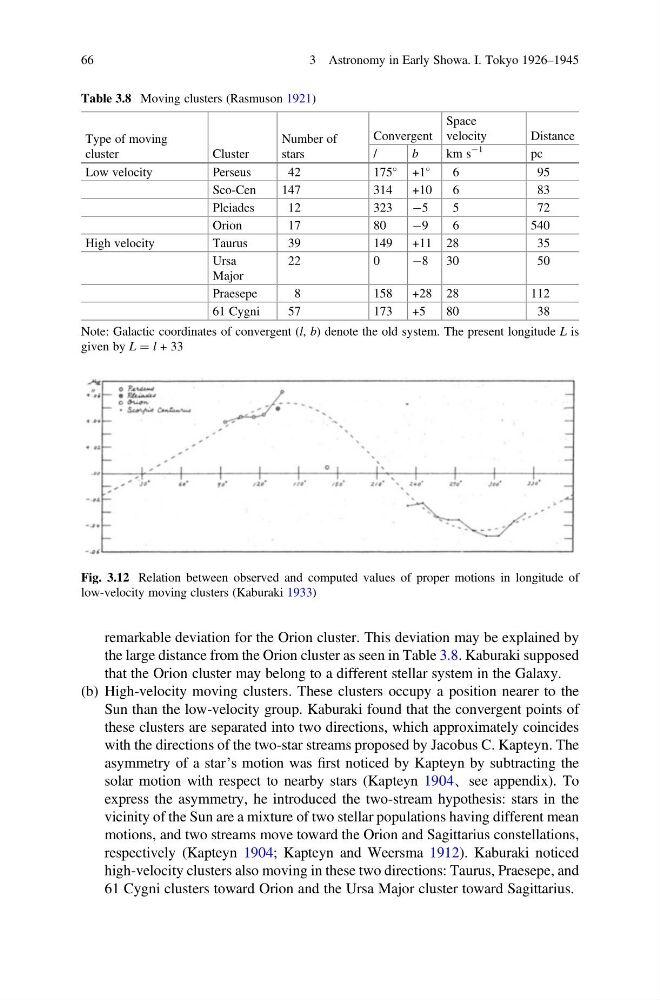
remarkable deviation for the Orion cluster. This deviation may be explained by
the large distance from the Orion cluster as seen in Table 3.8. Kaburaki supposed
that the Orion cluster may belong to a different stellar system in the Galaxy.
(b) High-velocity moving clusters. These clusters occupy a position nearer to the
Sun than the low-velocity group. Kaburaki found that the convergent points of
these clusters are separated into two directions, which approximately coincides
with the directions of the two-star streams proposed by Jacobus C. Kapteyn. The
asymmetry of a star’s motion was first noticed by Kapteyn by subtracting the
solar motion with respect to nearby stars (Kapteyn 1904、see appendix). To
express the asymmetry, he introduced the two-stream hypothesis: stars in the
vicinity of the Sun are a mixture of two stellar populations having different mean
motions, and two streams move toward the Orion and Sagittarius constellations,
respectively (Kapteyn 1904; Kapteyn and Weersma 1912). Kaburaki noticed
high-velocity clusters also moving in these two directions: Taurus, Praesepe, and
61 Cygni clusters toward Orion and the Ursa Major cluster toward Sagittarius.
Table 3.8 Moving clusters (Rasmuson 1921)
Type of moving
cluster
Cluster
Number of
stars
Convergent
Space
velocity
Distance
/
b
km s
À1
pc
Low velocity
Perseus
42
175
+1
6
9 5
Sco-Cen
147
314
+10
6
83
Pleiades
12
323
À5
5
72
Orion
17
80
À9
6
540
High velocity
Taurus
39
149
+11 28
35
Ursa
Major
22
0
À8 30
50
Praesepe
8
158
+28 28
112
61 Cygni
57
173
+5
80
38
Note: Galactic coordinates of convergent (l, b) denote the old system. The present longitude L is
given by L ¼ l + 33
Fig. 3.12 Relation between observed and computed values of proper motions in longitude of
low-velocity moving clusters (Kaburaki 1933)
66
3 Astronomy in Early Showa. I. Tokyo 1926–1945
the large distance from the Orion cluster as seen in Table 3.8. Kaburaki supposed
that the Orion cluster may belong to a different stellar system in the Galaxy.
(b) High-velocity moving clusters. These clusters occupy a position nearer to the
Sun than the low-velocity group. Kaburaki found that the convergent points of
these clusters are separated into two directions, which approximately coincides
with the directions of the two-star streams proposed by Jacobus C. Kapteyn. The
asymmetry of a star’s motion was first noticed by Kapteyn by subtracting the
solar motion with respect to nearby stars (Kapteyn 1904、see appendix). To
express the asymmetry, he introduced the two-stream hypothesis: stars in the
vicinity of the Sun are a mixture of two stellar populations having different mean
motions, and two streams move toward the Orion and Sagittarius constellations,
respectively (Kapteyn 1904; Kapteyn and Weersma 1912). Kaburaki noticed
high-velocity clusters also moving in these two directions: Taurus, Praesepe, and
61 Cygni clusters toward Orion and the Ursa Major cluster toward Sagittarius.
Table 3.8 Moving clusters (Rasmuson 1921)
Type of moving
cluster
Cluster
Number of
stars
Convergent
Space
velocity
Distance
/
b
km s
À1
pc
Low velocity
Perseus
42
175
+1
6
9 5
Sco-Cen
147
314
+10
6
83
Pleiades
12
323
À5
5
72
Orion
17
80
À9
6
540
High velocity
Taurus
39
149
+11 28
35
Ursa
Major
22
0
À8 30
50
Praesepe
8
158
+28 28
112
61 Cygni
57
173
+5
80
38
Note: Galactic coordinates of convergent (l, b) denote the old system. The present longitude L is
given by L ¼ l + 33
Fig. 3.12 Relation between observed and computed values of proper motions in longitude of
low-velocity moving clusters (Kaburaki 1933)
66
3 Astronomy in Early Showa. I. Tokyo 1926–1945