

At the end of 1950, Fujita moved to the Yerkes Observatory and continued the
spectroscopic observations of several carbon stars using the 40 inch (100 cm)
refractor. At this time, he worked on the spectral analysis to determine the effective
temperature, abundance of elements, and structure of stellar atmospheres of carbon
stars.
After a 9 month stay at Yerkes, he returned home in 1951, with great anticipation
for making observations with a large telescope.
3.5.4 Okayama Astrophysical Observatory and Observations
of Carbon Stars
The OAO was established in 1961, and Fujita began to work on spectroscopic
observations of late-type stars. His observations aimed at the infrared spectral region
from λ 7800 through λ 8900 Å of carbon stars with a high-dispersion spectrograph.
He selected this region because of the lack of previous spectroscopic observations
for carbon stars.
The spectra of carbon stars in this region are mainly composed of CN, C
13
N
14 ,
and the telluric bands of water vapor, as shown in Fig. 3.10. From the relative
intensities of these lines Fujita and Utsumi derived the relative isotope abundance of
C
12 and C
13 for some subtypes of carbon stars (Fujita and Utsumi 1963).
Fujita continued his infrared spectral observations of carbon stars and other latetype stars for a long time at the OAO. Based on his theoretical considerations of the
dissociation equilibrium of diatomic molecules, he refined the classification scheme
of carbon stars and the branching system of late-type stars. His works were taken up
by Yamashita Yasumasa and others.
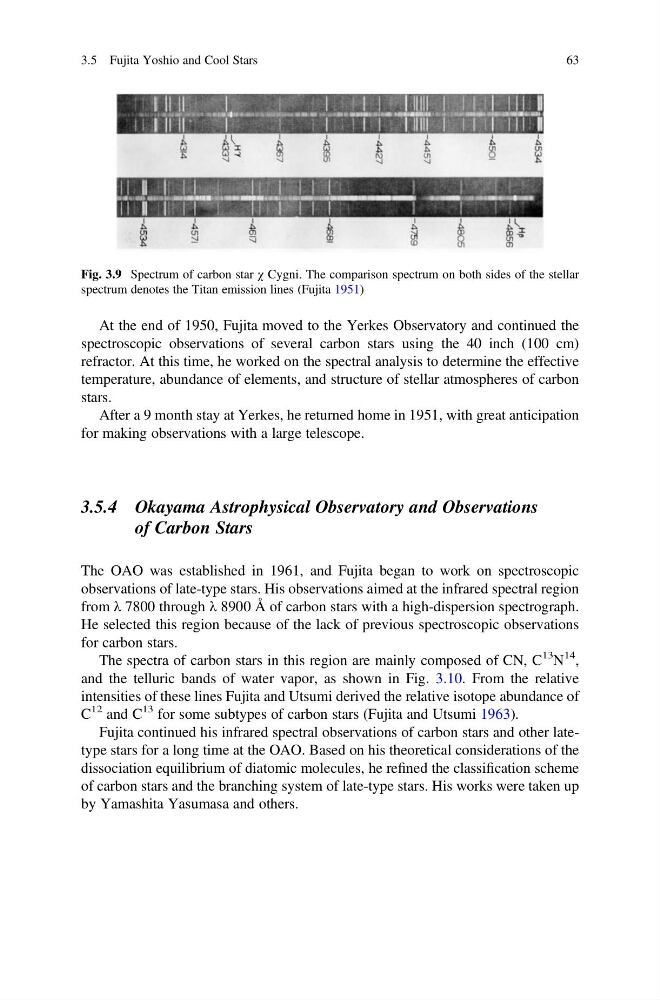
Fig. 3.9 Spectrum of carbon star χ Cygni. The comparison spectrum on both sides of the stellar
spectrum denotes the Titan emission lines (Fujita 1951)
3.5 Fujita Yoshio and Cool Stars
63
spectroscopic observations of several carbon stars using the 40 inch (100 cm)
refractor. At this time, he worked on the spectral analysis to determine the effective
temperature, abundance of elements, and structure of stellar atmospheres of carbon
stars.
After a 9 month stay at Yerkes, he returned home in 1951, with great anticipation
for making observations with a large telescope.
3.5.4 Okayama Astrophysical Observatory and Observations
of Carbon Stars
The OAO was established in 1961, and Fujita began to work on spectroscopic
observations of late-type stars. His observations aimed at the infrared spectral region
from λ 7800 through λ 8900 Å of carbon stars with a high-dispersion spectrograph.
He selected this region because of the lack of previous spectroscopic observations
for carbon stars.
The spectra of carbon stars in this region are mainly composed of CN, C
13
N
14 ,
and the telluric bands of water vapor, as shown in Fig. 3.10. From the relative
intensities of these lines Fujita and Utsumi derived the relative isotope abundance of
C
12 and C
13 for some subtypes of carbon stars (Fujita and Utsumi 1963).
Fujita continued his infrared spectral observations of carbon stars and other latetype stars for a long time at the OAO. Based on his theoretical considerations of the
dissociation equilibrium of diatomic molecules, he refined the classification scheme
of carbon stars and the branching system of late-type stars. His works were taken up
by Yamashita Yasumasa and others.
Fig. 3.9 Spectrum of carbon star χ Cygni. The comparison spectrum on both sides of the stellar
spectrum denotes the Titan emission lines (Fujita 1951)
3.5 Fujita Yoshio and Cool Stars
63