

In 1954, a project to construct a large telescope was undertaken in the TAO.
Fujita served as chairman of the construction committee. He paid particular attention
to the design of a high-dispersion Coudé spectrograph. After the establishment of the
OAO, he began to work on spectroscopic observations of carbon stars, work that
endured for his long professional life.
After retirement in 1969, Fujita moved to Tokai University as a professor of
astronomy and physics. In 1965 he was nominated as a member of the Japan
Academy (日本学士院), and later elected President of the Academy (1994–2006).
Fujita enjoyed his later years. In 2009, he was the oldest member, at age 100, of a
group that observed a solar eclipse from a ship in the central Pacific Ocean. He died
in January 2013 at age 104.
Fujita is also known as a poet of waka poetry, which is a type of poem in classical
Japanese literature:
Praise the Subaru Telescope
Calmly awaking to observe the stars
In the blue sky of Mauna Kea
(Aosora no Hosi wo kiwamu to Mauna Kea Ugoki somenishi Suharu tata emu)
This poem was presented at the Utakai Hajime (First Poetry Reading), convened by
the Emperor on New Year’s Day 1999.
3.5.2 Theoretical Spectroscopy
Fujita’s work on cool stars can be divided into early theoretical and later observational studies. In the1930s and 1940s, his main subject was the theoretical spectroscopy of diatomic molecules, and after the 1950s, his study became observational in
the US and in Japan. All his work was collected and published as a private issue
(Fujita 1997).
Fujita’s theoretical works were on the dissociation equilibrium of diatomic
molecules, such as CH, C 2 , and Z r O, observable in late-type stars (Fujita 1938).
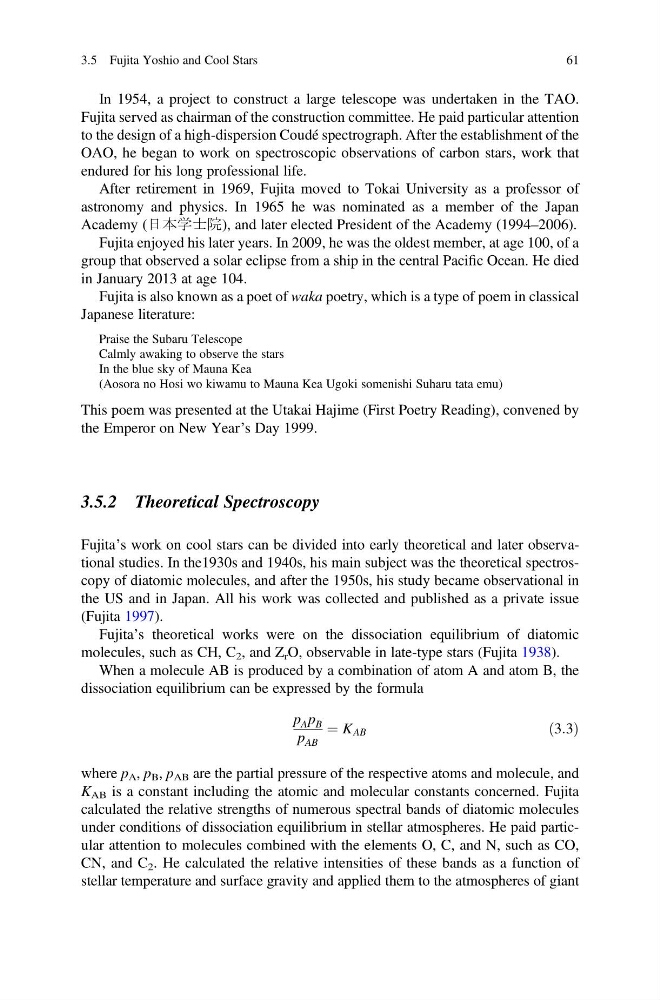
When a molecule AB is produced by a combination of atom A and atom B, the
dissociation equilibrium can be expressed by the formula
p A p B
p AB
¼ K AB
ð3:3Þ
where p A , p B , p AB are the partial pressure of the respective atoms and molecule, and
K AB is a constant including the atomic and molecular constants concerned. Fujita
calculated the relative strengths of numerous spectral bands of diatomic molecules
under conditions of dissociation equilibrium in stellar atmospheres. He paid particular attention to molecules combined with the elements O, C, and N, such as CO,
CN, and C 2 . He calculated the relative intensities of these bands as a function of
stellar temperature and surface gravity and applied them to the atmospheres of giant
3.5 Fujita Yoshio and Cool Stars
61
Fujita served as chairman of the construction committee. He paid particular attention
to the design of a high-dispersion Coudé spectrograph. After the establishment of the
OAO, he began to work on spectroscopic observations of carbon stars, work that
endured for his long professional life.
After retirement in 1969, Fujita moved to Tokai University as a professor of
astronomy and physics. In 1965 he was nominated as a member of the Japan
Academy (日本学士院), and later elected President of the Academy (1994–2006).
Fujita enjoyed his later years. In 2009, he was the oldest member, at age 100, of a
group that observed a solar eclipse from a ship in the central Pacific Ocean. He died
in January 2013 at age 104.
Fujita is also known as a poet of waka poetry, which is a type of poem in classical
Japanese literature:
Praise the Subaru Telescope
Calmly awaking to observe the stars
In the blue sky of Mauna Kea
(Aosora no Hosi wo kiwamu to Mauna Kea Ugoki somenishi Suharu tata emu)
This poem was presented at the Utakai Hajime (First Poetry Reading), convened by
the Emperor on New Year’s Day 1999.
3.5.2 Theoretical Spectroscopy
Fujita’s work on cool stars can be divided into early theoretical and later observational studies. In the1930s and 1940s, his main subject was the theoretical spectroscopy of diatomic molecules, and after the 1950s, his study became observational in
the US and in Japan. All his work was collected and published as a private issue
(Fujita 1997).
Fujita’s theoretical works were on the dissociation equilibrium of diatomic
molecules, such as CH, C 2 , and Z r O, observable in late-type stars (Fujita 1938).
When a molecule AB is produced by a combination of atom A and atom B, the
dissociation equilibrium can be expressed by the formula
p A p B
p AB
¼ K AB
ð3:3Þ
where p A , p B , p AB are the partial pressure of the respective atoms and molecule, and
K AB is a constant including the atomic and molecular constants concerned. Fujita
calculated the relative strengths of numerous spectral bands of diatomic molecules
under conditions of dissociation equilibrium in stellar atmospheres. He paid particular attention to molecules combined with the elements O, C, and N, such as CO,
CN, and C 2 . He calculated the relative intensities of these bands as a function of
stellar temperature and surface gravity and applied them to the atmospheres of giant
3.5 Fujita Yoshio and Cool Stars
61