

was to elucidate the quantum mechanical structure of this molecule. Fujita was
simply fascinated by the beauty of molecular band spectra and made up his mind
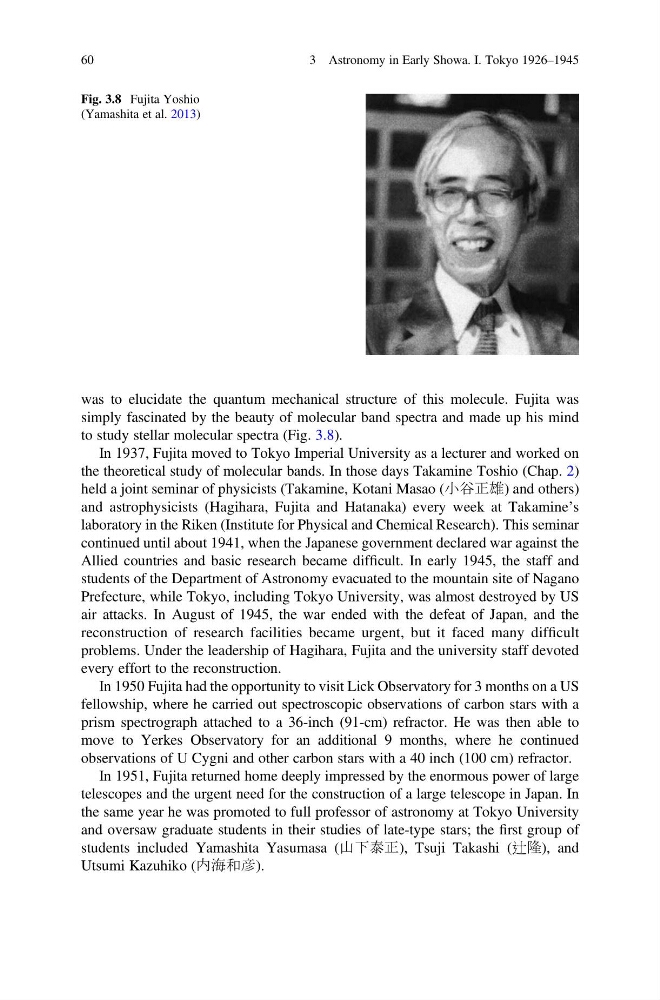
to study stellar molecular spectra (Fig. 3.8).
In 1937, Fujita moved to Tokyo Imperial University as a lecturer and worked on
the theoretical study of molecular bands. In those days Takamine Toshio (Chap. 2)
held a joint seminar of physicists (Takamine, Kotani Masao (小谷正雄) and others)
and astrophysicists (Hagihara, Fujita and Hatanaka) every week at Takamine’s
laboratory in the Riken (Institute for Physical and Chemical Research). This seminar
continued until about 1941, when the Japanese government declared war against the
Allied countries and basic research became difficult. In early 1945, the staff and
students of the Department of Astronomy evacuated to the mountain site of Nagano
Prefecture, while Tokyo, including Tokyo University, was almost destroyed by US
air attacks. In August of 1945, the war ended with the defeat of Japan, and the
reconstruction of research facilities became urgent, but it faced many difficult
problems. Under the leadership of Hagihara, Fujita and the university staff devoted
every effort to the reconstruction.
In 1950 Fujita had the opportunity to visit Lick Observatory for 3 months on a US
fellowship, where he carried out spectroscopic observations of carbon stars with a
prism spectrograph attached to a 36-inch (91-cm) refractor. He was then able to
move to Yerkes Observatory for an additional 9 months, where he continued
observations of U Cygni and other carbon stars with a 40 inch (100 cm) refractor.
In 1951, Fujita returned home deeply impressed by the enormous power of large
telescopes and the urgent need for the construction of a large telescope in Japan. In
the same year he was promoted to full professor of astronomy at Tokyo University
and oversaw graduate students in their studies of late-type stars; the first group of
students included Yamashita Yasumasa (山下泰正), Tsuji Takashi (辻隆), and
Utsumi Kazuhiko (内海和彦).
Fig. 3.8 Fujita Yoshio
(Yamashita et al. 2013)
60
3 Astronomy in Early Showa. I. Tokyo 1926–1945
simply fascinated by the beauty of molecular band spectra and made up his mind
to study stellar molecular spectra (Fig. 3.8).
In 1937, Fujita moved to Tokyo Imperial University as a lecturer and worked on
the theoretical study of molecular bands. In those days Takamine Toshio (Chap. 2)
held a joint seminar of physicists (Takamine, Kotani Masao (小谷正雄) and others)
and astrophysicists (Hagihara, Fujita and Hatanaka) every week at Takamine’s
laboratory in the Riken (Institute for Physical and Chemical Research). This seminar
continued until about 1941, when the Japanese government declared war against the
Allied countries and basic research became difficult. In early 1945, the staff and
students of the Department of Astronomy evacuated to the mountain site of Nagano
Prefecture, while Tokyo, including Tokyo University, was almost destroyed by US
air attacks. In August of 1945, the war ended with the defeat of Japan, and the
reconstruction of research facilities became urgent, but it faced many difficult
problems. Under the leadership of Hagihara, Fujita and the university staff devoted
every effort to the reconstruction.
In 1950 Fujita had the opportunity to visit Lick Observatory for 3 months on a US
fellowship, where he carried out spectroscopic observations of carbon stars with a
prism spectrograph attached to a 36-inch (91-cm) refractor. He was then able to
move to Yerkes Observatory for an additional 9 months, where he continued
observations of U Cygni and other carbon stars with a 40 inch (100 cm) refractor.
In 1951, Fujita returned home deeply impressed by the enormous power of large
telescopes and the urgent need for the construction of a large telescope in Japan. In
the same year he was promoted to full professor of astronomy at Tokyo University
and oversaw graduate students in their studies of late-type stars; the first group of
students included Yamashita Yasumasa (山下泰正), Tsuji Takashi (辻隆), and
Utsumi Kazuhiko (内海和彦).
Fig. 3.8 Fujita Yoshio
(Yamashita et al. 2013)
60
3 Astronomy in Early Showa. I. Tokyo 1926–1945