

Hatanaka was born in the city of Shingu (新宮市), Wakayama Prefecture, and
was adopted at age 3 into the Hatanaka family. In 1934, he entered Tokyo Imperial
University and studied astrophysics under Hagihara. Upon graduation in 1937, he
began to work at the university as a research assistant and was eventually promoted
to professor of astronomy in 1953. He remained there for all his later life. He worked
mainly in three fields: the physics of planetary nebulae (1942–1947), radio astronomy (1948–1962), and stellar evolution in the early Universe (1956–1964).
His contribution to the popularization of astronomy was also evident in the
writing of popular books, frequent appearances on public media (radio and TV),
popular lectures, and other factors.
In November 1963, he suddenly died of apoplexy at age 49, before his pioneering
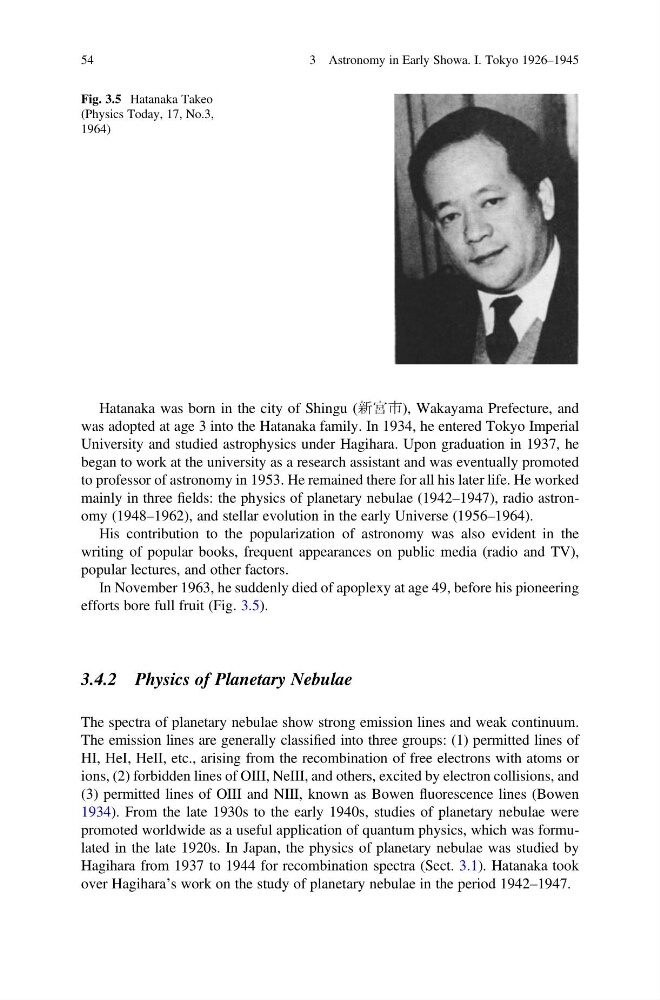
efforts bore full fruit (Fig. 3.5).
3.4.2 Physics of Planetary Nebulae
The spectra of planetary nebulae show strong emission lines and weak continuum.
The emission lines are generally classified into three groups: (1) permitted lines of
HI, HeI, HeII, etc., arising from the recombination of free electrons with atoms or
ions, (2) forbidden lines of OIII, NeIII, and others, excited by electron collisions, and
(3) permitted lines of OIII and NIII, known as Bowen fluorescence lines (Bowen
1934). From the late 1930s to the early 1940s, studies of planetary nebulae were
promoted worldwide as a useful application of quantum physics, which was formulated in the late 1920s. In Japan, the physics of planetary nebulae was studied by
Hagihara from 1937 to 1944 for recombination spectra (Sect. 3.1). Hatanaka took
over Hagihara’s work on the study of planetary nebulae in the period 1942–1947.
Fig. 3.5 Hatanaka Takeo
(Physics Today, 17, No.3,
1964)
54
3 Astronomy in Early Showa. I. Tokyo 1926–1945
was adopted at age 3 into the Hatanaka family. In 1934, he entered Tokyo Imperial
University and studied astrophysics under Hagihara. Upon graduation in 1937, he
began to work at the university as a research assistant and was eventually promoted
to professor of astronomy in 1953. He remained there for all his later life. He worked
mainly in three fields: the physics of planetary nebulae (1942–1947), radio astronomy (1948–1962), and stellar evolution in the early Universe (1956–1964).
His contribution to the popularization of astronomy was also evident in the
writing of popular books, frequent appearances on public media (radio and TV),
popular lectures, and other factors.
In November 1963, he suddenly died of apoplexy at age 49, before his pioneering
efforts bore full fruit (Fig. 3.5).
3.4.2 Physics of Planetary Nebulae
The spectra of planetary nebulae show strong emission lines and weak continuum.
The emission lines are generally classified into three groups: (1) permitted lines of
HI, HeI, HeII, etc., arising from the recombination of free electrons with atoms or
ions, (2) forbidden lines of OIII, NeIII, and others, excited by electron collisions, and
(3) permitted lines of OIII and NIII, known as Bowen fluorescence lines (Bowen
1934). From the late 1930s to the early 1940s, studies of planetary nebulae were
promoted worldwide as a useful application of quantum physics, which was formulated in the late 1920s. In Japan, the physics of planetary nebulae was studied by
Hagihara from 1937 to 1944 for recombination spectra (Sect. 3.1). Hatanaka took
over Hagihara’s work on the study of planetary nebulae in the period 1942–1947.
Fig. 3.5 Hatanaka Takeo
(Physics Today, 17, No.3,
1964)
54
3 Astronomy in Early Showa. I. Tokyo 1926–1945