

intensities of Balmer and Paschen lines, conditions of radiative equilibrium, and so
on. However, Hagihara’s theory was not accepted subsequently, for two main
reasons: first, the effects of a non-Maxwell distribution on the spectroscopic behaviors of planetary nebulae are relatively small compared to the variety of observed
behaviors, and, second, the numerical computation of the effects is complex compared to a simple Maxwell distribution.
Hagihara’s theoretical works on planetary nebulae were taken up by his students
Hatanaka Takeo (next section) and Unno Wasaburo (Chap. 7), both of whom were
promoted to professors of astronomy at the University of Tokyo.
3.3.4 Construction of the Okayama Astrophysical
Observatory
In the early 1950s, Hagihara began to consider the construction of a large optical
telescope in Japan. He argued for the necessity of a large telescope by citing an
analogy with one of the three legs of a tripod, that is, Japan, which is located around
120
in longitude from Europe and America.
Due to his patient persuasion, the telescope project was endorsed in 1954 and
construction started. The reflecting telescope with 188 cm apertures was ordered
from Grubb-Parson in England, and the observatory was sited atop Mt. Chikurinji in
Okayama Prefecture.
In 1961, the Okayama Astrophysical Observatory (OAO) was established and
Hagihara’s dream of a tripod was finally realized, though he had already retired from
the TAO by 1957 (see Chap. 6).
3.4 Hatanaka Takeo and Astrophysics
3.4.1 Life and Works
Hatanaka Takeo (畑中武夫, 1914–1963) is known as a pioneer in radio astronomy
in Japan. He also worked on the theoretical study of planetary nebulae and of stellar
evolution (Hitotuyanagi et al. 1964).
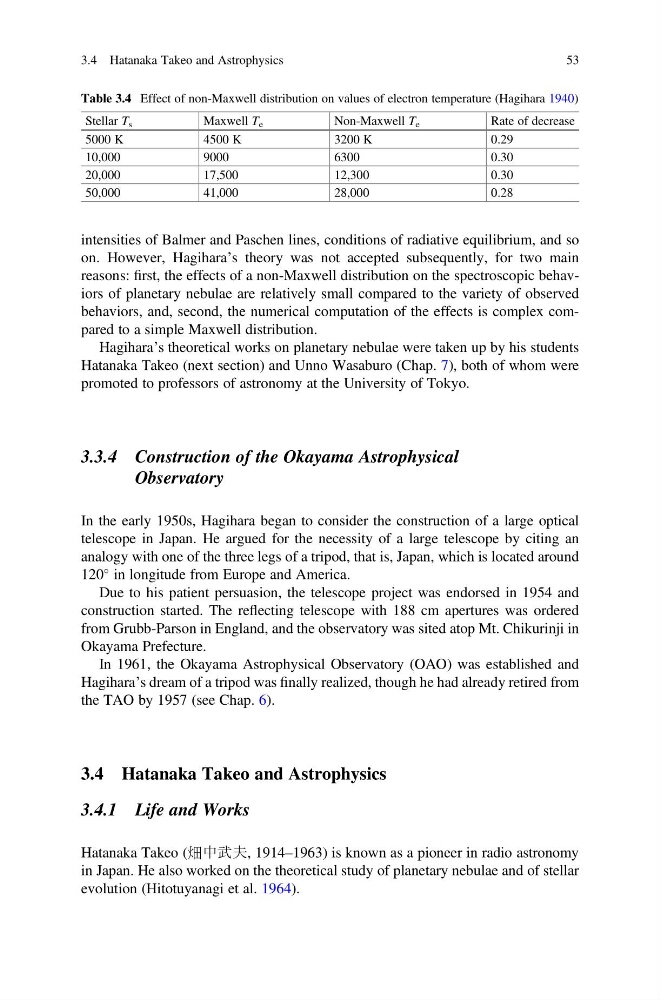
Table 3.4 Effect of non-Maxwell distribution on values of electron temperature (Hagihara 1940)
Stellar T s
Maxwell T e
Non-Maxwell T e
Rate of decrease
5000 K
4500 K
3200 K
0.29
10,000
9000
6300
0.30
20,000
17,500
12,300
0.30
50,000
41,000
28,000
0.28
3.4 Hatanaka Takeo and Astrophysics
53
on. However, Hagihara’s theory was not accepted subsequently, for two main
reasons: first, the effects of a non-Maxwell distribution on the spectroscopic behaviors of planetary nebulae are relatively small compared to the variety of observed
behaviors, and, second, the numerical computation of the effects is complex compared to a simple Maxwell distribution.
Hagihara’s theoretical works on planetary nebulae were taken up by his students
Hatanaka Takeo (next section) and Unno Wasaburo (Chap. 7), both of whom were
promoted to professors of astronomy at the University of Tokyo.
3.3.4 Construction of the Okayama Astrophysical
Observatory
In the early 1950s, Hagihara began to consider the construction of a large optical
telescope in Japan. He argued for the necessity of a large telescope by citing an
analogy with one of the three legs of a tripod, that is, Japan, which is located around
120
in longitude from Europe and America.
Due to his patient persuasion, the telescope project was endorsed in 1954 and
construction started. The reflecting telescope with 188 cm apertures was ordered
from Grubb-Parson in England, and the observatory was sited atop Mt. Chikurinji in
Okayama Prefecture.
In 1961, the Okayama Astrophysical Observatory (OAO) was established and
Hagihara’s dream of a tripod was finally realized, though he had already retired from
the TAO by 1957 (see Chap. 6).
3.4 Hatanaka Takeo and Astrophysics
3.4.1 Life and Works
Hatanaka Takeo (畑中武夫, 1914–1963) is known as a pioneer in radio astronomy
in Japan. He also worked on the theoretical study of planetary nebulae and of stellar
evolution (Hitotuyanagi et al. 1964).
Table 3.4 Effect of non-Maxwell distribution on values of electron temperature (Hagihara 1940)
Stellar T s
Maxwell T e
Non-Maxwell T e
Rate of decrease
5000 K
4500 K
3200 K
0.29
10,000
9000
6300
0.30
20,000
17,500
12,300
0.30
50,000
41,000
28,000
0.28
3.4 Hatanaka Takeo and Astrophysics
53