

(d) A large part of the radiative moments transferred to the nebular gas is due to the
Lyman radiation generated inside nebulae, and the moments increase rapidly
from the inner to the outer boundary. This is simply a result opposite to that of
J. H. Jeans’ theory, in which radiation pressure becomes zero at the outer
boundary (Jeans 1923). Hagihara argued that the amount of radiative moments
depends upon the temperature of the central stars and the optical depth for the
Lyman continuum. In some conditions, nebulae became unstable for expansion
(Hagihara and Hatanaka 1946).
3.3.3.2 Velocity Distribution of Electrons in Planetary Nebulae
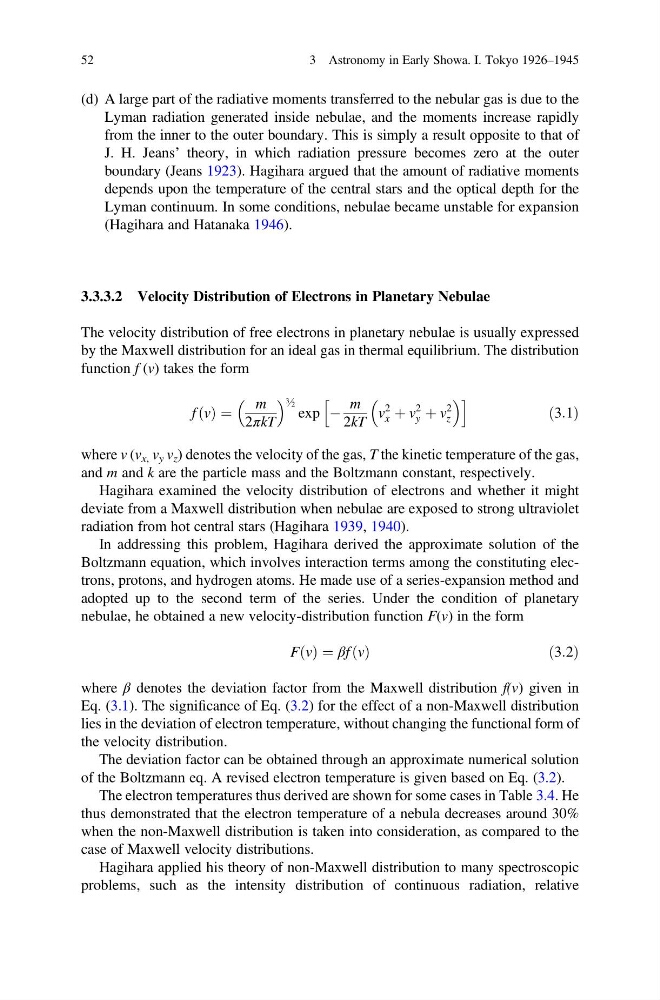
The velocity distribution of free electrons in planetary nebulae is usually expressed
by the Maxwell distribution for an ideal gas in thermal equilibrium. The distribution
function f (v) takes the form
f v
ð Þ ¼
m
2πkT
3= 2
exp À
m
2kT
v
2
x þ v
2
y þ v
2
z
h
i
ð3:1Þ
where v (v x, v y v z ) denotes the velocity of the gas, T the kinetic temperature of the gas,
and m and k are the particle mass and the Boltzmann constant, respectively.
Hagihara examined the velocity distribution of electrons and whether it might
deviate from a Maxwell distribution when nebulae are exposed to strong ultraviolet
radiation from hot central stars (Hagihara 1939, 1940).
In addressing this problem, Hagihara derived the approximate solution of the
Boltzmann equation, which involves interaction terms among the constituting electrons, protons, and hydrogen atoms. He made use of a series-expansion method and
adopted up to the second term of the series. Under the condition of planetary
nebulae, he obtained a new velocity-distribution function F(v) in the form
F v
ð Þ ¼ βf v
ð Þ
ð3:2Þ
where β denotes the deviation factor from the Maxwell distribution f(v) given in
Eq. (3.1). The significance of Eq. (3.2) for the effect of a non-Maxwell distribution
lies in the deviation of electron temperature, without changing the functional form of
the velocity distribution.
The deviation factor can be obtained through an approximate numerical solution
of the Boltzmann eq. A revised electron temperature is given based on Eq. (3.2).
The electron temperatures thus derived are shown for some cases in Table 3.4. He
thus demonstrated that the electron temperature of a nebula decreases around 30%
when the non-Maxwell distribution is taken into consideration, as compared to the
case of Maxwell velocity distributions.
Hagihara applied his theory of non-Maxwell distribution to many spectroscopic
problems, such as the intensity distribution of continuous radiation, relative
52
3 Astronomy in Early Showa. I. Tokyo 1926–1945
Lyman radiation generated inside nebulae, and the moments increase rapidly
from the inner to the outer boundary. This is simply a result opposite to that of
J. H. Jeans’ theory, in which radiation pressure becomes zero at the outer
boundary (Jeans 1923). Hagihara argued that the amount of radiative moments
depends upon the temperature of the central stars and the optical depth for the
Lyman continuum. In some conditions, nebulae became unstable for expansion
(Hagihara and Hatanaka 1946).
3.3.3.2 Velocity Distribution of Electrons in Planetary Nebulae
The velocity distribution of free electrons in planetary nebulae is usually expressed
by the Maxwell distribution for an ideal gas in thermal equilibrium. The distribution
function f (v) takes the form
f v
ð Þ ¼
m
2πkT
3= 2
exp À
m
2kT
v
2
x þ v
2
y þ v
2
z
h
i
ð3:1Þ
where v (v x, v y v z ) denotes the velocity of the gas, T the kinetic temperature of the gas,
and m and k are the particle mass and the Boltzmann constant, respectively.
Hagihara examined the velocity distribution of electrons and whether it might
deviate from a Maxwell distribution when nebulae are exposed to strong ultraviolet
radiation from hot central stars (Hagihara 1939, 1940).
In addressing this problem, Hagihara derived the approximate solution of the
Boltzmann equation, which involves interaction terms among the constituting electrons, protons, and hydrogen atoms. He made use of a series-expansion method and
adopted up to the second term of the series. Under the condition of planetary
nebulae, he obtained a new velocity-distribution function F(v) in the form
F v
ð Þ ¼ βf v
ð Þ
ð3:2Þ
where β denotes the deviation factor from the Maxwell distribution f(v) given in
Eq. (3.1). The significance of Eq. (3.2) for the effect of a non-Maxwell distribution
lies in the deviation of electron temperature, without changing the functional form of
the velocity distribution.
The deviation factor can be obtained through an approximate numerical solution
of the Boltzmann eq. A revised electron temperature is given based on Eq. (3.2).
The electron temperatures thus derived are shown for some cases in Table 3.4. He
thus demonstrated that the electron temperature of a nebula decreases around 30%
when the non-Maxwell distribution is taken into consideration, as compared to the
case of Maxwell velocity distributions.
Hagihara applied his theory of non-Maxwell distribution to many spectroscopic
problems, such as the intensity distribution of continuous radiation, relative
52
3 Astronomy in Early Showa. I. Tokyo 1926–1945