

to the outer space. This trajectory may be applicable to the motion of a particle
falling onto a black hole or a white dwarf.
3.3.3 Physics of Planetary Nebulae
From 1937 through 1944, Hagihara worked on the physics of planetary nebulae in
two fields: the physical state of nebulae in radiative equilibrium and velocity
distribution of electrons in nebulae.
3.3.3.1 Planetary Nebulae in Radiative Equilibrium
Planetary nebulae are tenuous gaseous objects surrounding central hot stars, which
emit strong ultraviolet radiation and ionize hydrogen in nebulae. In 1937, Hagihara
constructed a nebular model, under the assumption that planetary nebulae are
composed of pure hydrogen in a state of isothermal and radiative equilibrium
(Hagihara 1937). Hagihara’s work started almost the same year as J. G. Baker and
D. H. Menzel in the United States. He solved the equations of radiative transfer
inside nebulae for every radiation of Lyman, Balmer, and Paschen series, including
both their continuum and line series. Starting from the transfer of the Lyman
continuum as the first approximation, he dealt with the Lyman, Balmer, and Paschen
lines as the second approximation. Some of the results of his calculations were as
follows.
(a) Nebular hydrogen atoms are ionized almost from the ground energy levels by the
Lyman continuum, and the ionization from the second and third energy levels is
negligible.
(b) In the Lyman series, Lyman alpha (Lα) is exceedingly intense, as compared to
Lβ and higher members, which are several orders of magnitude weaker.
(c) In the Balmer and Paschen lines, in contrast to the Lyman series, the emergent
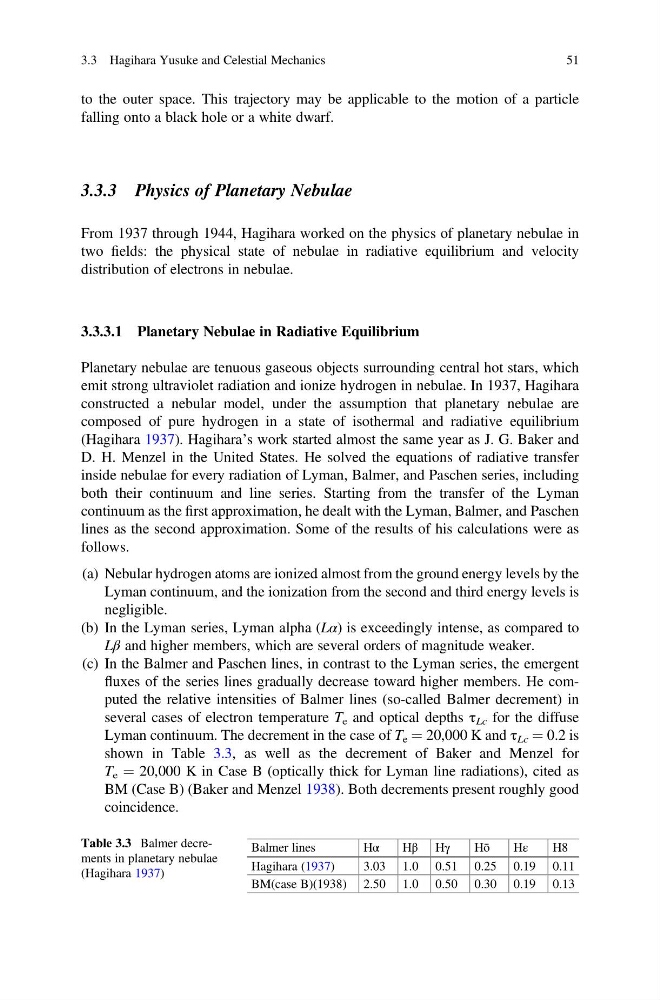
fluxes of the series lines gradually decrease toward higher members. He computed the relative intensities of Balmer lines (so-called Balmer decrement) in
several cases of electron temperature T e and optical depths τ Lc for the diffuse
Lyman continuum. The decrement in the case of T e ¼ 20,000 K and τ Lc ¼ 0.2 is
shown in Table 3.3, as well as the decrement of Baker and Menzel for
T e ¼ 20,000 K in Case B (optically thick for Lyman line radiations), cited as
BM (Case B) (Baker and Menzel 1938). Both decrements present roughly good
coincidence.
Table 3.3 Balmer decrements in planetary nebulae
(Hagihara 1937)
Balmer lines
Hα
Hβ Hγ
Hō
Hε
H8
Hagihara (1937)
3.03 1.0 0.51 0.25 0.19 0.11
BM(case B)(1938) 2.50 1.0 0.50 0.30 0.19 0.13
3.3 Hagihara Yusuke and Celestial Mechanics
51
falling onto a black hole or a white dwarf.
3.3.3 Physics of Planetary Nebulae
From 1937 through 1944, Hagihara worked on the physics of planetary nebulae in
two fields: the physical state of nebulae in radiative equilibrium and velocity
distribution of electrons in nebulae.
3.3.3.1 Planetary Nebulae in Radiative Equilibrium
Planetary nebulae are tenuous gaseous objects surrounding central hot stars, which
emit strong ultraviolet radiation and ionize hydrogen in nebulae. In 1937, Hagihara
constructed a nebular model, under the assumption that planetary nebulae are
composed of pure hydrogen in a state of isothermal and radiative equilibrium
(Hagihara 1937). Hagihara’s work started almost the same year as J. G. Baker and
D. H. Menzel in the United States. He solved the equations of radiative transfer
inside nebulae for every radiation of Lyman, Balmer, and Paschen series, including
both their continuum and line series. Starting from the transfer of the Lyman
continuum as the first approximation, he dealt with the Lyman, Balmer, and Paschen
lines as the second approximation. Some of the results of his calculations were as
follows.
(a) Nebular hydrogen atoms are ionized almost from the ground energy levels by the
Lyman continuum, and the ionization from the second and third energy levels is
negligible.
(b) In the Lyman series, Lyman alpha (Lα) is exceedingly intense, as compared to
Lβ and higher members, which are several orders of magnitude weaker.
(c) In the Balmer and Paschen lines, in contrast to the Lyman series, the emergent
fluxes of the series lines gradually decrease toward higher members. He computed the relative intensities of Balmer lines (so-called Balmer decrement) in
several cases of electron temperature T e and optical depths τ Lc for the diffuse
Lyman continuum. The decrement in the case of T e ¼ 20,000 K and τ Lc ¼ 0.2 is
shown in Table 3.3, as well as the decrement of Baker and Menzel for
T e ¼ 20,000 K in Case B (optically thick for Lyman line radiations), cited as
BM (Case B) (Baker and Menzel 1938). Both decrements present roughly good
coincidence.
Table 3.3 Balmer decrements in planetary nebulae
(Hagihara 1937)
Balmer lines
Hα
Hβ Hγ
Hō
Hε
H8
Hagihara (1937)
3.03 1.0 0.51 0.25 0.19 0.11
BM(case B)(1938) 2.50 1.0 0.50 0.30 0.19 0.13
3.3 Hagihara Yusuke and Celestial Mechanics
51