

3.3.2 Celestial Mechanics
Hagihara’s works on celestial mechanics cover three main fields: (1) two-body
problems in the general-relativistic Schwarzschild field (1930), (2) stability of
planetary and satellite systems and the theory of secular perturbations
(1927–1944), and (3) extension of the fundamental theory of celestial mechanics
(1933–1944). These works were later collected and rearranged in his five-volume
Celestial Mechanics, published in the period 1970–1976.
Hagihara’s first work was on general relativity. The exact equation of the
gravitational field around a mass point was derived by Karl Schwarzschild in 1916
and is called the Schwarzschild field. Hagihara traced the trajectories of a test particle
in a strong Schwarzschild gravitational field under various initial conditions. As a
result, he derived various types of trajectories classified as, for example,
pseudocircular, quasi-elliptic, quasi-parabolic, quasi-hyperbolic, quasi-hyperbolic
spiral, and others. A common feature of these types is the remarkable secular
variation, so, he used the term quasi or pseudo for the type of trajectory (Hagihara
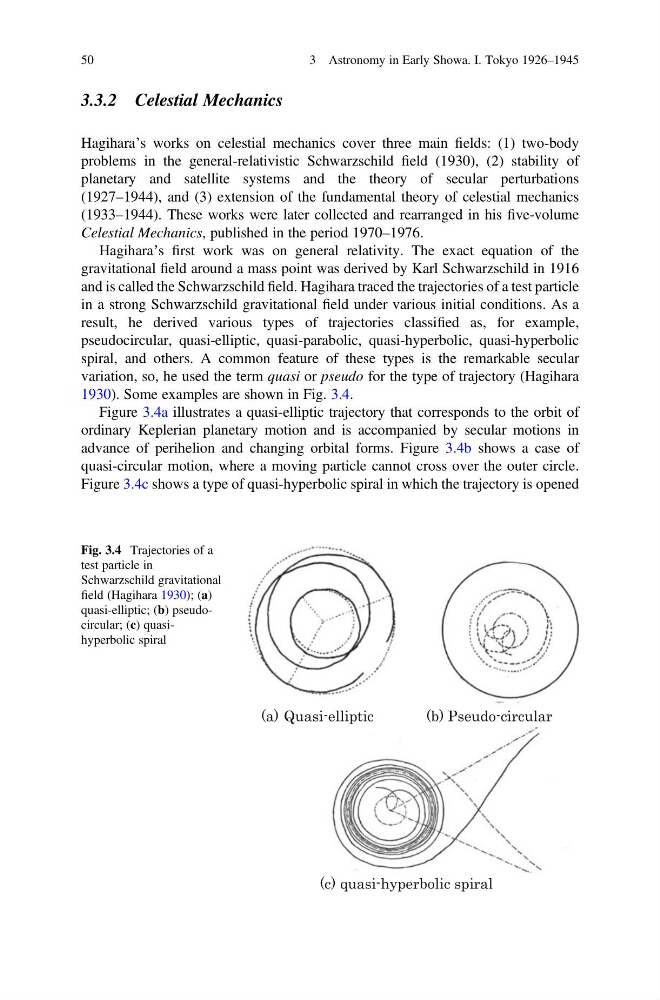
1930). Some examples are shown in Fig. 3.4.
Figure 3.4a illustrates a quasi-elliptic trajectory that corresponds to the orbit of
ordinary Keplerian planetary motion and is accompanied by secular motions in
advance of perihelion and changing orbital forms. Figure 3.4b shows a case of
quasi-circular motion, where a moving particle cannot cross over the outer circle.
Figure 3.4c shows a type of quasi-hyperbolic spiral in which the trajectory is opened
(a) Quasi-elliptic
(b) Pseudo-circular
(c) quasi-hyperbolic spiral
Fig. 3.4 Trajectories of a
test particle in
Schwarzschild gravitational
field (Hagihara 1930); (a)
quasi-elliptic; (b) pseudocircular; (c) quasihyperbolic spiral
50
3 Astronomy in Early Showa. I. Tokyo 1926–1945
Hagihara’s works on celestial mechanics cover three main fields: (1) two-body
problems in the general-relativistic Schwarzschild field (1930), (2) stability of
planetary and satellite systems and the theory of secular perturbations
(1927–1944), and (3) extension of the fundamental theory of celestial mechanics
(1933–1944). These works were later collected and rearranged in his five-volume
Celestial Mechanics, published in the period 1970–1976.
Hagihara’s first work was on general relativity. The exact equation of the
gravitational field around a mass point was derived by Karl Schwarzschild in 1916
and is called the Schwarzschild field. Hagihara traced the trajectories of a test particle
in a strong Schwarzschild gravitational field under various initial conditions. As a
result, he derived various types of trajectories classified as, for example,
pseudocircular, quasi-elliptic, quasi-parabolic, quasi-hyperbolic, quasi-hyperbolic
spiral, and others. A common feature of these types is the remarkable secular
variation, so, he used the term quasi or pseudo for the type of trajectory (Hagihara
1930). Some examples are shown in Fig. 3.4.
Figure 3.4a illustrates a quasi-elliptic trajectory that corresponds to the orbit of
ordinary Keplerian planetary motion and is accompanied by secular motions in
advance of perihelion and changing orbital forms. Figure 3.4b shows a case of
quasi-circular motion, where a moving particle cannot cross over the outer circle.
Figure 3.4c shows a type of quasi-hyperbolic spiral in which the trajectory is opened
(a) Quasi-elliptic
(b) Pseudo-circular
(c) quasi-hyperbolic spiral
Fig. 3.4 Trajectories of a
test particle in
Schwarzschild gravitational
field (Hagihara 1930); (a)
quasi-elliptic; (b) pseudocircular; (c) quasihyperbolic spiral
50
3 Astronomy in Early Showa. I. Tokyo 1926–1945