

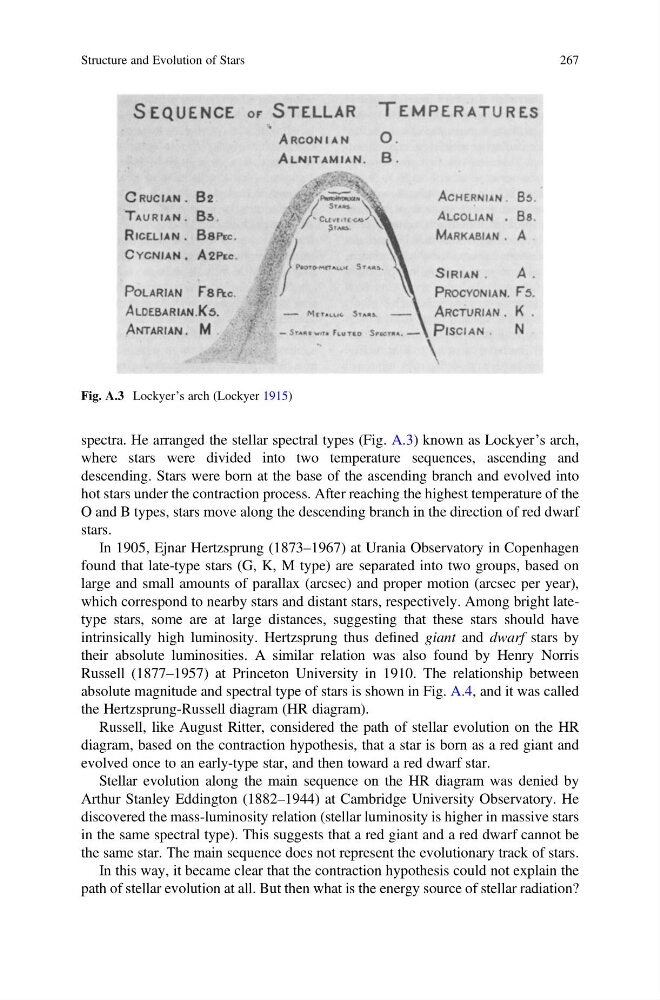
spectra. He arranged the stellar spectral types (Fig. A.3) known as Lockyer’s arch,
where stars were divided into two temperature sequences, ascending and
descending. Stars were born at the base of the ascending branch and evolved into
hot stars under the contraction process. After reaching the highest temperature of the
O and B types, stars move along the descending branch in the direction of red dwarf
stars.
In 1905, Ejnar Hertzsprung (1873–1967) at Urania Observatory in Copenhagen
found that late-type stars (G, K, M type) are separated into two groups, based on
large and small amounts of parallax (arcsec) and proper motion (arcsec per year),
which correspond to nearby stars and distant stars, respectively. Among bright latetype stars, some are at large distances, suggesting that these stars should have
intrinsically high luminosity. Hertzsprung thus defined giant and dwarf stars by
their absolute luminosities. A similar relation was also found by Henry Norris
Russell (1877–1957) at Princeton University in 1910. The relationship between
absolute magnitude and spectral type of stars is shown in Fig. A.4, and it was called
the Hertzsprung-Russell diagram (HR diagram).
Russell, like August Ritter, considered the path of stellar evolution on the HR
diagram, based on the contraction hypothesis, that a star is born as a red giant and
evolved once to an early-type star, and then toward a red dwarf star.
Stellar evolution along the main sequence on the HR diagram was denied by
Arthur Stanley Eddington (1882–1944) at Cambridge University Observatory. He
discovered the mass-luminosity relation (stellar luminosity is higher in massive stars
in the same spectral type). This suggests that a red giant and a red dwarf cannot be
the same star. The main sequence does not represent the evolutionary track of stars.
In this way, it became clear that the contraction hypothesis could not explain the
path of stellar evolution at all. But then what is the energy source of stellar radiation?
Fig. A.3 Lockyer’s arch (Lockyer 1915)
Structure and Evolution of Stars
267
where stars were divided into two temperature sequences, ascending and
descending. Stars were born at the base of the ascending branch and evolved into
hot stars under the contraction process. After reaching the highest temperature of the
O and B types, stars move along the descending branch in the direction of red dwarf
stars.
In 1905, Ejnar Hertzsprung (1873–1967) at Urania Observatory in Copenhagen
found that late-type stars (G, K, M type) are separated into two groups, based on
large and small amounts of parallax (arcsec) and proper motion (arcsec per year),
which correspond to nearby stars and distant stars, respectively. Among bright latetype stars, some are at large distances, suggesting that these stars should have
intrinsically high luminosity. Hertzsprung thus defined giant and dwarf stars by
their absolute luminosities. A similar relation was also found by Henry Norris
Russell (1877–1957) at Princeton University in 1910. The relationship between
absolute magnitude and spectral type of stars is shown in Fig. A.4, and it was called
the Hertzsprung-Russell diagram (HR diagram).
Russell, like August Ritter, considered the path of stellar evolution on the HR
diagram, based on the contraction hypothesis, that a star is born as a red giant and
evolved once to an early-type star, and then toward a red dwarf star.
Stellar evolution along the main sequence on the HR diagram was denied by
Arthur Stanley Eddington (1882–1944) at Cambridge University Observatory. He
discovered the mass-luminosity relation (stellar luminosity is higher in massive stars
in the same spectral type). This suggests that a red giant and a red dwarf cannot be
the same star. The main sequence does not represent the evolutionary track of stars.
In this way, it became clear that the contraction hypothesis could not explain the
path of stellar evolution at all. But then what is the energy source of stellar radiation?
Fig. A.3 Lockyer’s arch (Lockyer 1915)
Structure and Evolution of Stars
267