

Structure and Evolution of Stars
The idea that the Sun is a gaseous body was inspired by Scottish physicist John
James Waterstone (1811–1883), along with German medical doctor Julius Robert
von Mayer (1814–1873). Waterstone claimed in 1845 that the Sun was brightening
by its own gravitational contraction, while Mayer suggested in the same year that the
infalling of small bodies, like comets and asteroids, onto the solar surface represents
the origin of solar energy. Waterstone’s contraction hypothesis had been advocated
by a physiologist and a proponent of energy-conservation law, Hermann von
Helmholtz (1821–1894), so the name of Waterstone was replaced by Helmholtz.
Helmholtz supposed that a star was born as a bright white star that evolved into a
small red star through gravitational contraction. This one-way evolution was widely
accepted throughout the nineteenth century.
Jonathan Homer Lane (1819–1880), an examiner at the Patent Office in
Washington, D.C., derived the mathematical equations on the internal structure of
the Sun in 1870 and numerically solved them in some typical cases, in which he
suggested that the central temperature of the Sun should be higher than one million
degrees.
In 1907, Robert Emden (1862–1940), a Swiss physicist at the University of
Munich, verified Lane’s theoretical study on the the stellar structure in a state of
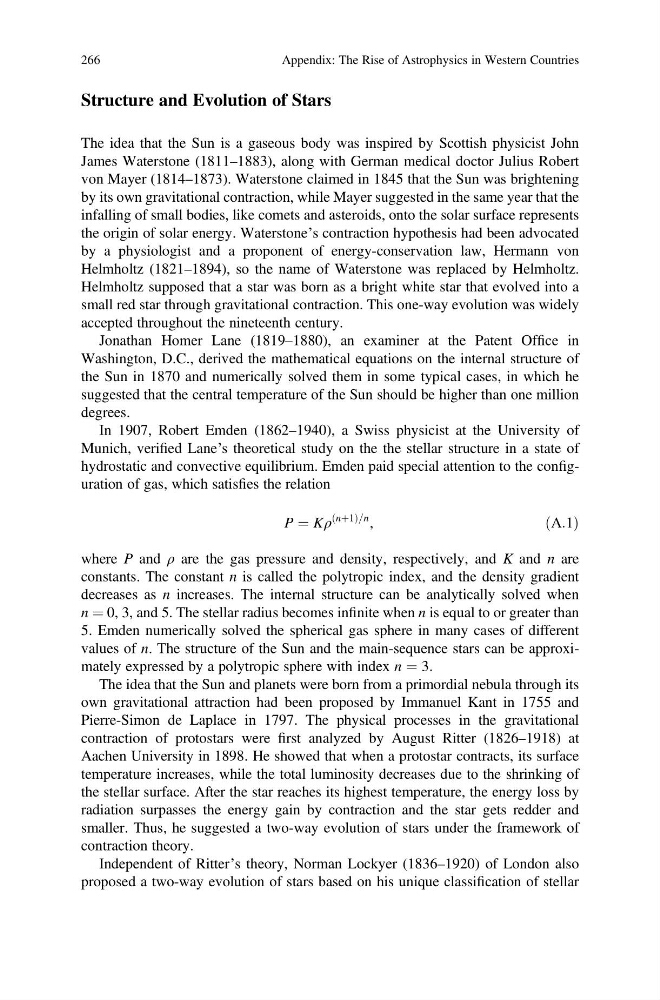
hydrostatic and convective equilibrium. Emden paid special attention to the configuration of gas, which satisfies the relation
P ¼ Kρ
nþ1
ð
Þ=n ,
ðA:1Þ
where P and ρ are the gas pressure and density, respectively, and K and n are
constants. The constant n is called the polytropic index, and the density gradient
decreases as n increases. The internal structure can be analytically solved when
n ¼ 0, 3, and 5. The stellar radius becomes infinite when n is equal to or greater than
5. Emden numerically solved the spherical gas sphere in many cases of different
values of n. The structure of the Sun and the main-sequence stars can be approximately expressed by a polytropic sphere with index n ¼ 3.
The idea that the Sun and planets were born from a primordial nebula through its
own gravitational attraction had been proposed by Immanuel Kant in 1755 and
Pierre-Simon de Laplace in 1797. The physical processes in the gravitational
contraction of protostars were first analyzed by August Ritter (1826–1918) at
Aachen University in 1898. He showed that when a protostar contracts, its surface
temperature increases, while the total luminosity decreases due to the shrinking of
the stellar surface. After the star reaches its highest temperature, the energy loss by
radiation surpasses the energy gain by contraction and the star gets redder and
smaller. Thus, he suggested a two-way evolution of stars under the framework of
contraction theory.
Independent of Ritter’s theory, Norman Lockyer (1836–1920) of London also
proposed a two-way evolution of stars based on his unique classification of stellar
266
Appendix: The Rise of Astrophysics in Western Countries
The idea that the Sun is a gaseous body was inspired by Scottish physicist John
James Waterstone (1811–1883), along with German medical doctor Julius Robert
von Mayer (1814–1873). Waterstone claimed in 1845 that the Sun was brightening
by its own gravitational contraction, while Mayer suggested in the same year that the
infalling of small bodies, like comets and asteroids, onto the solar surface represents
the origin of solar energy. Waterstone’s contraction hypothesis had been advocated
by a physiologist and a proponent of energy-conservation law, Hermann von
Helmholtz (1821–1894), so the name of Waterstone was replaced by Helmholtz.
Helmholtz supposed that a star was born as a bright white star that evolved into a
small red star through gravitational contraction. This one-way evolution was widely
accepted throughout the nineteenth century.
Jonathan Homer Lane (1819–1880), an examiner at the Patent Office in
Washington, D.C., derived the mathematical equations on the internal structure of
the Sun in 1870 and numerically solved them in some typical cases, in which he
suggested that the central temperature of the Sun should be higher than one million
degrees.
In 1907, Robert Emden (1862–1940), a Swiss physicist at the University of
Munich, verified Lane’s theoretical study on the the stellar structure in a state of
hydrostatic and convective equilibrium. Emden paid special attention to the configuration of gas, which satisfies the relation
P ¼ Kρ
nþ1
ð
Þ=n ,
ðA:1Þ
where P and ρ are the gas pressure and density, respectively, and K and n are
constants. The constant n is called the polytropic index, and the density gradient
decreases as n increases. The internal structure can be analytically solved when
n ¼ 0, 3, and 5. The stellar radius becomes infinite when n is equal to or greater than
5. Emden numerically solved the spherical gas sphere in many cases of different
values of n. The structure of the Sun and the main-sequence stars can be approximately expressed by a polytropic sphere with index n ¼ 3.
The idea that the Sun and planets were born from a primordial nebula through its
own gravitational attraction had been proposed by Immanuel Kant in 1755 and
Pierre-Simon de Laplace in 1797. The physical processes in the gravitational
contraction of protostars were first analyzed by August Ritter (1826–1918) at
Aachen University in 1898. He showed that when a protostar contracts, its surface
temperature increases, while the total luminosity decreases due to the shrinking of
the stellar surface. After the star reaches its highest temperature, the energy loss by
radiation surpasses the energy gain by contraction and the star gets redder and
smaller. Thus, he suggested a two-way evolution of stars under the framework of
contraction theory.
Independent of Ritter’s theory, Norman Lockyer (1836–1920) of London also
proposed a two-way evolution of stars based on his unique classification of stellar
266
Appendix: The Rise of Astrophysics in Western Countries