

R – N
/
O – B – A – F – G – K – M
S
Stellar photometry was carried out by Pickering himself and the fourth woman
computer, Henrietta Leavitt (1868–1921).
Pickering’s first project was the establishment of a photometric system of stars,
using a visual photometer that he himself had invented. In 1879, he determined, with
unprecedented accuracy, the stellar magnitude of 80,000 stars.
The photographic photometry of stars was advanced by Leavitt. In 1909, she
began to measure the photographic magnitudes of a sequence of 47 stars near the
North Pole. Her work was completed as the North Polar Sequence, which became a
standard reference on photographic photometry applicable to any region of the sky.
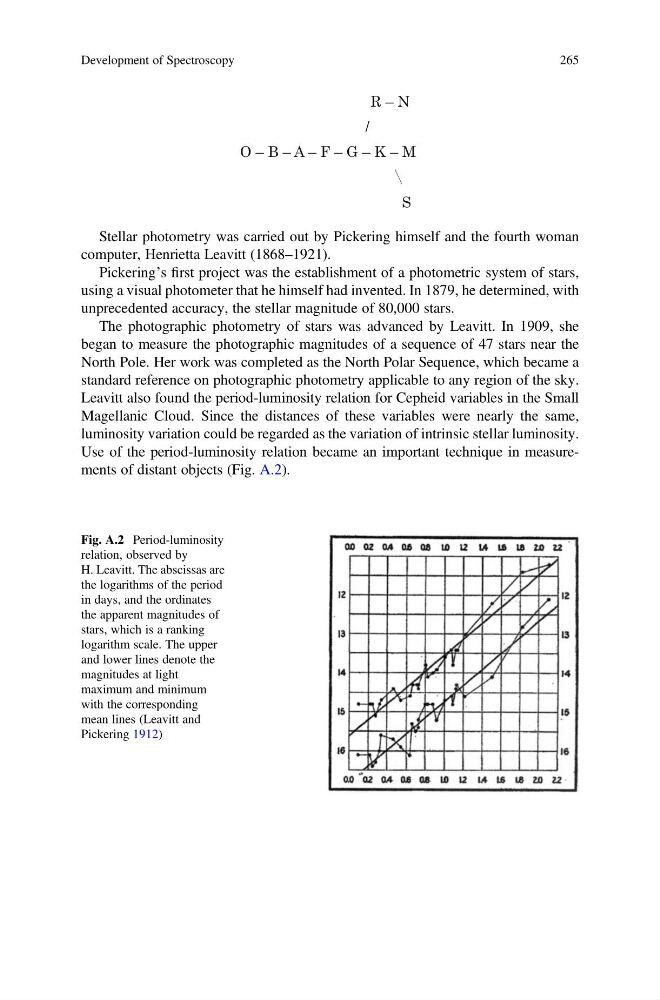
Leavitt also found the period-luminosity relation for Cepheid variables in the Small
Magellanic Cloud. Since the distances of these variables were nearly the same,
luminosity variation could be regarded as the variation of intrinsic stellar luminosity.
Use of the period-luminosity relation became an important technique in measurements of distant objects (Fig. A.2).
Fig. A.2 Period-luminosity
relation, observed by
H. Leavitt. The abscissas are
the logarithms of the period
in days, and the ordinates
the apparent magnitudes of
stars, which is a ranking
logarithm scale. The upper
and lower lines denote the
magnitudes at light
maximum and minimum
with the corresponding
mean lines (Leavitt and
Pickering 1912)
Development of Spectroscopy
265
/
O – B – A – F – G – K – M
S
Stellar photometry was carried out by Pickering himself and the fourth woman
computer, Henrietta Leavitt (1868–1921).
Pickering’s first project was the establishment of a photometric system of stars,
using a visual photometer that he himself had invented. In 1879, he determined, with
unprecedented accuracy, the stellar magnitude of 80,000 stars.
The photographic photometry of stars was advanced by Leavitt. In 1909, she
began to measure the photographic magnitudes of a sequence of 47 stars near the
North Pole. Her work was completed as the North Polar Sequence, which became a
standard reference on photographic photometry applicable to any region of the sky.
Leavitt also found the period-luminosity relation for Cepheid variables in the Small
Magellanic Cloud. Since the distances of these variables were nearly the same,
luminosity variation could be regarded as the variation of intrinsic stellar luminosity.
Use of the period-luminosity relation became an important technique in measurements of distant objects (Fig. A.2).
Fig. A.2 Period-luminosity
relation, observed by
H. Leavitt. The abscissas are
the logarithms of the period
in days, and the ordinates
the apparent magnitudes of
stars, which is a ranking
logarithm scale. The upper
and lower lines denote the
magnitudes at light
maximum and minimum
with the corresponding
mean lines (Leavitt and
Pickering 1912)
Development of Spectroscopy
265