

photographic spectral plates. In the 1870s, son Henry constructed a private observatory, equipped with a 70-cm reflector, and carried out photographic observations
of the Orion nebula and spectroscopic observations of several tens of stars.
Henry’s spectroscopic works were followed up by Edward C. Pickering (1846–
1919) at the Harvard College Observatory (HCO) in Cambridge, Massachusetts.
Pickering organized two big projects: the stellar photometry and the spectral classification of stars, both in a wide field of the sky. For these purposes, Pickering hired
many women computers (assistants) at the HCO.
The first woman computer was Williamina P. Fleming (1857–1911), who carried
out the spectral classifications of stars based on objective-prism spectrograms.
Photographic images made it possible to classify stellar spectra more precisely
compared to the classifications of Secchi and Vogel, which were based on sketched
spectra. Fleming and Pickering classified spectra using new symbols, A, B, . . . .
M. New classifications for around 10,000 stars were published as the “Henry Draper
Memorial Catalogue” under the names Pickering and Fleming in 1890.
Antonia Maury (1866–1952), the second woman computer, promoted her own
classification scheme in Pickering’s project. Maury paid special attention to the
width of spectral lines on her high-dispersion spectra in 1902. She arranged the
spectral classes as I, II, III, . . ., XXII in the order of stellar effective temperature and
the three divisions a, b, c due to the width of the line. Division c was defined by sharp
absorption lines of hydrogen and helium. The c characteristic was soon confirmed by
Ejnar Hertzsprung in 1905 as the spectral characteristics of giant stars.
Annie Jump Cannon (1863–1941), the third woman astronomer, took over
Fleming’s scheme with some amendments. She energetically classified more than
200,000 stars in the northern and southern hemispheres of the sky. The results were
published in nine volumes between 1918 and 1924 as the Henry Draper Catalogue.
Cannon’s classification was adopted as the standard system at the General Assembly
of the International Astronomical Union (IAU) held in Rome in 1922. Her system,
with some modification, is given as follows:
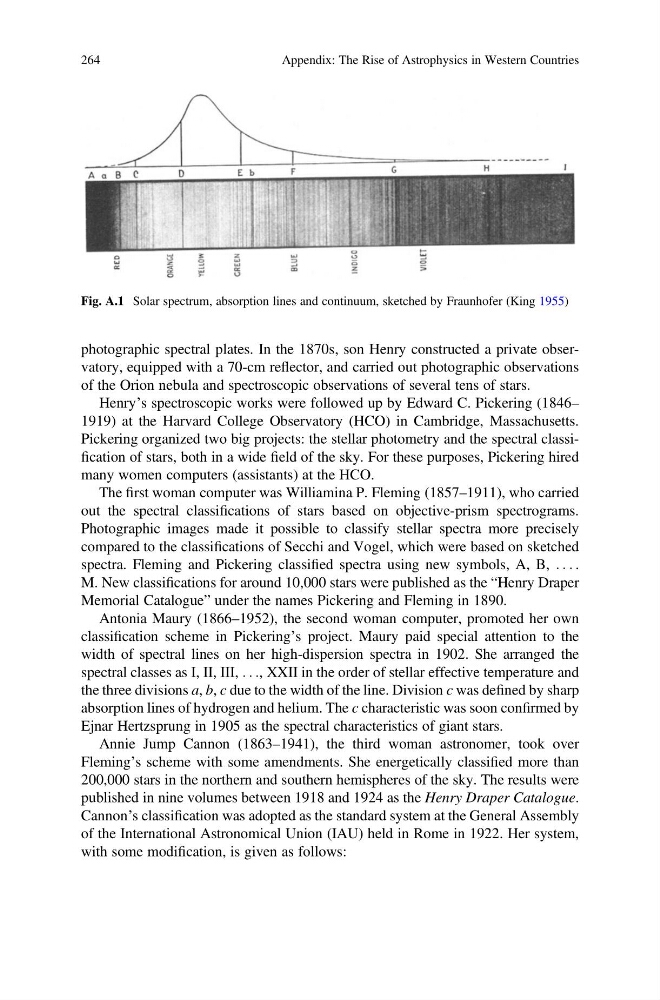
Fig. A.1 Solar spectrum, absorption lines and continuum, sketched by Fraunhofer (King 1955)
264
Appendix: The Rise of Astrophysics in Western Countries
of the Orion nebula and spectroscopic observations of several tens of stars.
Henry’s spectroscopic works were followed up by Edward C. Pickering (1846–
1919) at the Harvard College Observatory (HCO) in Cambridge, Massachusetts.
Pickering organized two big projects: the stellar photometry and the spectral classification of stars, both in a wide field of the sky. For these purposes, Pickering hired
many women computers (assistants) at the HCO.
The first woman computer was Williamina P. Fleming (1857–1911), who carried
out the spectral classifications of stars based on objective-prism spectrograms.
Photographic images made it possible to classify stellar spectra more precisely
compared to the classifications of Secchi and Vogel, which were based on sketched
spectra. Fleming and Pickering classified spectra using new symbols, A, B, . . . .
M. New classifications for around 10,000 stars were published as the “Henry Draper
Memorial Catalogue” under the names Pickering and Fleming in 1890.
Antonia Maury (1866–1952), the second woman computer, promoted her own
classification scheme in Pickering’s project. Maury paid special attention to the
width of spectral lines on her high-dispersion spectra in 1902. She arranged the
spectral classes as I, II, III, . . ., XXII in the order of stellar effective temperature and
the three divisions a, b, c due to the width of the line. Division c was defined by sharp
absorption lines of hydrogen and helium. The c characteristic was soon confirmed by
Ejnar Hertzsprung in 1905 as the spectral characteristics of giant stars.
Annie Jump Cannon (1863–1941), the third woman astronomer, took over
Fleming’s scheme with some amendments. She energetically classified more than
200,000 stars in the northern and southern hemispheres of the sky. The results were
published in nine volumes between 1918 and 1924 as the Henry Draper Catalogue.
Cannon’s classification was adopted as the standard system at the General Assembly
of the International Astronomical Union (IAU) held in Rome in 1922. Her system,
with some modification, is given as follows:
Fig. A.1 Solar spectrum, absorption lines and continuum, sketched by Fraunhofer (King 1955)
264
Appendix: The Rise of Astrophysics in Western Countries