

In 1926, Eddington suggested the possibility of subatomic processes in some form,
such as in the formation of heavy elements from light elements (nuclear fusion),
mass annihilation by the collision of electrons with positively charged particles, and
the destruction of heavy elements (radioactive elements). Subramanyan Chandrasekhar (1910–1995), who discovered the existence of an upper limit of mass for white
dwarf stars, also worked in the early 1930s on the structure and evolution of stars.
Thermonuclear reaction cycles were found by Hans Albrecht Bethe (1906–2005)
at Cornell University in Ithaca, New York, in 1937, and by Carl Friedrich von
Weizsäcker (1912–2007) at Berlin University in Berlin, Germany, in 1938, independently. These works became the starting points of the modern theory of stellar
evolution in the 1940s and thereafter.
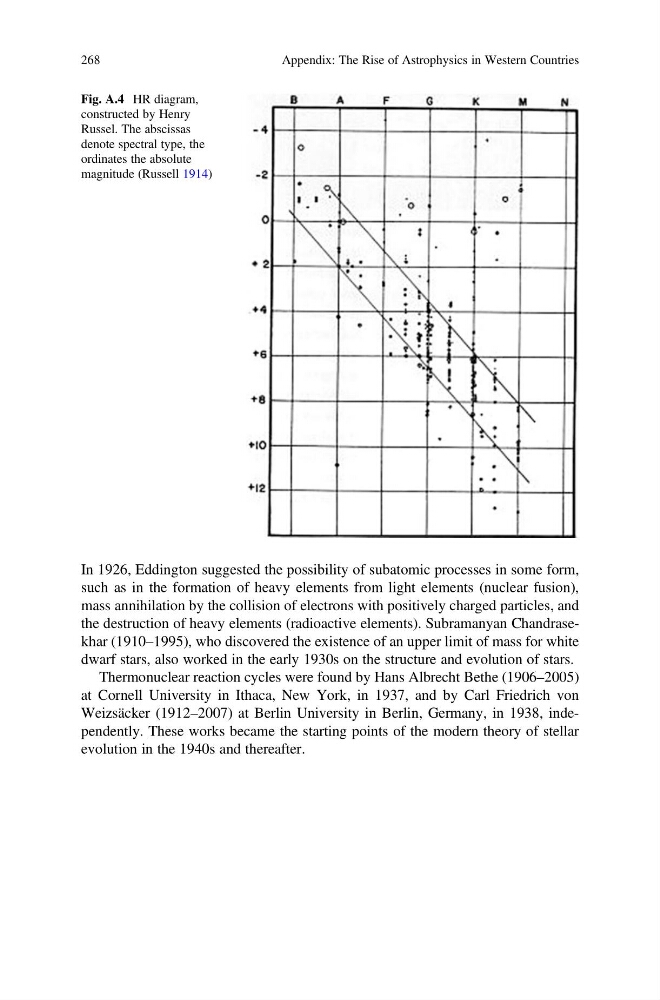
Fig. A.4 HR diagram,
constructed by Henry
Russel. The abscissas
denote spectral type, the
ordinates the absolute
magnitude (Russell 1914)
268
Appendix: The Rise of Astrophysics in Western Countries
such as in the formation of heavy elements from light elements (nuclear fusion),
mass annihilation by the collision of electrons with positively charged particles, and
the destruction of heavy elements (radioactive elements). Subramanyan Chandrasekhar (1910–1995), who discovered the existence of an upper limit of mass for white
dwarf stars, also worked in the early 1930s on the structure and evolution of stars.
Thermonuclear reaction cycles were found by Hans Albrecht Bethe (1906–2005)
at Cornell University in Ithaca, New York, in 1937, and by Carl Friedrich von
Weizsäcker (1912–2007) at Berlin University in Berlin, Germany, in 1938, independently. These works became the starting points of the modern theory of stellar
evolution in the 1940s and thereafter.
Fig. A.4 HR diagram,
constructed by Henry
Russel. The abscissas
denote spectral type, the
ordinates the absolute
magnitude (Russell 1914)
268
Appendix: The Rise of Astrophysics in Western Countries