

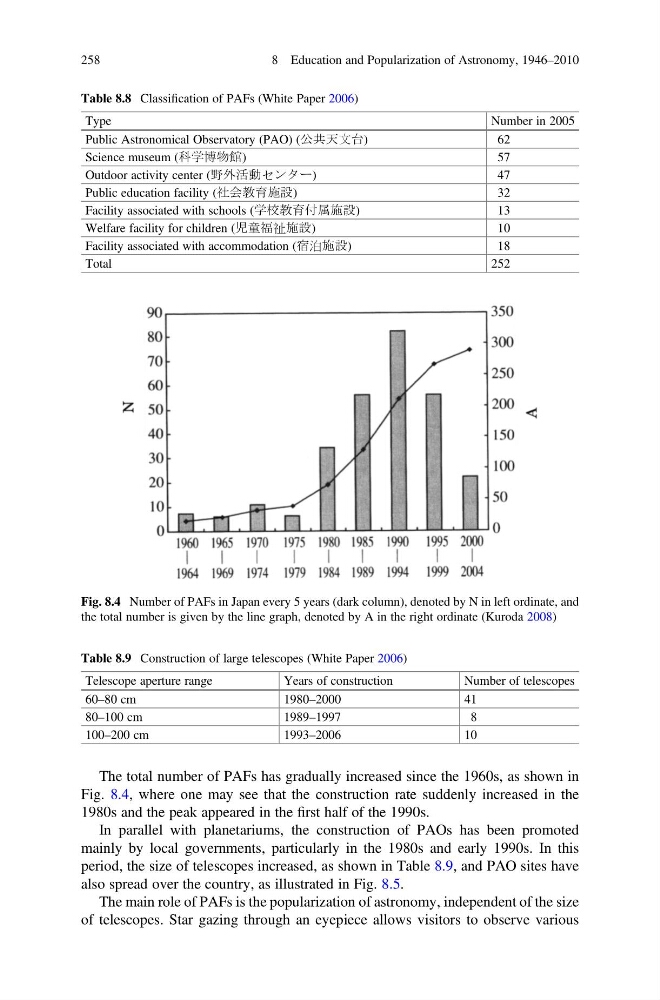
The total number of PAFs has gradually increased since the 1960s, as shown in
Fig. 8.4, where one may see that the construction rate suddenly increased in the
1980s and the peak appeared in the first half of the 1990s.
In parallel with planetariums, the construction of PAOs has been promoted
mainly by local governments, particularly in the 1980s and early 1990s. In this
period, the size of telescopes increased, as shown in Table 8.9, and PAO sites have
also spread over the country, as illustrated in Fig. 8.5.
The main role of PAFs is the popularization of astronomy, independent of the size
of telescopes. Star gazing through an eyepiece allows visitors to observe various
Table 8.8 Classification of PAFs (White Paper 2006)
Type
Number in 2005
Public Astronomical Observatory (PAO) (公共天文台)
6 2
Science museum (科学博物館)
5 7
Outdoor activity center (野外活動センター)
4 7
Public education facility (社会教育施設)
3 2
Facility associated with schools (学校教育付属施設)
1 3
Welfare facility for children (児童福祉施設)
1 0
Facility associated with accommodation (宿泊施設)
1 8
Total
252
Fig. 8.4 Number of PAFs in Japan every 5 years (dark column), denoted by N in left ordinate, and
the total number is given by the line graph, denoted by A in the right ordinate (Kuroda 2008)
Table 8.9 Construction of large telescopes (White Paper 2006)
Telescope aperture range
Years of construction
Number of telescopes
60–80 cm
1980–2000
41
80–100 cm
1989–1997
8
100–200 cm
1993–2006
10
258
8 Education and Popularization of Astronomy, 1946–2010
Fig. 8.4, where one may see that the construction rate suddenly increased in the
1980s and the peak appeared in the first half of the 1990s.
In parallel with planetariums, the construction of PAOs has been promoted
mainly by local governments, particularly in the 1980s and early 1990s. In this
period, the size of telescopes increased, as shown in Table 8.9, and PAO sites have
also spread over the country, as illustrated in Fig. 8.5.
The main role of PAFs is the popularization of astronomy, independent of the size
of telescopes. Star gazing through an eyepiece allows visitors to observe various
Table 8.8 Classification of PAFs (White Paper 2006)
Type
Number in 2005
Public Astronomical Observatory (PAO) (公共天文台)
6 2
Science museum (科学博物館)
5 7
Outdoor activity center (野外活動センター)
4 7
Public education facility (社会教育施設)
3 2
Facility associated with schools (学校教育付属施設)
1 3
Welfare facility for children (児童福祉施設)
1 0
Facility associated with accommodation (宿泊施設)
1 8
Total
252
Fig. 8.4 Number of PAFs in Japan every 5 years (dark column), denoted by N in left ordinate, and
the total number is given by the line graph, denoted by A in the right ordinate (Kuroda 2008)
Table 8.9 Construction of large telescopes (White Paper 2006)
Telescope aperture range
Years of construction
Number of telescopes
60–80 cm
1980–2000
41
80–100 cm
1989–1997
8
100–200 cm
1993–2006
10
258
8 Education and Popularization of Astronomy, 1946–2010