

astronomical phenomena. Larger telescopes can reach deeper skies. The telescope
size has gradually increased, as seen earlier.
Most of the telescopes in Table 8.9 are equipped with observational devices such
as charge-coupled device (CCD) cameras, video cameras, photoelectric photometers, and spectrographs with cooled CCD detectors. They allow for astrophysical
observations of various celestial objects such as comets, planetary surfaces, variable
stars, novae, supernovae, and galaxies, often in collaboration with universities,
NAOJ, and the Astronomical Society of Japan. These observations take place in
parallel with ordinary popularization activities.
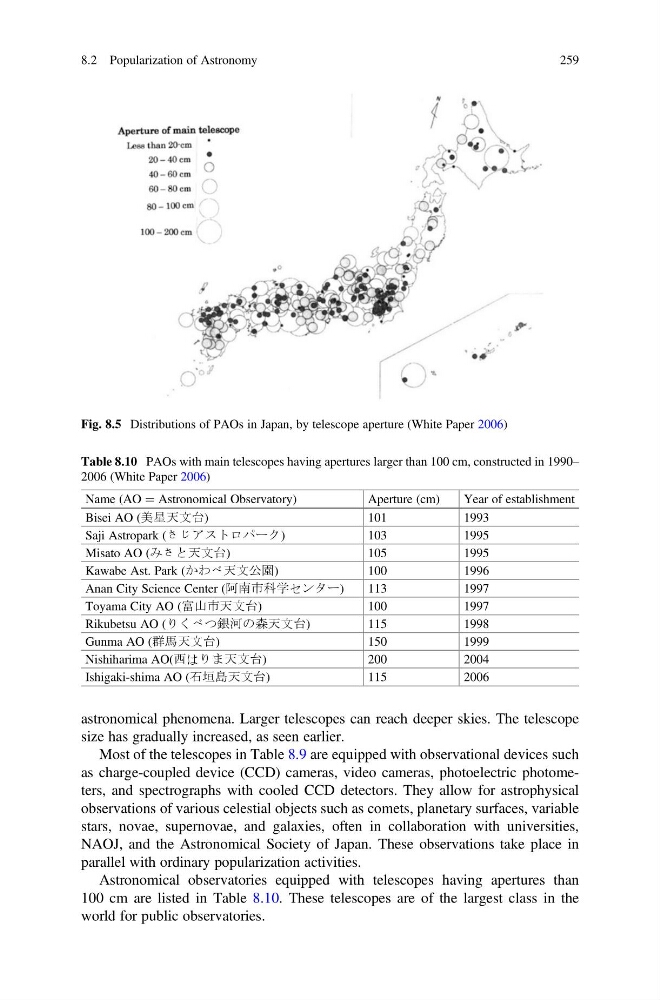
Astronomical observatories equipped with telescopes having apertures than
100 cm are listed in Table 8.10. These telescopes are of the largest class in the
world for public observatories.
Fig. 8.5 Distributions of PAOs in Japan, by telescope aperture (White Paper 2006)
Table 8.10 PAOs with main telescopes having apertures larger than 100 cm, constructed in 1990–
2006 (White Paper 2006)
Name (AO ¼ Astronomical Observatory)
Aperture (cm)
Year of establishment
Bisei AO (美星天文台)
101
1993
Saji Astropark (さじアストロパーク)
103
1995
Misato AO (みさと天文台)
105
1995
Kawabe Ast. Park (かわべ天文公園)
100
1996
Anan City Science Center (阿南市科学センター)
113
1997
Toyama City AO (富山市天文台)
100
1997
Rikubetsu AO (りくべつ銀河の森天文台)
115
1998
Gunma AO (群馬天文台)
150
1999
Nishiharima AO(西はりま天文台)
200
2004
Ishigaki-shima AO (石垣島天文台)
115
2006
8.2 Popularization of Astronomy
259
size has gradually increased, as seen earlier.
Most of the telescopes in Table 8.9 are equipped with observational devices such
as charge-coupled device (CCD) cameras, video cameras, photoelectric photometers, and spectrographs with cooled CCD detectors. They allow for astrophysical
observations of various celestial objects such as comets, planetary surfaces, variable
stars, novae, supernovae, and galaxies, often in collaboration with universities,
NAOJ, and the Astronomical Society of Japan. These observations take place in
parallel with ordinary popularization activities.
Astronomical observatories equipped with telescopes having apertures than
100 cm are listed in Table 8.10. These telescopes are of the largest class in the
world for public observatories.
Fig. 8.5 Distributions of PAOs in Japan, by telescope aperture (White Paper 2006)
Table 8.10 PAOs with main telescopes having apertures larger than 100 cm, constructed in 1990–
2006 (White Paper 2006)
Name (AO ¼ Astronomical Observatory)
Aperture (cm)
Year of establishment
Bisei AO (美星天文台)
101
1993
Saji Astropark (さじアストロパーク)
103
1995
Misato AO (みさと天文台)
105
1995
Kawabe Ast. Park (かわべ天文公園)
100
1996
Anan City Science Center (阿南市科学センター)
113
1997
Toyama City AO (富山市天文台)
100
1997
Rikubetsu AO (りくべつ銀河の森天文台)
115
1998
Gunma AO (群馬天文台)
150
1999
Nishiharima AO(西はりま天文台)
200
2004
Ishigaki-shima AO (石垣島天文台)
115
2006
8.2 Popularization of Astronomy
259