

8.2.2 Public Astronomical Observatories
A public astronomical observatory (PAO) is a facility with a dome, a telescope, and
some observational devices that is open to the public for star gazing. In addition PAO
often provides the observational devices such as CCD camera, photometer and
spectrograph for astrophysical observations by advanced visitors.
In Japan, the first PAO was the Kurashiki Observatory (倉敷天文台) with a 32-cm
reflector in the city of Kurashiki, which opened in 1926. The second was the Ikoma
Astronomical Museum (生駒天文博物館) with a 60-cm reflector, which opened in
1936. Both facilities were established under the guidance of Yamamoto Issei of Kyoto
University (Chap. 4). In 1941, Yamaguchi Museum (山口博物館), equipped with a
10-cm refractor, was established by the local government of Yamaguchi Prefecture.
Since the postwar period various types of public observatories have been
established. According to a survey conducted by the Japan Public Observatory
Society (JAPOS), the types can be classified as given in Table 8.8 (White Paper
2006). In this table, the PAOs are included in the public astronomical facilities
(PAFs). PAOs, however, are distinguished by certain advanced astronomical equipment and relatively large telescopes.
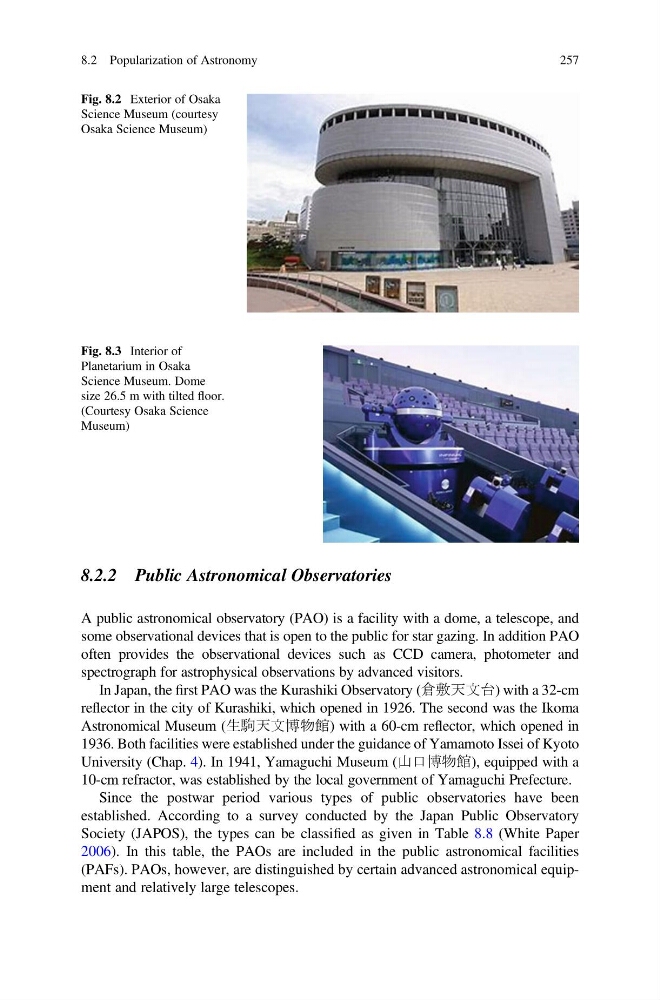
Fig. 8.2 Exterior of Osaka
Science Museum (courtesy
Osaka Science Museum)
Fig. 8.3 Interior of
Planetarium in Osaka
Science Museum. Dome
size 26.5 m with tilted floor.
(Courtesy Osaka Science
Museum)
8.2 Popularization of Astronomy
257
A public astronomical observatory (PAO) is a facility with a dome, a telescope, and
some observational devices that is open to the public for star gazing. In addition PAO
often provides the observational devices such as CCD camera, photometer and
spectrograph for astrophysical observations by advanced visitors.
In Japan, the first PAO was the Kurashiki Observatory (倉敷天文台) with a 32-cm
reflector in the city of Kurashiki, which opened in 1926. The second was the Ikoma
Astronomical Museum (生駒天文博物館) with a 60-cm reflector, which opened in
1936. Both facilities were established under the guidance of Yamamoto Issei of Kyoto
University (Chap. 4). In 1941, Yamaguchi Museum (山口博物館), equipped with a
10-cm refractor, was established by the local government of Yamaguchi Prefecture.
Since the postwar period various types of public observatories have been
established. According to a survey conducted by the Japan Public Observatory
Society (JAPOS), the types can be classified as given in Table 8.8 (White Paper
2006). In this table, the PAOs are included in the public astronomical facilities
(PAFs). PAOs, however, are distinguished by certain advanced astronomical equipment and relatively large telescopes.
Fig. 8.2 Exterior of Osaka
Science Museum (courtesy
Osaka Science Museum)
Fig. 8.3 Interior of
Planetarium in Osaka
Science Museum. Dome
size 26.5 m with tilted floor.
(Courtesy Osaka Science
Museum)
8.2 Popularization of Astronomy
257