

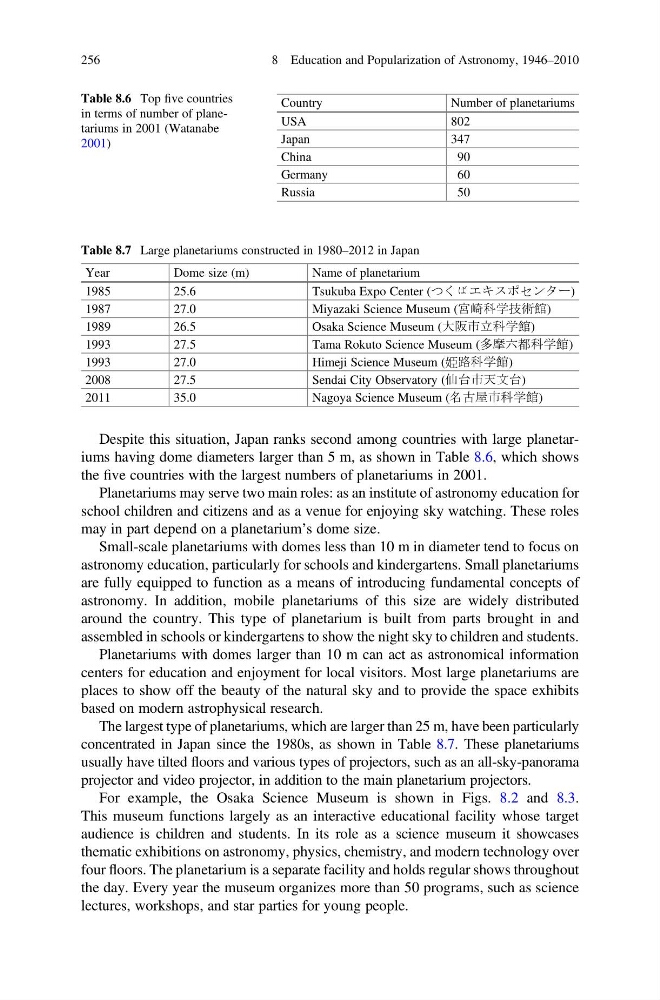
Despite this situation, Japan ranks second among countries with large planetariums having dome diameters larger than 5 m, as shown in Table 8.6, which shows
the five countries with the largest numbers of planetariums in 2001.
Planetariums may serve two main roles: as an institute of astronomy education for
school children and citizens and as a venue for enjoying sky watching. These roles
may in part depend on a planetarium’s dome size.
Small-scale planetariums with domes less than 10 m in diameter tend to focus on
astronomy education, particularly for schools and kindergartens. Small planetariums
are fully equipped to function as a means of introducing fundamental concepts of
astronomy. In addition, mobile planetariums of this size are widely distributed
around the country. This type of planetarium is built from parts brought in and
assembled in schools or kindergartens to show the night sky to children and students.
Planetariums with domes larger than 10 m can act as astronomical information
centers for education and enjoyment for local visitors. Most large planetariums are
places to show off the beauty of the natural sky and to provide the space exhibits
based on modern astrophysical research.
The largest type of planetariums, which are larger than 25 m, have been particularly
concentrated in Japan since the 1980s, as shown in Table 8.7. These planetariums
usually have tilted floors and various types of projectors, such as an all-sky-panorama
projector and video projector, in addition to the main planetarium projectors.
For example, the Osaka Science Museum is shown in Figs. 8.2 and 8.3.
This museum functions largely as an interactive educational facility whose target
audience is children and students. In its role as a science museum it showcases
thematic exhibitions on astronomy, physics, chemistry, and modern technology over
four floors. The planetarium is a separate facility and holds regular shows throughout
the day. Every year the museum organizes more than 50 programs, such as science
lectures, workshops, and star parties for young people.
Table 8.6 Top five countries
in terms of number of planetariums in 2001 (Watanabe
2001)
Country
Number of planetariums
USA
802
Japan
347
China
90
Germany
60
Russia
50
Table 8.7 Large planetariums constructed in 1980–2012 in Japan
Year
Dome size (m)
Name of planetarium
1985
25.6
Tsukuba Expo Center (つくばエキスポセンター)
1987
27.0
Miyazaki Science Museum (宮崎科学技術館)
1989
26.5
Osaka Science Museum (大阪市立科学館)
1993
27.5
Tama Rokuto Science Museum (多摩六都科学館)
1993
27.0
Himeji Science Museum (姫路科学館)
2008
27.5
Sendai City Observatory (仙台市天文台)
2011
35.0
Nagoya Science Museum (名古屋市科学館)
256
8 Education and Popularization of Astronomy, 1946–2010
the five countries with the largest numbers of planetariums in 2001.
Planetariums may serve two main roles: as an institute of astronomy education for
school children and citizens and as a venue for enjoying sky watching. These roles
may in part depend on a planetarium’s dome size.
Small-scale planetariums with domes less than 10 m in diameter tend to focus on
astronomy education, particularly for schools and kindergartens. Small planetariums
are fully equipped to function as a means of introducing fundamental concepts of
astronomy. In addition, mobile planetariums of this size are widely distributed
around the country. This type of planetarium is built from parts brought in and
assembled in schools or kindergartens to show the night sky to children and students.
Planetariums with domes larger than 10 m can act as astronomical information
centers for education and enjoyment for local visitors. Most large planetariums are
places to show off the beauty of the natural sky and to provide the space exhibits
based on modern astrophysical research.
The largest type of planetariums, which are larger than 25 m, have been particularly
concentrated in Japan since the 1980s, as shown in Table 8.7. These planetariums
usually have tilted floors and various types of projectors, such as an all-sky-panorama
projector and video projector, in addition to the main planetarium projectors.
For example, the Osaka Science Museum is shown in Figs. 8.2 and 8.3.
This museum functions largely as an interactive educational facility whose target
audience is children and students. In its role as a science museum it showcases
thematic exhibitions on astronomy, physics, chemistry, and modern technology over
four floors. The planetarium is a separate facility and holds regular shows throughout
the day. Every year the museum organizes more than 50 programs, such as science
lectures, workshops, and star parties for young people.
Table 8.6 Top five countries
in terms of number of planetariums in 2001 (Watanabe
2001)
Country
Number of planetariums
USA
802
Japan
347
China
90
Germany
60
Russia
50
Table 8.7 Large planetariums constructed in 1980–2012 in Japan
Year
Dome size (m)
Name of planetarium
1985
25.6
Tsukuba Expo Center (つくばエキスポセンター)
1987
27.0
Miyazaki Science Museum (宮崎科学技術館)
1989
26.5
Osaka Science Museum (大阪市立科学館)
1993
27.5
Tama Rokuto Science Museum (多摩六都科学館)
1993
27.0
Himeji Science Museum (姫路科学館)
2008
27.5
Sendai City Observatory (仙台市天文台)
2011
35.0
Nagoya Science Museum (名古屋市科学館)
256
8 Education and Popularization of Astronomy, 1946–2010