

survey from 2001, and the number of universities offering graduate courses in
astronomy and space science is shown. The universities are separated into three
types: national, public (established by local government), and private (Sawa 2005).
This table indicates that every year more than 60 new astronomers entered the
Japanese astronomical community in the fields of research and education. This
reflects the background of the development of astrophysics in the last quarter of
the twentieth century in Japan.
8.2 Popularization of Astronomy
8.2.1 Planetariums and Science Museums
Planetariums are theaters that bring the awe and wonder of the Universe to children
and citizens. Planetariums also act as the centers of science education.
In Japan, the first planetariums were built in Osaka (Osaka Electric Science
Museum, 大阪電気科学館) in 1937 and in Tokyo (Tonichi Astronomical Museum
東日天文館) in 1938. In the postwar era, the first planetarium was Goto Planetarium
(五島プラネタリウム), constructed in 1956 in Tokyo, and subsequent construction
has taken place since the 1960s. The number of planetarium facilities increased
almost in direct proportion to the country’s population growth. The diameters of
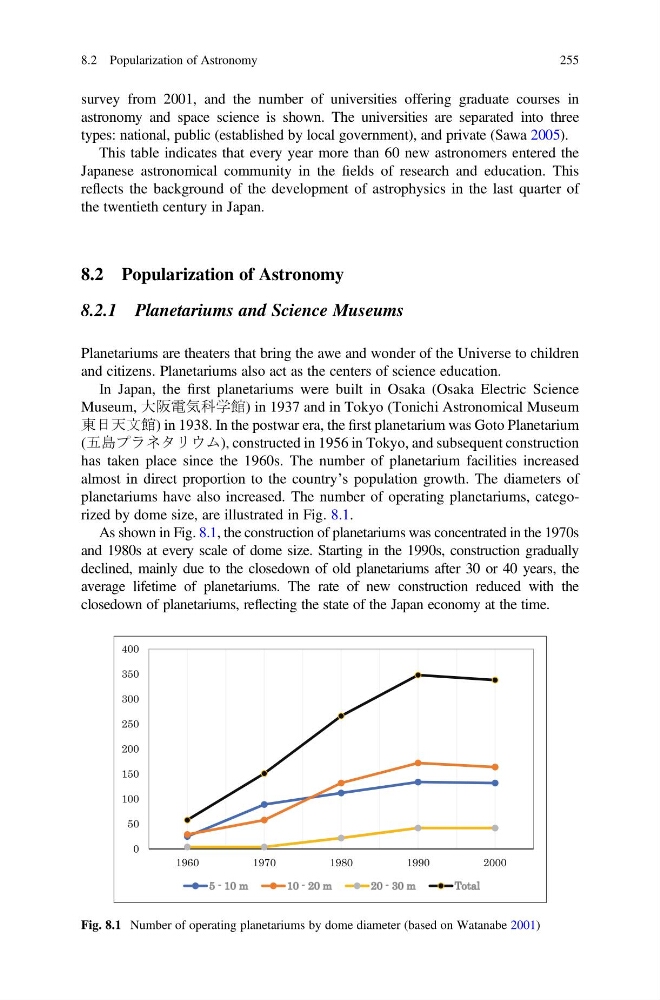
planetariums have also increased. The number of operating planetariums, categorized by dome size, are illustrated in Fig. 8.1.
As shown in Fig. 8.1, the construction of planetariums was concentrated in the 1970s
and 1980s at every scale of dome size. Starting in the 1990s, construction gradually
declined, mainly due to the closedown of old planetariums after 30 or 40 years, the
average lifetime of planetariums. The rate of new construction reduced with the
closedown of planetariums, reflecting the state of the Japan economy at the time.
0
50
100
150
200
250
300
350
400
1960
1970
1980
1990
2000
Fig. 8.1 Number of operating planetariums by dome diameter (based on Watanabe 2001)
8.2 Popularization of Astronomy
255
astronomy and space science is shown. The universities are separated into three
types: national, public (established by local government), and private (Sawa 2005).
This table indicates that every year more than 60 new astronomers entered the
Japanese astronomical community in the fields of research and education. This
reflects the background of the development of astrophysics in the last quarter of
the twentieth century in Japan.
8.2 Popularization of Astronomy
8.2.1 Planetariums and Science Museums
Planetariums are theaters that bring the awe and wonder of the Universe to children
and citizens. Planetariums also act as the centers of science education.
In Japan, the first planetariums were built in Osaka (Osaka Electric Science
Museum, 大阪電気科学館) in 1937 and in Tokyo (Tonichi Astronomical Museum
東日天文館) in 1938. In the postwar era, the first planetarium was Goto Planetarium
(五島プラネタリウム), constructed in 1956 in Tokyo, and subsequent construction
has taken place since the 1960s. The number of planetarium facilities increased
almost in direct proportion to the country’s population growth. The diameters of
planetariums have also increased. The number of operating planetariums, categorized by dome size, are illustrated in Fig. 8.1.
As shown in Fig. 8.1, the construction of planetariums was concentrated in the 1970s
and 1980s at every scale of dome size. Starting in the 1990s, construction gradually
declined, mainly due to the closedown of old planetariums after 30 or 40 years, the
average lifetime of planetariums. The rate of new construction reduced with the
closedown of planetariums, reflecting the state of the Japan economy at the time.
0
50
100
150
200
250
300
350
400
1960
1970
1980
1990
2000
Fig. 8.1 Number of operating planetariums by dome diameter (based on Watanabe 2001)
8.2 Popularization of Astronomy
255