

The results of the survey for each case are as follows:
(1) College of Liberal Arts
Among the 35 surveyed colleges, 13 (37%) had registered teachers of astronomy,
and the remaining 22 (63%) had none. In addition, astronomy experiments, such as
telescope handling and observations of solar and planetary surfaces, were carried out
at only three (8.6%) colleges. In every college, the number of astronomy courses was
quite low compared to other fields of science, like physics, chemistry, and biology.
(2) Faculty of Education
In the faculties of education, astronomy was a part of Earth science, which was one
of the compulsory courses (the others being physics, chemistry, and biology). In Earth
science (astronomy, meteorology, mineralogy, geology), however, astronomy was a
minor branch in the teaching staff and lecture hours. This became evident through the
survey of Sawa Takeyasu in 1983. He counted the number of teachers in each branch
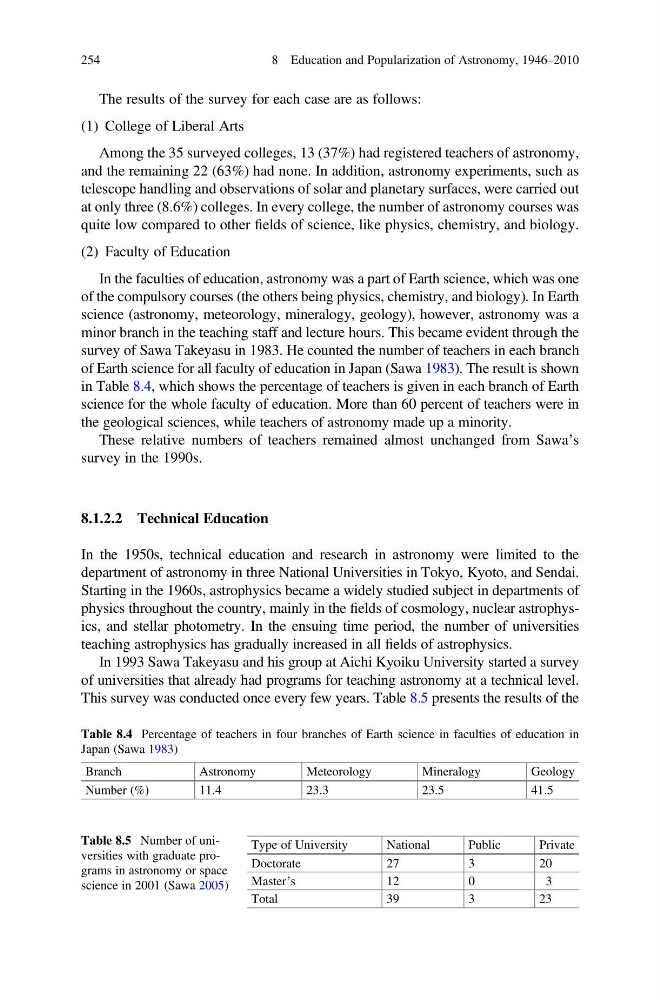
of Earth science for all faculty of education in Japan (Sawa 1983). The result is shown
in Table 8.4, which shows the percentage of teachers is given in each branch of Earth
science for the whole faculty of education. More than 60 percent of teachers were in
the geological sciences, while teachers of astronomy made up a minority.
These relative numbers of teachers remained almost unchanged from Sawa’s
survey in the 1990s.
8.1.2.2 Technical Education
In the 1950s, technical education and research in astronomy were limited to the
department of astronomy in three National Universities in Tokyo, Kyoto, and Sendai.
Starting in the 1960s, astrophysics became a widely studied subject in departments of
physics throughout the country, mainly in the fields of cosmology, nuclear astrophysics, and stellar photometry. In the ensuing time period, the number of universities
teaching astrophysics has gradually increased in all fields of astrophysics.
In 1993 Sawa Takeyasu and his group at Aichi Kyoiku University started a survey
of universities that already had programs for teaching astronomy at a technical level.
This survey was conducted once every few years. Table 8.5 presents the results of the
Table 8.4 Percentage of teachers in four branches of Earth science in faculties of education in
Japan (Sawa 1983)
Branch
Astronomy
Meteorology
Mineralogy
Geology
Number (%)
11.4
23.3
23.5
41.5
Table 8.5 Number of universities with graduate programs in astronomy or space
science in 2001 (Sawa 2005)
Type of University
National
Public
Private
Doctorate
27
3
20
Master’s
1 2
0
3
Total
39
3
23
254
8 Education and Popularization of Astronomy, 1946–2010
(1) College of Liberal Arts
Among the 35 surveyed colleges, 13 (37%) had registered teachers of astronomy,
and the remaining 22 (63%) had none. In addition, astronomy experiments, such as
telescope handling and observations of solar and planetary surfaces, were carried out
at only three (8.6%) colleges. In every college, the number of astronomy courses was
quite low compared to other fields of science, like physics, chemistry, and biology.
(2) Faculty of Education
In the faculties of education, astronomy was a part of Earth science, which was one
of the compulsory courses (the others being physics, chemistry, and biology). In Earth
science (astronomy, meteorology, mineralogy, geology), however, astronomy was a
minor branch in the teaching staff and lecture hours. This became evident through the
survey of Sawa Takeyasu in 1983. He counted the number of teachers in each branch
of Earth science for all faculty of education in Japan (Sawa 1983). The result is shown
in Table 8.4, which shows the percentage of teachers is given in each branch of Earth
science for the whole faculty of education. More than 60 percent of teachers were in
the geological sciences, while teachers of astronomy made up a minority.
These relative numbers of teachers remained almost unchanged from Sawa’s
survey in the 1990s.
8.1.2.2 Technical Education
In the 1950s, technical education and research in astronomy were limited to the
department of astronomy in three National Universities in Tokyo, Kyoto, and Sendai.
Starting in the 1960s, astrophysics became a widely studied subject in departments of
physics throughout the country, mainly in the fields of cosmology, nuclear astrophysics, and stellar photometry. In the ensuing time period, the number of universities
teaching astrophysics has gradually increased in all fields of astrophysics.
In 1993 Sawa Takeyasu and his group at Aichi Kyoiku University started a survey
of universities that already had programs for teaching astronomy at a technical level.
This survey was conducted once every few years. Table 8.5 presents the results of the
Table 8.4 Percentage of teachers in four branches of Earth science in faculties of education in
Japan (Sawa 1983)
Branch
Astronomy
Meteorology
Mineralogy
Geology
Number (%)
11.4
23.3
23.5
41.5
Table 8.5 Number of universities with graduate programs in astronomy or space
science in 2001 (Sawa 2005)
Type of University
National
Public
Private
Doctorate
27
3
20
Master’s
1 2
0
3
Total
39
3
23
254
8 Education and Popularization of Astronomy, 1946–2010