

(c) New activity of Astronomical Society of Japan for astronomy education in the
1990s and establishment of the Public Relations Center (天文情報センター) in
NAOJ in 1998.
These activities have greatly supplemented the insufficient state of astronomy
education in lower schools. The numbers of students interested in astronomy have
gradually increase across the country, and students’ understanding of astronomical
phenomena has shown steady progress in astronomy classes. Some student groups
have taken up astronomical observations and their scientific reductions.
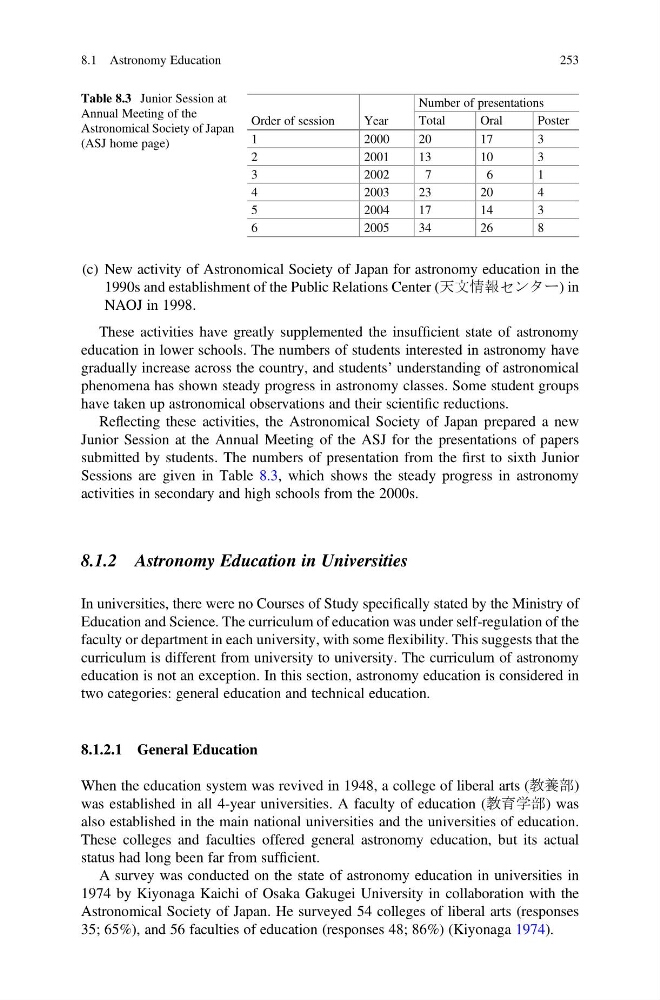
Reflecting these activities, the Astronomical Society of Japan prepared a new
Junior Session at the Annual Meeting of the ASJ for the presentations of papers
submitted by students. The numbers of presentation from the first to sixth Junior
Sessions are given in Table 8.3, which shows the steady progress in astronomy
activities in secondary and high schools from the 2000s.
8.1.2 Astronomy Education in Universities
In universities, there were no Courses of Study specifically stated by the Ministry of
Education and Science. The curriculum of education was under self-regulation of the
faculty or department in each university, with some flexibility. This suggests that the
curriculum is different from university to university. The curriculum of astronomy
education is not an exception. In this section, astronomy education is considered in
two categories: general education and technical education.
8.1.2.1 General Education
When the education system was revived in 1948, a college of liberal arts (教養部)
was established in all 4-year universities. A faculty of education (教育学部) was
also established in the main national universities and the universities of education.
These colleges and faculties offered general astronomy education, but its actual
status had long been far from sufficient.
A survey was conducted on the state of astronomy education in universities in
1974 by Kiyonaga Kaichi of Osaka Gakugei University in collaboration with the
Astronomical Society of Japan. He surveyed 54 colleges of liberal arts (responses
35; 65%), and 56 faculties of education (responses 48; 86%) (Kiyonaga 1974).
Table 8.3 Junior Session at
Annual Meeting of the
Astronomical Society of Japan
(ASJ home page)
Order of session
Year
Number of presentations
Total
Oral
Poster
1
2000
20
17
3
2
2001
13
10
3
3
2002
7
6
1
4
2003
23
20
4
5
2004
17
14
3
6
2005
34
26
8
8.1 Astronomy Education
253
1990s and establishment of the Public Relations Center (天文情報センター) in
NAOJ in 1998.
These activities have greatly supplemented the insufficient state of astronomy
education in lower schools. The numbers of students interested in astronomy have
gradually increase across the country, and students’ understanding of astronomical
phenomena has shown steady progress in astronomy classes. Some student groups
have taken up astronomical observations and their scientific reductions.
Reflecting these activities, the Astronomical Society of Japan prepared a new
Junior Session at the Annual Meeting of the ASJ for the presentations of papers
submitted by students. The numbers of presentation from the first to sixth Junior
Sessions are given in Table 8.3, which shows the steady progress in astronomy
activities in secondary and high schools from the 2000s.
8.1.2 Astronomy Education in Universities
In universities, there were no Courses of Study specifically stated by the Ministry of
Education and Science. The curriculum of education was under self-regulation of the
faculty or department in each university, with some flexibility. This suggests that the
curriculum is different from university to university. The curriculum of astronomy
education is not an exception. In this section, astronomy education is considered in
two categories: general education and technical education.
8.1.2.1 General Education
When the education system was revived in 1948, a college of liberal arts (教養部)
was established in all 4-year universities. A faculty of education (教育学部) was
also established in the main national universities and the universities of education.
These colleges and faculties offered general astronomy education, but its actual
status had long been far from sufficient.
A survey was conducted on the state of astronomy education in universities in
1974 by Kiyonaga Kaichi of Osaka Gakugei University in collaboration with the
Astronomical Society of Japan. He surveyed 54 colleges of liberal arts (responses
35; 65%), and 56 faculties of education (responses 48; 86%) (Kiyonaga 1974).
Table 8.3 Junior Session at
Annual Meeting of the
Astronomical Society of Japan
(ASJ home page)
Order of session
Year
Number of presentations
Total
Oral
Poster
1
2000
20
17
3
2
2001
13
10
3
3
2002
7
6
1
4
2003
23
20
4
5
2004
17
14
3
6
2005
34
26
8
8.1 Astronomy Education
253