

In high schools, the science program is divided into four subjects: physics,
chemistry, biology, and Earth science, where Earth science includes meteorology,
geology, and astronomy. Among these, the astronomy curriculum consists of the
following subjects (Course of Study, 2009):
(1) solar System
(a) Rotation and revolution of Earth
(b) Moon and planets, their structure and orbital motions
(c) Solar activity, observations of solar surface.
(2) Stars and the Galaxy
(a) Properties of stars and their evolution
(b) Structure of the Galaxy, stellar and nonstellar objects, and their distributions
(3) Galaxies and the Universe
(a) Variety of galaxies based on structure, distribution, and recession velocity
(b) Expanding Universe; outline of modern cosmology
Clearly, astronomy is sufficiently treated in Earth science. The problem, however,
is that a small number of students select Earth science in high school. Students must
select three subjects from four electives over the course of 3 years, and the number of
students selecting Earth science is generally low. In many high schools, Earth
science is not even offered due to the small number of students selecting this subject.
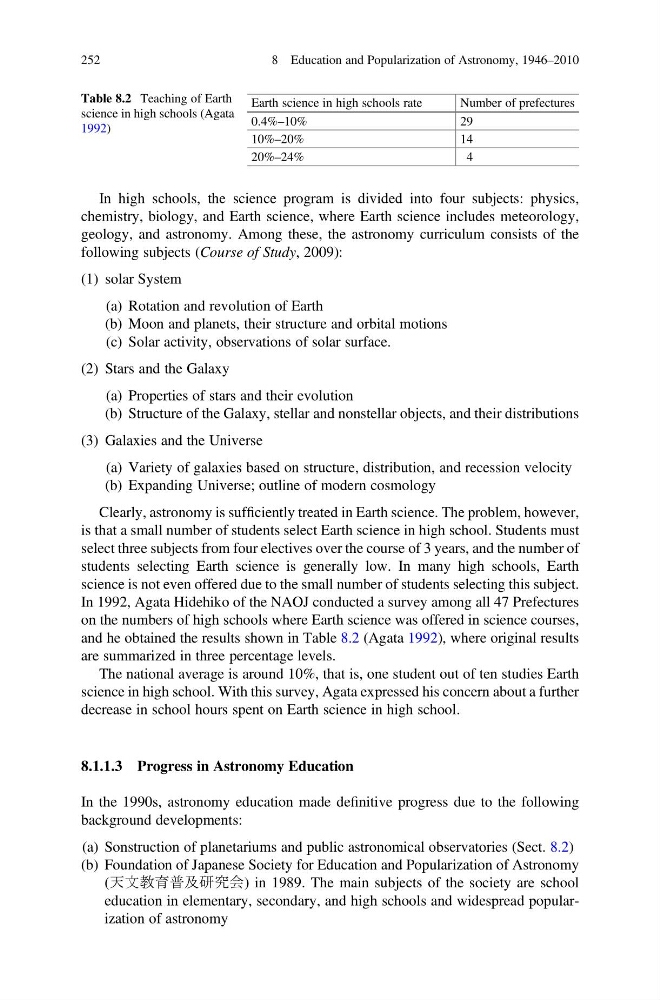
In 1992, Agata Hidehiko of the NAOJ conducted a survey among all 47 Prefectures
on the numbers of high schools where Earth science was offered in science courses,
and he obtained the results shown in Table 8.2 (Agata 1992), where original results
are summarized in three percentage levels.
The national average is around 10%, that is, one student out of ten studies Earth
science in high school. With this survey, Agata expressed his concern about a further
decrease in school hours spent on Earth science in high school.
8.1.1.3 Progress in Astronomy Education
In the 1990s, astronomy education made definitive progress due to the following
background developments:
(a) Sonstruction of planetariums and public astronomical observatories (Sect. 8.2)
(b) Foundation of Japanese Society for Education and Popularization of Astronomy
(天文教育普及研究会) in 1989. The main subjects of the society are school
education in elementary, secondary, and high schools and widespread popularization of astronomy
Table 8.2 Teaching of Earth
science in high schools (Agata
1992)
Earth science in high schools rate
Number of prefectures
0.4%–10%
29
10%–20%
14
20%–24%
4
252
8 Education and Popularization of Astronomy, 1946–2010
chemistry, biology, and Earth science, where Earth science includes meteorology,
geology, and astronomy. Among these, the astronomy curriculum consists of the
following subjects (Course of Study, 2009):
(1) solar System
(a) Rotation and revolution of Earth
(b) Moon and planets, their structure and orbital motions
(c) Solar activity, observations of solar surface.
(2) Stars and the Galaxy
(a) Properties of stars and their evolution
(b) Structure of the Galaxy, stellar and nonstellar objects, and their distributions
(3) Galaxies and the Universe
(a) Variety of galaxies based on structure, distribution, and recession velocity
(b) Expanding Universe; outline of modern cosmology
Clearly, astronomy is sufficiently treated in Earth science. The problem, however,
is that a small number of students select Earth science in high school. Students must
select three subjects from four electives over the course of 3 years, and the number of
students selecting Earth science is generally low. In many high schools, Earth
science is not even offered due to the small number of students selecting this subject.
In 1992, Agata Hidehiko of the NAOJ conducted a survey among all 47 Prefectures
on the numbers of high schools where Earth science was offered in science courses,
and he obtained the results shown in Table 8.2 (Agata 1992), where original results
are summarized in three percentage levels.
The national average is around 10%, that is, one student out of ten studies Earth
science in high school. With this survey, Agata expressed his concern about a further
decrease in school hours spent on Earth science in high school.
8.1.1.3 Progress in Astronomy Education
In the 1990s, astronomy education made definitive progress due to the following
background developments:
(a) Sonstruction of planetariums and public astronomical observatories (Sect. 8.2)
(b) Foundation of Japanese Society for Education and Popularization of Astronomy
(天文教育普及研究会) in 1989. The main subjects of the society are school
education in elementary, secondary, and high schools and widespread popularization of astronomy
Table 8.2 Teaching of Earth
science in high schools (Agata
1992)
Earth science in high schools rate
Number of prefectures
0.4%–10%
29
10%–20%
14
20%–24%
4
252
8 Education and Popularization of Astronomy, 1946–2010