

7.9 Cosmology
7.9.1 Nariai and Cosmology
In the early postwar period, the modern cosmology was based on Einstein’s general
relativity as mostly promoted by Nariai Hidekazu (成相秀一, 1923–1990) (Tomita
1991).
Nariai was born in Daisha (Izumo City, Shimane Prefecture), and studied astrophysics under Matukuma Takehiko of Tohoku University (See Chap. 5). After
graduation in 1947, he started cosmological study almost by himself to derive a
new solution of Einstein’s field equation. In 1950, he found a solution for the
homogeneous and static universe with spherical symmetry, including the cosmological constant. His solution was eventually in parallel with de Sitter’s model of an
empty and expanding universe with positive cosmological constant. Nariai showed
in 1952 that, while both were mutually independent having different metrics in
space-time, both solutions take the same form only when the propagation of light is
treated in the radial direction. It was in 1984 that Nariai unified both solutions in
higher dimensional space-time and he considered its characteristics in detail
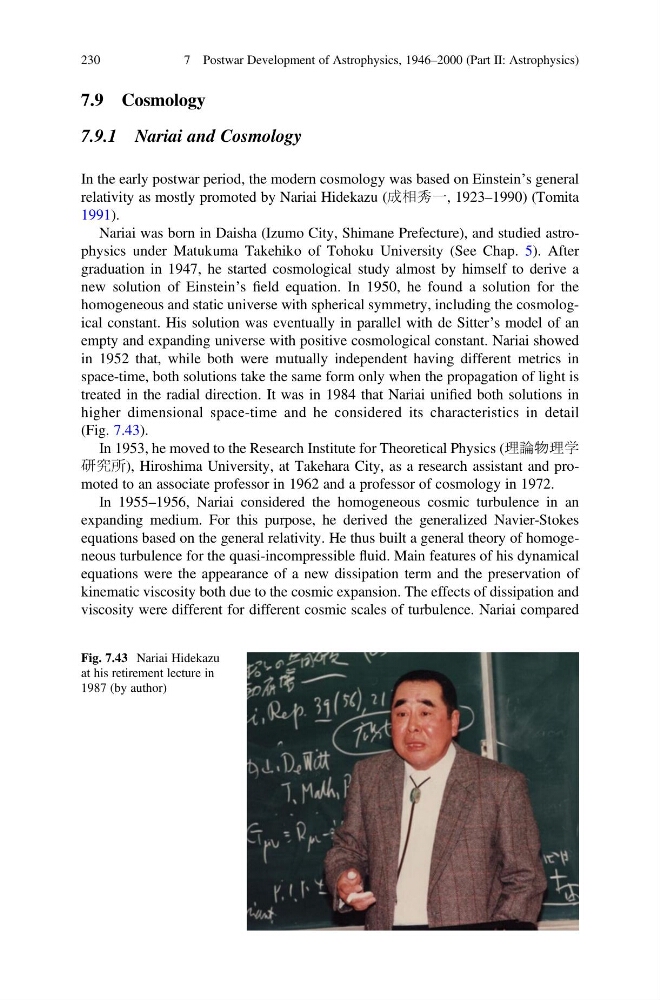
(Fig. 7.43).
In 1953, he moved to the Research Institute for Theoretical Physics (理論物理学
研究所), Hiroshima University, at Takehara City, as a research assistant and promoted to an associate professor in 1962 and a professor of cosmology in 1972.
In 1955–1956, Nariai considered the homogeneous cosmic turbulence in an
expanding medium. For this purpose, he derived the generalized Navier-Stokes
equations based on the general relativity. He thus built a general theory of homogeneous turbulence for the quasi-incompressible fluid. Main features of his dynamical
equations were the appearance of a new dissipation term and the preservation of
kinematic viscosity both due to the cosmic expansion. The effects of dissipation and
viscosity were different for different cosmic scales of turbulence. Nariai compared
Fig. 7.43 Nariai Hidekazu
at his retirement lecture in
1987 (by author)
230
7 Postwar Development of Astrophysics, 1946–2000 (Part II: Astrophysics)
7.9.1 Nariai and Cosmology
In the early postwar period, the modern cosmology was based on Einstein’s general
relativity as mostly promoted by Nariai Hidekazu (成相秀一, 1923–1990) (Tomita
1991).
Nariai was born in Daisha (Izumo City, Shimane Prefecture), and studied astrophysics under Matukuma Takehiko of Tohoku University (See Chap. 5). After
graduation in 1947, he started cosmological study almost by himself to derive a
new solution of Einstein’s field equation. In 1950, he found a solution for the
homogeneous and static universe with spherical symmetry, including the cosmological constant. His solution was eventually in parallel with de Sitter’s model of an
empty and expanding universe with positive cosmological constant. Nariai showed
in 1952 that, while both were mutually independent having different metrics in
space-time, both solutions take the same form only when the propagation of light is
treated in the radial direction. It was in 1984 that Nariai unified both solutions in
higher dimensional space-time and he considered its characteristics in detail
(Fig. 7.43).
In 1953, he moved to the Research Institute for Theoretical Physics (理論物理学
研究所), Hiroshima University, at Takehara City, as a research assistant and promoted to an associate professor in 1962 and a professor of cosmology in 1972.
In 1955–1956, Nariai considered the homogeneous cosmic turbulence in an
expanding medium. For this purpose, he derived the generalized Navier-Stokes
equations based on the general relativity. He thus built a general theory of homogeneous turbulence for the quasi-incompressible fluid. Main features of his dynamical
equations were the appearance of a new dissipation term and the preservation of
kinematic viscosity both due to the cosmic expansion. The effects of dissipation and
viscosity were different for different cosmic scales of turbulence. Nariai compared
Fig. 7.43 Nariai Hidekazu
at his retirement lecture in
1987 (by author)
230
7 Postwar Development of Astrophysics, 1946–2000 (Part II: Astrophysics)