

three types of cosmic scale of turbulence: large, intermediate, and small, and showed
that the intermediate scale was the only case to be taken as the trigger of the galaxiesformation. In the 1960s, Nariai and his colleagues including Tomita Kenji and
Kimura Toshiei developed the theory of the formation of proto-galaxies by the
gravitational instability in the cosmic turbulence in the hot big-bang universe.
In the 1960s and thereafter, Nariai immersed himself in the studies of theoretical
physics and cosmology (Nariai 1984). His main subject areas include the followings.
1. Quantization of gravitational field in the expanding universe (in 1962–1964).
2. Creation of particles in Hoyle’s cosmology and in other several types of universe
(in 1964–1982)
3. Gravitational instability in an expanding universe (in 1965–1973)
4. Generation of sound from the primordial turbulence in an expanding universe
(in 1973–1974)
Quantization of gravitational field is important in the stage of very-early universe.
Nariai’s works had the basic significance in the theory of inflation universe. Other
subjects were also basic ones and have been carried out under collaboration with his
colleagues and students in the respective ages (Nariai 1984). After some illness, he
died at age 64 in 1990 at Takehara City.
7.9.2 Development of Cosmology
Nariai’s study of cosmology in Japan has been succeeded and extended by the next
generation since the 1970s. In Kyoto, the works of Tomimatsu Akira, Sato Humitaka
and Sato Katsuhiko are to be noticed, all of them were the disciples of Hayashi
Chushiro in Kyoto University.
The exact solution of Einstein’s field equations in general relativity was first
discovered for a point mass by Karl Schwarzschild in 1916. In the next year,
Hermann Weyl extended the exact solution to the field around a deformed mass
(axially symmetric mass). In 1963, Roy P. Kerr generalized Schwarzschild’s solution to a rotating mass. Kerr’s solution just describes the space-time around a
rotating black-hole.
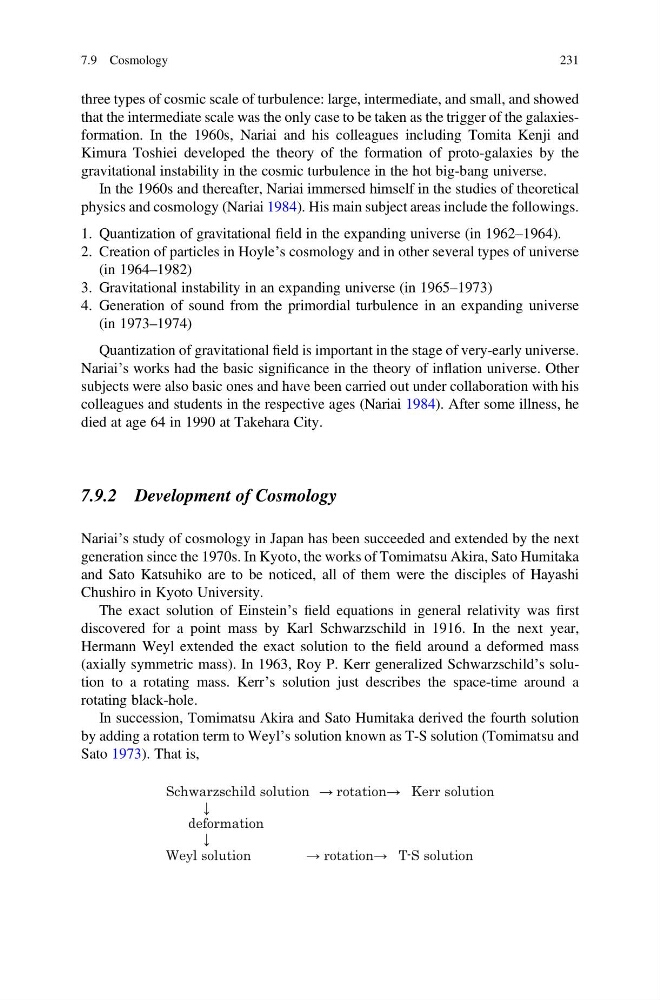
In succession, Tomimatsu Akira and Sato Humitaka derived the fourth solution
by adding a rotation term to Weyl’s solution known as T-S solution (Tomimatsu and
Sato 1973). That is,
Schwarzschild solution → rotation→ Kerr solution
↓
deformation
↓
Weyl solution
→ rotation→ T-S solution
7.9 Cosmology
231
that the intermediate scale was the only case to be taken as the trigger of the galaxiesformation. In the 1960s, Nariai and his colleagues including Tomita Kenji and
Kimura Toshiei developed the theory of the formation of proto-galaxies by the
gravitational instability in the cosmic turbulence in the hot big-bang universe.
In the 1960s and thereafter, Nariai immersed himself in the studies of theoretical
physics and cosmology (Nariai 1984). His main subject areas include the followings.
1. Quantization of gravitational field in the expanding universe (in 1962–1964).
2. Creation of particles in Hoyle’s cosmology and in other several types of universe
(in 1964–1982)
3. Gravitational instability in an expanding universe (in 1965–1973)
4. Generation of sound from the primordial turbulence in an expanding universe
(in 1973–1974)
Quantization of gravitational field is important in the stage of very-early universe.
Nariai’s works had the basic significance in the theory of inflation universe. Other
subjects were also basic ones and have been carried out under collaboration with his
colleagues and students in the respective ages (Nariai 1984). After some illness, he
died at age 64 in 1990 at Takehara City.
7.9.2 Development of Cosmology
Nariai’s study of cosmology in Japan has been succeeded and extended by the next
generation since the 1970s. In Kyoto, the works of Tomimatsu Akira, Sato Humitaka
and Sato Katsuhiko are to be noticed, all of them were the disciples of Hayashi
Chushiro in Kyoto University.
The exact solution of Einstein’s field equations in general relativity was first
discovered for a point mass by Karl Schwarzschild in 1916. In the next year,
Hermann Weyl extended the exact solution to the field around a deformed mass
(axially symmetric mass). In 1963, Roy P. Kerr generalized Schwarzschild’s solution to a rotating mass. Kerr’s solution just describes the space-time around a
rotating black-hole.
In succession, Tomimatsu Akira and Sato Humitaka derived the fourth solution
by adding a rotation term to Weyl’s solution known as T-S solution (Tomimatsu and
Sato 1973). That is,
Schwarzschild solution → rotation→ Kerr solution
↓
deformation
↓
Weyl solution
→ rotation→ T-S solution
7.9 Cosmology
231