

region via transition region. The [Fe II] emission together with [O I] line are formed
in the transition region excited by electron collisions, whereas Hα and [N II] lines are
produced in the ionized region (Mouri and Taniguchi 1993).
In 1994, Aoki Kentaro, Ohtani Hiroshi and their group performed spectroscopic
observations of the extended emission-line region of the Seyfert 1 galaxy NGC 3516
with the Spectronebulargragh of the OAO, which is an area spectroscopic-system to
sweep images in the Hα, [OIII] and other emission lines. They thus confirmed the
existence of both the narrow and broad emission-line regions. With their results they
posed a question to the simple unified scheme of Seyfert nuclei (Aoki et al. 1994).
Nakai Naomasa and his group (1995) searched for water-maser emission with
extremely high radial velocity, using the 45 m Nobeyama telescope and the 64 m
Parkes telescope in Australia.
They surveyed 18 Seyfert galaxies, among which maser emission was detected in
seven Seyfert galaxies with a velocity width of range around Æ1000 km s
À1 . They
thus found that the maser features are consistent with a compact disk which is
rotating around a massive black hole at the galactic center (Nakai et al. 1995).
Taniguchi Yoshiaki and Murayama Takashi also considered the physical properties of dusty tori of Seyfert nuclei probed by the H 2 O maser emission at 22 GHz
observed with the US Very Large Allay (VLA) and US Very Long Baseline Array
(VLBA). Assuming a simple cylinder model for the dusty torus, they derived that the
tori structure as vertically thin, and its outer radius around several to ten parsecs.
However, the observed maser regions are concentrated in the inner 1 pc regions of
the torus. For this property, they argued that only the inner region has necessary
physical conditions enough to cause the maser emission, where the temperature is as
high as several hundred K, and the density is as high as ~10
10 cm
À3 (Taniguchi and
Murayama 1998).
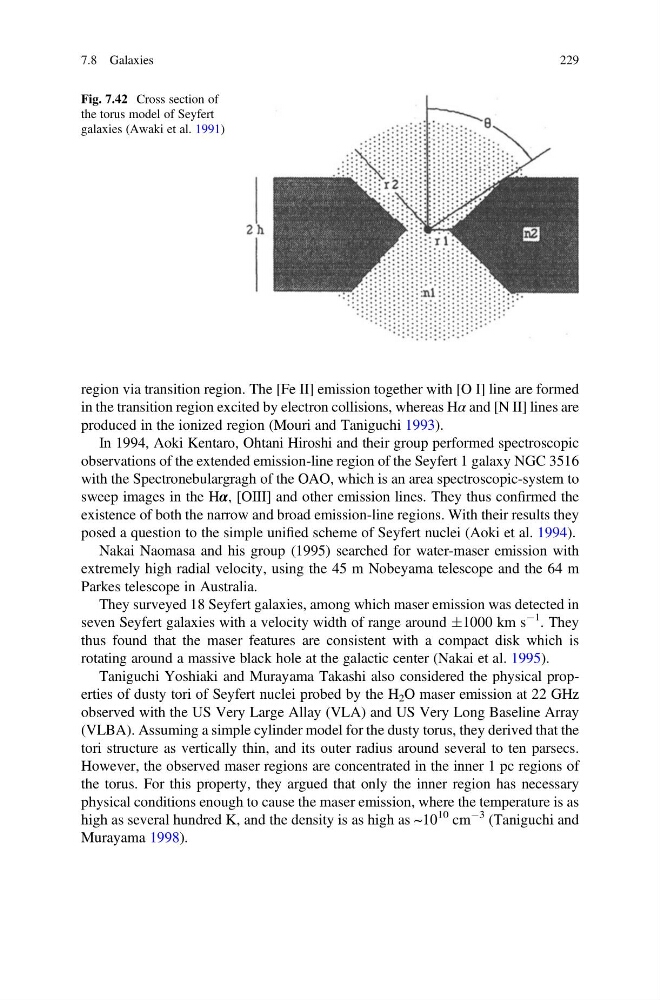
Fig. 7.42 Cross section of
the torus model of Seyfert
galaxies (Awaki et al. 1991)
7.8 Galaxies
229
in the transition region excited by electron collisions, whereas Hα and [N II] lines are
produced in the ionized region (Mouri and Taniguchi 1993).
In 1994, Aoki Kentaro, Ohtani Hiroshi and their group performed spectroscopic
observations of the extended emission-line region of the Seyfert 1 galaxy NGC 3516
with the Spectronebulargragh of the OAO, which is an area spectroscopic-system to
sweep images in the Hα, [OIII] and other emission lines. They thus confirmed the
existence of both the narrow and broad emission-line regions. With their results they
posed a question to the simple unified scheme of Seyfert nuclei (Aoki et al. 1994).
Nakai Naomasa and his group (1995) searched for water-maser emission with
extremely high radial velocity, using the 45 m Nobeyama telescope and the 64 m
Parkes telescope in Australia.
They surveyed 18 Seyfert galaxies, among which maser emission was detected in
seven Seyfert galaxies with a velocity width of range around Æ1000 km s
À1 . They
thus found that the maser features are consistent with a compact disk which is
rotating around a massive black hole at the galactic center (Nakai et al. 1995).
Taniguchi Yoshiaki and Murayama Takashi also considered the physical properties of dusty tori of Seyfert nuclei probed by the H 2 O maser emission at 22 GHz
observed with the US Very Large Allay (VLA) and US Very Long Baseline Array
(VLBA). Assuming a simple cylinder model for the dusty torus, they derived that the
tori structure as vertically thin, and its outer radius around several to ten parsecs.
However, the observed maser regions are concentrated in the inner 1 pc regions of
the torus. For this property, they argued that only the inner region has necessary
physical conditions enough to cause the maser emission, where the temperature is as
high as several hundred K, and the density is as high as ~10
10 cm
À3 (Taniguchi and
Murayama 1998).
Fig. 7.42 Cross section of
the torus model of Seyfert
galaxies (Awaki et al. 1991)
7.8 Galaxies
229