

GINGA that found a strong X-ray source in the center from its high spatial resolution. Koyama Katsuji and his group observed the galactic center with a highly
ionized iron-emission line at 6.7 keV in 1989 and discovered an optically thin hot
plasma cloud, with temperature as high as several l0 to 100 million-degrees. On the
origin of such high-temperature plasma, they suggested shock-wave heating caused
by a past violent and variable activity of the galactic center (Koyama et al. 1989;
Yamaguchi et al. 1990).
The next satellite ASCA has a capability to observe the Galactic center with
higher spatial and spectral resolutions in the energy range up to 10 keV. In spectral
observations, Koyama Katsuji, Maeda Yoshitomo, and their group found several
emission lines of highly ionized metals such as S XV, S XVI, Ca XIX, Fe XXV, Fe
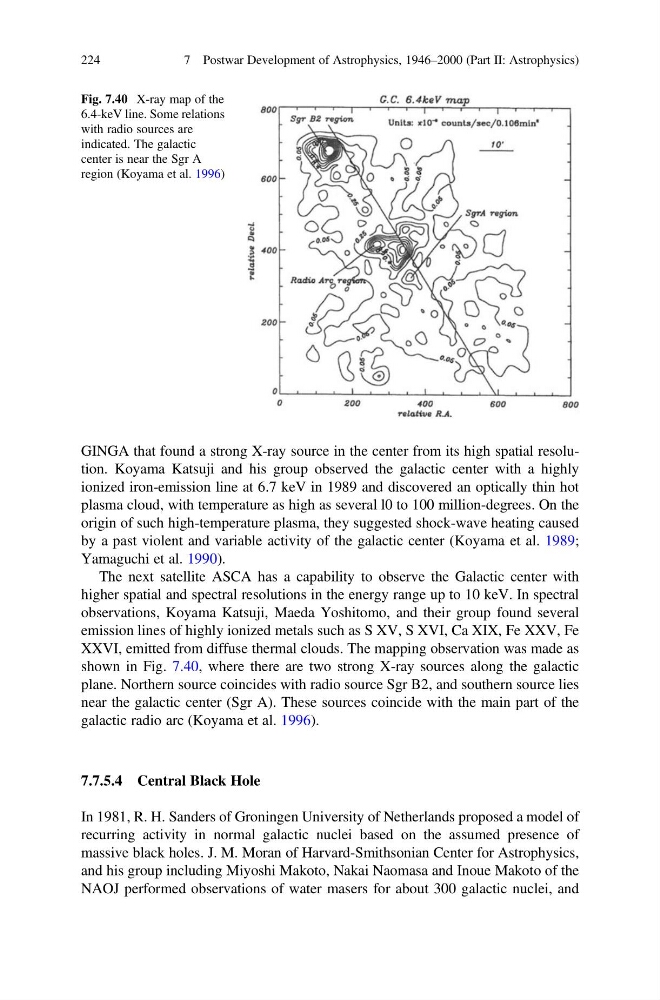
XXVI, emitted from diffuse thermal clouds. The mapping observation was made as
shown in Fig. 7.40, where there are two strong X-ray sources along the galactic
plane. Northern source coincides with radio source Sgr B2, and southern source lies
near the galactic center (Sgr A). These sources coincide with the main part of the
galactic radio arc (Koyama et al. 1996).
7.7.5.4 Central Black Hole
In 1981, R. H. Sanders of Groningen University of Netherlands proposed a model of
recurring activity in normal galactic nuclei based on the assumed presence of
massive black holes. J. M. Moran of Harvard-Smithsonian Center for Astrophysics,
and his group including Miyoshi Makoto, Nakai Naomasa and Inoue Makoto of the
NAOJ performed observations of water masers for about 300 galactic nuclei, and
Fig. 7.40 X-ray map of the
6.4-keV line. Some relations
with radio sources are
indicated. The galactic
center is near the Sgr A
region (Koyama et al. 1996)
224
7 Postwar Development of Astrophysics, 1946–2000 (Part II: Astrophysics)
ionized iron-emission line at 6.7 keV in 1989 and discovered an optically thin hot
plasma cloud, with temperature as high as several l0 to 100 million-degrees. On the
origin of such high-temperature plasma, they suggested shock-wave heating caused
by a past violent and variable activity of the galactic center (Koyama et al. 1989;
Yamaguchi et al. 1990).
The next satellite ASCA has a capability to observe the Galactic center with
higher spatial and spectral resolutions in the energy range up to 10 keV. In spectral
observations, Koyama Katsuji, Maeda Yoshitomo, and their group found several
emission lines of highly ionized metals such as S XV, S XVI, Ca XIX, Fe XXV, Fe
XXVI, emitted from diffuse thermal clouds. The mapping observation was made as
shown in Fig. 7.40, where there are two strong X-ray sources along the galactic
plane. Northern source coincides with radio source Sgr B2, and southern source lies
near the galactic center (Sgr A). These sources coincide with the main part of the
galactic radio arc (Koyama et al. 1996).
7.7.5.4 Central Black Hole
In 1981, R. H. Sanders of Groningen University of Netherlands proposed a model of
recurring activity in normal galactic nuclei based on the assumed presence of
massive black holes. J. M. Moran of Harvard-Smithsonian Center for Astrophysics,
and his group including Miyoshi Makoto, Nakai Naomasa and Inoue Makoto of the
NAOJ performed observations of water masers for about 300 galactic nuclei, and
Fig. 7.40 X-ray map of the
6.4-keV line. Some relations
with radio sources are
indicated. The galactic
center is near the Sgr A
region (Koyama et al. 1996)
224
7 Postwar Development of Astrophysics, 1946–2000 (Part II: Astrophysics)