

Sofue Yoshiaki and Handa Toshihiro (1984) and their group observed central
region of the Galaxy using the Nobeyama 45-m telescope at 10 GHz continuum.
They found two spurs forming a giant Ω-shaped radio loop which was called the
central galactic lobe (CGL) (Sofue and Handa 1984; Sofue et al. 1986a). The flat
spectrum suggests a thermal radiation from ionized gas. A survey of CO line
emission showed the high-velocity feature of the lobe expanding vertically from
the Galactic plane. Uchida Yutaka and his group (1987) proposed a magnetodynamic mechanism to produce the CGL by the combined effects of rotating disk
and magnetic field near the galactic center (Sofue 1984a, b, 1985; Uchida et al.
1985).
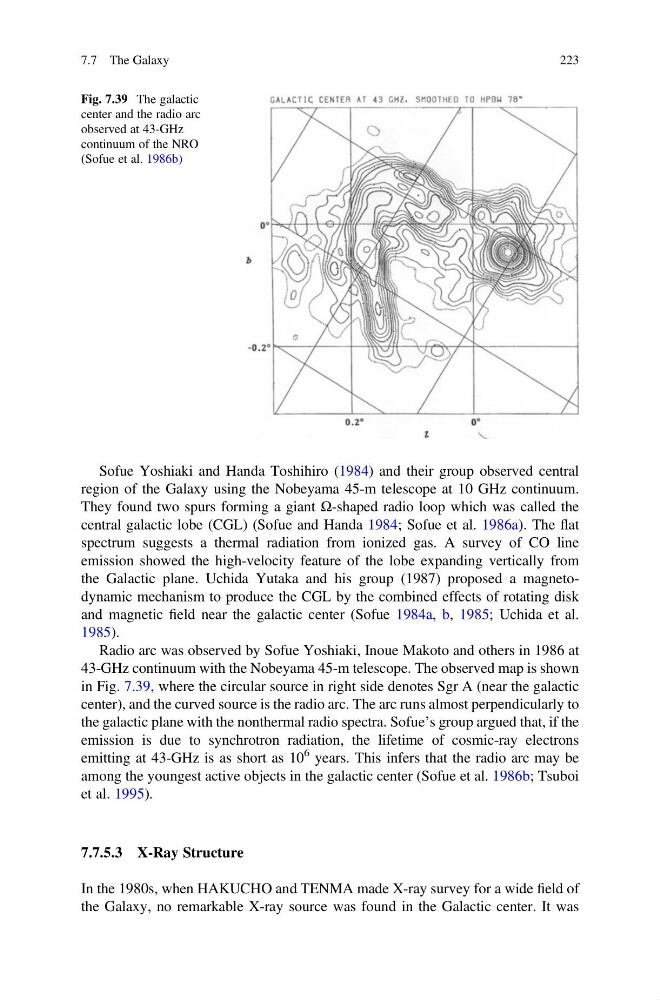
Radio arc was observed by Sofue Yoshiaki, Inoue Makoto and others in 1986 at
43-GHz continuum with the Nobeyama 45-m telescope. The observed map is shown
in Fig. 7.39, where the circular source in right side denotes Sgr A (near the galactic
center), and the curved source is the radio arc. The arc runs almost perpendicularly to
the galactic plane with the nonthermal radio spectra. Sofue’s group argued that, if the
emission is due to synchrotron radiation, the lifetime of cosmic-ray electrons
emitting at 43-GHz is as short as 10
6 years. This infers that the radio arc may be
among the youngest active objects in the galactic center (Sofue et al. 1986b; Tsuboi
et al. 1995).
7.7.5.3 X-Ray Structure
In the 1980s, when HAKUCHO and TENMA made X-ray survey for a wide field of
the Galaxy, no remarkable X-ray source was found in the Galactic center. It was
Fig. 7.39 The galactic
center and the radio arc
observed at 43-GHz
continuum of the NRO
(Sofue et al. 1986b)
7.7 The Galaxy
223
region of the Galaxy using the Nobeyama 45-m telescope at 10 GHz continuum.
They found two spurs forming a giant Ω-shaped radio loop which was called the
central galactic lobe (CGL) (Sofue and Handa 1984; Sofue et al. 1986a). The flat
spectrum suggests a thermal radiation from ionized gas. A survey of CO line
emission showed the high-velocity feature of the lobe expanding vertically from
the Galactic plane. Uchida Yutaka and his group (1987) proposed a magnetodynamic mechanism to produce the CGL by the combined effects of rotating disk
and magnetic field near the galactic center (Sofue 1984a, b, 1985; Uchida et al.
1985).
Radio arc was observed by Sofue Yoshiaki, Inoue Makoto and others in 1986 at
43-GHz continuum with the Nobeyama 45-m telescope. The observed map is shown
in Fig. 7.39, where the circular source in right side denotes Sgr A (near the galactic
center), and the curved source is the radio arc. The arc runs almost perpendicularly to
the galactic plane with the nonthermal radio spectra. Sofue’s group argued that, if the
emission is due to synchrotron radiation, the lifetime of cosmic-ray electrons
emitting at 43-GHz is as short as 10
6 years. This infers that the radio arc may be
among the youngest active objects in the galactic center (Sofue et al. 1986b; Tsuboi
et al. 1995).
7.7.5.3 X-Ray Structure
In the 1980s, when HAKUCHO and TENMA made X-ray survey for a wide field of
the Galaxy, no remarkable X-ray source was found in the Galactic center. It was
Fig. 7.39 The galactic
center and the radio arc
observed at 43-GHz
continuum of the NRO
(Sofue et al. 1986b)
7.7 The Galaxy
223