

In Japan, first observations were made in the near IR region by Okuda Haruyuki’s
group in 1971, using the 188 cm and 90 cm telescopes of the OAO (Okuda and
Maihara 1971; Maihara et al. 1972). At the Agematsu IR observatory, Kobayashi
Yukiyasu and Kawara Kimiaki observed the polarization of IR emission in the
Galactic Center (Kobayashi et al. 1980).
In 1990, Okuda and Shibai Hiroshi made oversea IR observations using the IR
telescopes at Mauna Kea and found a compact cluster of five luminous infrared
sources, which was called the Infrared Quintuplet. These infrared sources were later
explained as a cluster of Wolf-Rayet type massive stars (Okuda et al. 1990; Figer
et al. 1999).
Radio observations of the Galactic center started in the 1980s in Japan by Kaifu
Norio’s group, based on the 6-m telescope at the TAO. Subsequently the Nobeyama
45-m telescope was used actively. In the 1990s, X-ray observations with GINGA
and ASCA satellites were widely carried out by Koyama Katsuji and his group.
Theoretical modellings of activities in the Galactic center were constructed mainly
by Uchida Yutaka, Shibata Kazunari, and Sofue Yoshiaki. With these works, the
complicated and active nature of the central region has been gradually clarified.
Some of remarkable studies include the followings.
7.7.5.1 Expanding Rings
By making use of the 21-cm line data, obtained with the Parkes radio telescope in
Australia, Kaifu Norio, Iguchi Tetsuo and Kato Takaji found an expanding ring of
neutral hydrogen at 270-pc from the Galactic center in 1974. They supposed that this
ring may be an indication of the past explosion of the nucleus of the Galaxy. On the
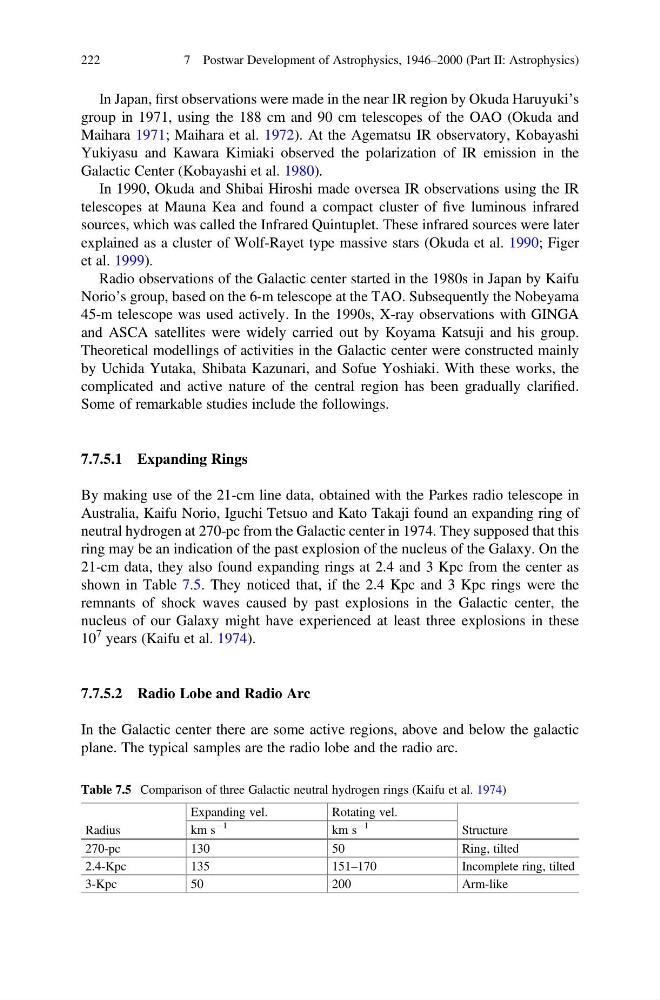
21-cm data, they also found expanding rings at 2.4 and 3 Kpc from the center as
shown in Table 7.5. They noticed that, if the 2.4 Kpc and 3 Kpc rings were the
remnants of shock waves caused by past explosions in the Galactic center, the
nucleus of our Galaxy might have experienced at least three explosions in these
10
7 years (Kaifu et al. 1974).
7.7.5.2 Radio Lobe and Radio Arc
In the Galactic center there are some active regions, above and below the galactic
plane. The typical samples are the radio lobe and the radio arc.
Table 7.5 Comparison of three Galactic neutral hydrogen rings (Kaifu et al. 1974)
Radius
Expanding vel.
Rotating vel.
Structure
km s
À1
km s
À1
270-pc
130
50
Ring, tilted
2.4-Kpc
135
151–170
Incomplete ring, tilted
3-Kpc
50
200
Arm-like
222
7 Postwar Development of Astrophysics, 1946–2000 (Part II: Astrophysics)
group in 1971, using the 188 cm and 90 cm telescopes of the OAO (Okuda and
Maihara 1971; Maihara et al. 1972). At the Agematsu IR observatory, Kobayashi
Yukiyasu and Kawara Kimiaki observed the polarization of IR emission in the
Galactic Center (Kobayashi et al. 1980).
In 1990, Okuda and Shibai Hiroshi made oversea IR observations using the IR
telescopes at Mauna Kea and found a compact cluster of five luminous infrared
sources, which was called the Infrared Quintuplet. These infrared sources were later
explained as a cluster of Wolf-Rayet type massive stars (Okuda et al. 1990; Figer
et al. 1999).
Radio observations of the Galactic center started in the 1980s in Japan by Kaifu
Norio’s group, based on the 6-m telescope at the TAO. Subsequently the Nobeyama
45-m telescope was used actively. In the 1990s, X-ray observations with GINGA
and ASCA satellites were widely carried out by Koyama Katsuji and his group.
Theoretical modellings of activities in the Galactic center were constructed mainly
by Uchida Yutaka, Shibata Kazunari, and Sofue Yoshiaki. With these works, the
complicated and active nature of the central region has been gradually clarified.
Some of remarkable studies include the followings.
7.7.5.1 Expanding Rings
By making use of the 21-cm line data, obtained with the Parkes radio telescope in
Australia, Kaifu Norio, Iguchi Tetsuo and Kato Takaji found an expanding ring of
neutral hydrogen at 270-pc from the Galactic center in 1974. They supposed that this
ring may be an indication of the past explosion of the nucleus of the Galaxy. On the
21-cm data, they also found expanding rings at 2.4 and 3 Kpc from the center as
shown in Table 7.5. They noticed that, if the 2.4 Kpc and 3 Kpc rings were the
remnants of shock waves caused by past explosions in the Galactic center, the
nucleus of our Galaxy might have experienced at least three explosions in these
10
7 years (Kaifu et al. 1974).
7.7.5.2 Radio Lobe and Radio Arc
In the Galactic center there are some active regions, above and below the galactic
plane. The typical samples are the radio lobe and the radio arc.
Table 7.5 Comparison of three Galactic neutral hydrogen rings (Kaifu et al. 1974)
Radius
Expanding vel.
Rotating vel.
Structure
km s
À1
km s
À1
270-pc
130
50
Ring, tilted
2.4-Kpc
135
151–170
Incomplete ring, tilted
3-Kpc
50
200
Arm-like
222
7 Postwar Development of Astrophysics, 1946–2000 (Part II: Astrophysics)