

subsequently observed, and these observations gradually shed light on the starforming processes.
7.7.4.1 The Orion Star-Forming Regions
Molecular line observations of the Orion region were made mainly with CO, CS, and
HN 3 lines. Among these, a wide field of Orion A was surveyed with CS by
Tatematsu Ken’ichi, Umemoto Tomofumi, and others in 1991–1993. The CS
(1–0, 149 GHz) molecule is suitable for observations of parts of higher molecular
density compared to CO molecules. Orion A is an elongated, narrow radio source
centered at the Orion nebula. Tatematsu’s group surveyed the main part of Orion A
in a 1.5
 2.5
field extending north and south of the central nebula. The surveyed
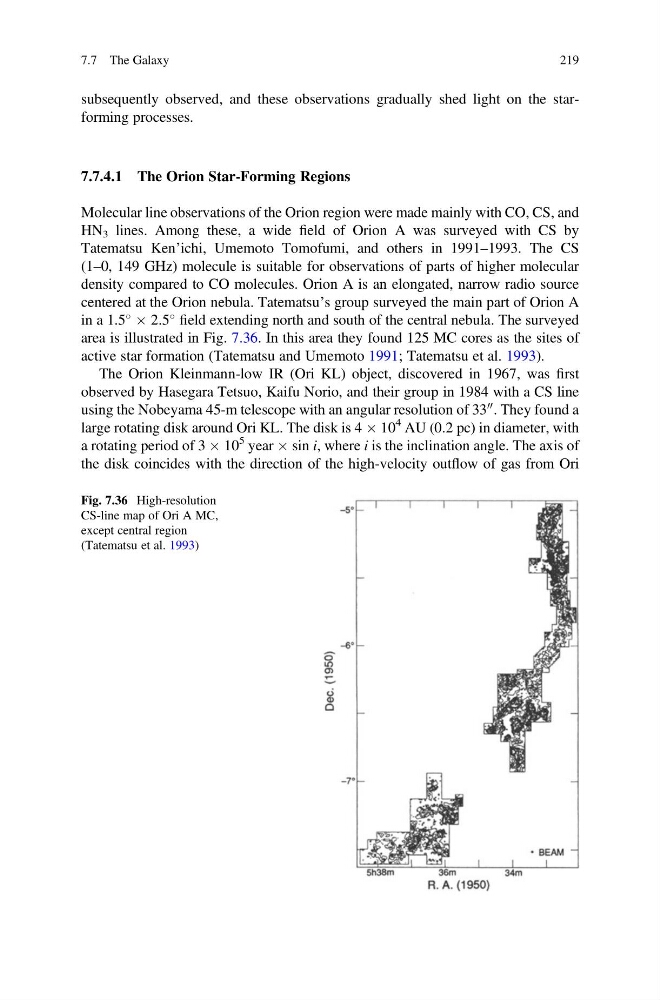
area is illustrated in Fig. 7.36. In this area they found 125 MC cores as the sites of
active star formation (Tatematsu and Umemoto 1991; Tatematsu et al. 1993).
The Orion Kleinmann-low IR (Ori KL) object, discovered in 1967, was first
observed by Hasegara Tetsuo, Kaifu Norio, and their group in 1984 with a CS line
using the Nobeyama 45-m telescope with an angular resolution of 33
00 . They found a
large rotating disk around Ori KL. The disk is 4 Â 10
4 AU (0.2 pc) in diameter, with
a rotating period of 3 Â 10
5 year  sin i, where i is the inclination angle. The axis of
the disk coincides with the direction of the high-velocity outflow of gas from Ori
Fig. 7.36 High-resolution
CS-line map of Ori A MC,
except central region
(Tatematsu et al. 1993)
7.7 The Galaxy
219
7.7.4.1 The Orion Star-Forming Regions
Molecular line observations of the Orion region were made mainly with CO, CS, and
HN 3 lines. Among these, a wide field of Orion A was surveyed with CS by
Tatematsu Ken’ichi, Umemoto Tomofumi, and others in 1991–1993. The CS
(1–0, 149 GHz) molecule is suitable for observations of parts of higher molecular
density compared to CO molecules. Orion A is an elongated, narrow radio source
centered at the Orion nebula. Tatematsu’s group surveyed the main part of Orion A
in a 1.5
 2.5
field extending north and south of the central nebula. The surveyed
area is illustrated in Fig. 7.36. In this area they found 125 MC cores as the sites of
active star formation (Tatematsu and Umemoto 1991; Tatematsu et al. 1993).
The Orion Kleinmann-low IR (Ori KL) object, discovered in 1967, was first
observed by Hasegara Tetsuo, Kaifu Norio, and their group in 1984 with a CS line
using the Nobeyama 45-m telescope with an angular resolution of 33
00 . They found a
large rotating disk around Ori KL. The disk is 4 Â 10
4 AU (0.2 pc) in diameter, with
a rotating period of 3 Â 10
5 year  sin i, where i is the inclination angle. The axis of
the disk coincides with the direction of the high-velocity outflow of gas from Ori
Fig. 7.36 High-resolution
CS-line map of Ori A MC,
except central region
(Tatematsu et al. 1993)
7.7 The Galaxy
219