

The first postwar observations of the Orion region were made by Isobe Shuzo of
the TAO (Isobe 1973). He carried out photographic photometry at the Hα line for the
whole region of the Orion OB association (5
 35
). In parallel, he performed star
counting on Palomar Sky Survey prints in the same sky region. Based on these data
he found that a considerable part of the interstellar absorption on the line of sight was
due to the circumstellar dust grains in the Orion association.
SFRs are roughly divided into two types: giant molecular clouds (GMCs) and
ordinary molecular clouds (MCs). GMCs are associated with HII regions and OB
associations and are sites of massive star formation, whereas MCs are specified by
dark nebulae, which are the formation sites of small- or intermediate-mass stars. In
Nobeyama, the first target was the Orion region. Some other GMCs and MCs were
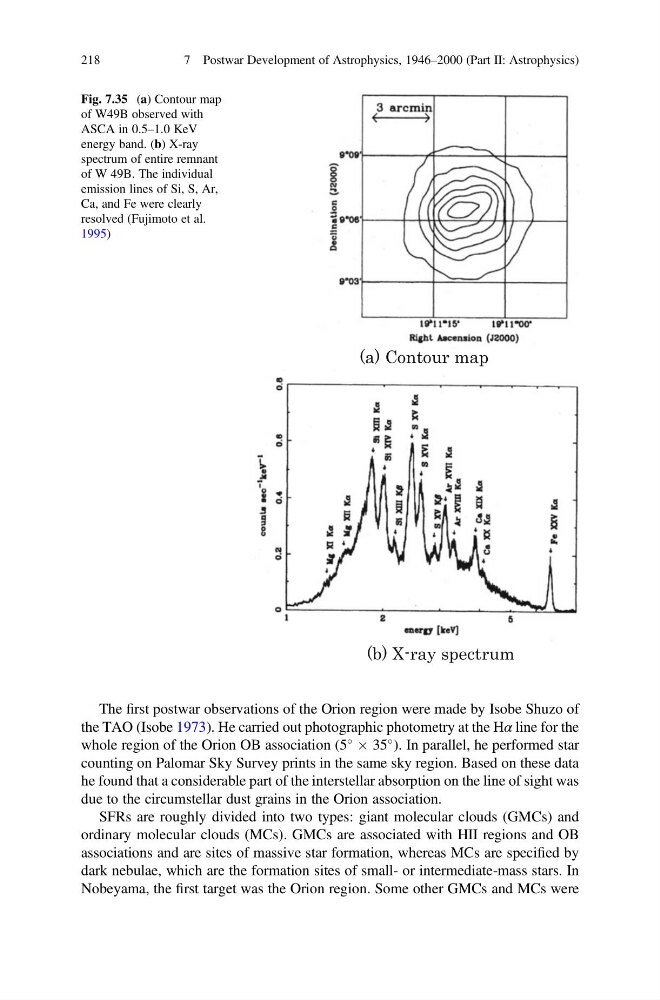
(a) Contour map
(b) X-ray spectrum
Fig. 7.35 (a) Contour map
of W49B observed with
ASCA in 0.5–1.0 KeV
energy band. (b) X-ray
spectrum of entire remnant
of W 49B. The individual
emission lines of Si, S, Ar,
Ca, and Fe were clearly
resolved (Fujimoto et al.
1995)
218
7 Postwar Development of Astrophysics, 1946–2000 (Part II: Astrophysics)
the TAO (Isobe 1973). He carried out photographic photometry at the Hα line for the
whole region of the Orion OB association (5
 35
). In parallel, he performed star
counting on Palomar Sky Survey prints in the same sky region. Based on these data
he found that a considerable part of the interstellar absorption on the line of sight was
due to the circumstellar dust grains in the Orion association.
SFRs are roughly divided into two types: giant molecular clouds (GMCs) and
ordinary molecular clouds (MCs). GMCs are associated with HII regions and OB
associations and are sites of massive star formation, whereas MCs are specified by
dark nebulae, which are the formation sites of small- or intermediate-mass stars. In
Nobeyama, the first target was the Orion region. Some other GMCs and MCs were
(a) Contour map
(b) X-ray spectrum
Fig. 7.35 (a) Contour map
of W49B observed with
ASCA in 0.5–1.0 KeV
energy band. (b) X-ray
spectrum of entire remnant
of W 49B. The individual
emission lines of Si, S, Ar,
Ca, and Fe were clearly
resolved (Fujimoto et al.
1995)
218
7 Postwar Development of Astrophysics, 1946–2000 (Part II: Astrophysics)